Summer is in full swing in many parts of Pakistan, and an unfortunate treat of summer, i.e. electricity loadshedding, is also here. As I hear from my parents, losing power for a few hours a day is normal routine in Karachi, and the people are only left guessing for how long would they remain without such a necessary utility. Growing up we used to look for loadshedding schedules in newspapers pretty much the same way people look for Iftar timings during Ramzan.
 Loadshedding is an unavoidable problem in Pakistan. In the past, excuses given by the administration for loadshedding were lame at best: heating up of transformers, shutting down of power-gen units, unforeseen technical problems etc. I have wished for the administration to just tell the truth about our inability to produce as much power as we consume. There is simply not enough electricity being produced in the country and given the lack of investments in power generation, the shortage of power is not just a nuisance to the ordinary people who need fans and cold water to cool themselves off, but is also stunting the growth of our industry and economy.
It seems this year the government has decided to tell the truth about the shortage of supply and is already thinking of plans to conserve and “manage” the demand. This is a positive change, and I hope citizens will fully support this effort.
According to a report in the Dawn:
The government is set to introduce this week drastic measures for energy conservation, including closure of commercial activities after sunset and possibly two weekly public holidays, to overcome the energy crisis in the country.
This is part of a larger “demand management plan� which will be announced on Monday in Karachi by Minister for Water and Power Liaquat Ali Jatoi and come into force the following day for about four months, subject to approval by Prime Minister Shaukat Aziz.

It is estimated that while the current shortage of power is roughly 1,000 MW on a total generation capacity of 16,000 MW, the gap is expected to grow to 2,500 MW by the peak of summer.
The government has not been able to plan for the future despite repeated warnings from Nepra and Wapda and failed to firm up enough power generation capacity as the demand continued to increase and the pace of unplanned village electrification was pushed up on political considerations. Installation of two old and rented power stations of about 300MW is the only capacity addition that has taken place in seven years.
Last year, loadshedding was restricted to two-three hours daily in rural areas and between half and one hour daily in most of major cities. The shortage this year has gone up significantly.
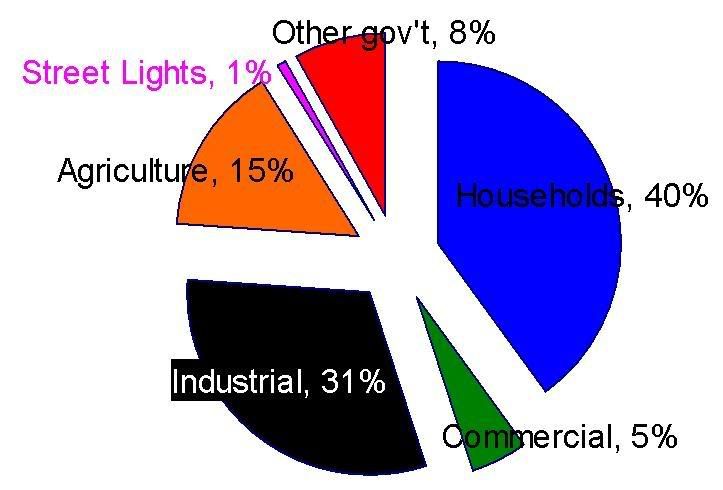
It is clear that the gap between our supply and demand would be impossible to bridge, and excessive loadshedding would be necessary, unless our consumption patterns were altered significantly. It is with this consideration that government is attempting to launch a series of actions to reduce consumption, especially at peak hours. This sort of “demand management” is the best thing that the administration can do in the short term, even though it behooves them to think how we will attempt to solve this problem in the long term (the figure above shows the distribution of electricity consumption in Pakistan, 1990-2000).
“Demand management is inevitable now because of a wide gap in energy demand and supply,� the official said, adding: “Demand management is better than loadshedding because it allows people to adjust accordingly, instead of living in uncertainty.�
He said industrial concerns would be required to stagger their weekly holidays on Fridays and Saturdays. This would enable power utilities to supply similar quantities on most days of the week, instead of the lean day on Sunday, he said.
An official close to the secretary for water and power said the ministry had also proposed two weekly holidays – Saturday and Sundays – in the public sector. This will not only be an energy-saving measure but also an alternative for business and commercial concerns against their loss arising out of business closure after sunset. All markets and commercial centres would close at 8pm.
There will be no power supply to wedding halls after 10pm and they will have to arrange their own generators if they desired to prolong their functions. Likewise, public street-lightening will be cut by 50 per cent to save another 25MW of electricity every day.
Various programmes and advertisements will be run on the print and electronic media to persuade the general public to save energy. The government hopes that the measures will effectively bridge the gap between demand and supply and there will be only limited scope for loadshedding.
It is important that all sectors of society contribute equally to the energy conservation program so there is at least some hope of reaching the desired targets. This is a simple requirement off our civic sense and responsibility. I have unfortunately witnessed affluent households running several air conditioners in their homes, while hospitals in certain parts of the same city have had to suspened surgeries in operation theatres because of a lack of power. Shuttering shops a few hours early may feel like a burden on the shopkeepers, but I feel it is worth the effort. Offices, even government ministries, can be kept at elevated temperatures and the AC/s turned down, and perhaps the halogen-lit billboards can also get a break some nights to conserve a few MW? There are many ideas to choose from.
Ofcourse the long term solution lies only in a sustained strategy to conserve, manage, and produce electricity. Pakistan is endowed with natural resources that make electricity production easier than in some other parts of the world. Nuclear-, hydro-, thermo-, wind, solar and other renewables are all possible in Pakistan. But what is needed for the potential to be relaized is a comprehensive energy policy from the government that realizes the need for a long term committment to development of the energy sector. Aside from availability of clean water, this is probably one sector where appropriate government intervention can possibly help.






Shaukat Aziz and Musharaf are talking all the time for foreign investments in Pakistan and what not. How can someone bring investment to a country where lack of electricity is huge issue and its there since decades. As bittertruth mentioned, Mushy and Co. cant even blame on previous governments as this problem was always there. They have totally failed on this and the irony is that still nothing is being done as Musharaf is ‘busy’ in so many other things.
Well Blame it on the Taraqi. All these new industries require Bijli.
We should protest and say NO more Taraqi!!!!!!!!
I heard PM saying that a few months ago. Its like making a building without a foundation.
This Bijli problem will make ppl in Karachi madder and CJ will have to becareful. Bijli bachao is for poor only.
Few years back, a Saudi group (one which is very close to SCECO, the national ‘Saudi Electric Company’) came to inspect whether they can buy KESC and left in a hurry saying that this company is so corrupt that it will take them their lifetime to start getting some profit and that too without scaling up production. I dont remember correctly but I think some Chinese bidders also left the prospect for similar reasons.
A year after that, we read that KESC is outsourcing some of its operations to the equipment supplier Siemens Pakistan, but soon afterwards we read that they have cut off that deal too. I attended a seminar where the CEO of Siemens was so optimistic about solving the problem and had some initial plans ready to revive production capacity. but somehow the project was taken away from them.
For a long time, we have seen a debate over the Kalabagh Dam. The main problem was that its construction would worsen inter-provincial relationships. Some independent experts gave a wonderful alternative to construct several smaller dams throughout the country but no one actually gave it a serious look and every body in islamabad was more concerned about the egoistic kalabagh ‘damn’ debate.
Now the government after a successful launch of a Pushtoon Nationalist Movement, and followed by a reviving Baloch Movement, is looking forward to create the Sindhi Nationalist movement (Sindhudesh etc) by constructing Kalabagh dam whose output will be the same as its alternatives but it will still be too late.
I can’t recall but somewhere I heard that 2008-2009 will be the years when Karachi will only have 8 hours electricy per day, in other words, no load shedding at all, it will be a norm.
Some years ago, this government did take a good step by installing wind mills at clifton beach as a pilot project. no further developments on that yet or are there??
Any one for solar energy? or biomass fuel?
Any one in the business of renewable energy in general???
It the same as before isn’t it. They make fools of us citizens – stringing together new slogans and mottoes. Defaming each other no end and for what? No one truly cares about the people, all they want is their share of power and they’re willing to go to great lengths to get it!
It is purely lack of planning and contradicting with government’s slogan “Pakistan First” because this government is working for his lords instead of working for people.
On other hand I think government is trying to help people to let them save money for future for not letting them shopping at nights.
Who is responsible for Karachi’s loadshedding? Central government or local government. If it is central government, then local government rulers are also part of central government. Do we think after this big energy crisis, MQM will be able to attract people for his May 12th rally?