Summer is in full swing in many parts of Pakistan, and an unfortunate treat of summer, i.e. electricity loadshedding, is also here. As I hear from my parents, losing power for a few hours a day is normal routine in Karachi, and the people are only left guessing for how long would they remain without such a necessary utility. Growing up we used to look for loadshedding schedules in newspapers pretty much the same way people look for Iftar timings during Ramzan.
 Loadshedding is an unavoidable problem in Pakistan. In the past, excuses given by the administration for loadshedding were lame at best: heating up of transformers, shutting down of power-gen units, unforeseen technical problems etc. I have wished for the administration to just tell the truth about our inability to produce as much power as we consume. There is simply not enough electricity being produced in the country and given the lack of investments in power generation, the shortage of power is not just a nuisance to the ordinary people who need fans and cold water to cool themselves off, but is also stunting the growth of our industry and economy.
It seems this year the government has decided to tell the truth about the shortage of supply and is already thinking of plans to conserve and “manage” the demand. This is a positive change, and I hope citizens will fully support this effort.
According to a report in the Dawn:
The government is set to introduce this week drastic measures for energy conservation, including closure of commercial activities after sunset and possibly two weekly public holidays, to overcome the energy crisis in the country.
This is part of a larger “demand management plan� which will be announced on Monday in Karachi by Minister for Water and Power Liaquat Ali Jatoi and come into force the following day for about four months, subject to approval by Prime Minister Shaukat Aziz.

It is estimated that while the current shortage of power is roughly 1,000 MW on a total generation capacity of 16,000 MW, the gap is expected to grow to 2,500 MW by the peak of summer.
The government has not been able to plan for the future despite repeated warnings from Nepra and Wapda and failed to firm up enough power generation capacity as the demand continued to increase and the pace of unplanned village electrification was pushed up on political considerations. Installation of two old and rented power stations of about 300MW is the only capacity addition that has taken place in seven years.
Last year, loadshedding was restricted to two-three hours daily in rural areas and between half and one hour daily in most of major cities. The shortage this year has gone up significantly.
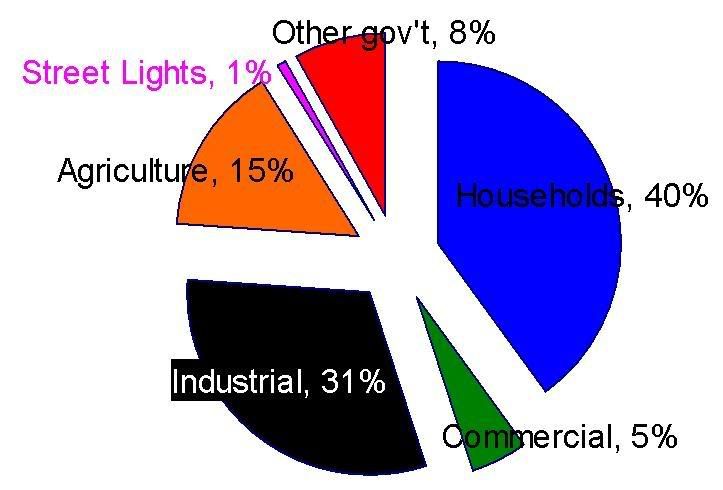
It is clear that the gap between our supply and demand would be impossible to bridge, and excessive loadshedding would be necessary, unless our consumption patterns were altered significantly. It is with this consideration that government is attempting to launch a series of actions to reduce consumption, especially at peak hours. This sort of “demand management” is the best thing that the administration can do in the short term, even though it behooves them to think how we will attempt to solve this problem in the long term (the figure above shows the distribution of electricity consumption in Pakistan, 1990-2000).
“Demand management is inevitable now because of a wide gap in energy demand and supply,� the official said, adding: “Demand management is better than loadshedding because it allows people to adjust accordingly, instead of living in uncertainty.�
He said industrial concerns would be required to stagger their weekly holidays on Fridays and Saturdays. This would enable power utilities to supply similar quantities on most days of the week, instead of the lean day on Sunday, he said.
An official close to the secretary for water and power said the ministry had also proposed two weekly holidays – Saturday and Sundays – in the public sector. This will not only be an energy-saving measure but also an alternative for business and commercial concerns against their loss arising out of business closure after sunset. All markets and commercial centres would close at 8pm.
There will be no power supply to wedding halls after 10pm and they will have to arrange their own generators if they desired to prolong their functions. Likewise, public street-lightening will be cut by 50 per cent to save another 25MW of electricity every day.
Various programmes and advertisements will be run on the print and electronic media to persuade the general public to save energy. The government hopes that the measures will effectively bridge the gap between demand and supply and there will be only limited scope for loadshedding.
It is important that all sectors of society contribute equally to the energy conservation program so there is at least some hope of reaching the desired targets. This is a simple requirement off our civic sense and responsibility. I have unfortunately witnessed affluent households running several air conditioners in their homes, while hospitals in certain parts of the same city have had to suspened surgeries in operation theatres because of a lack of power. Shuttering shops a few hours early may feel like a burden on the shopkeepers, but I feel it is worth the effort. Offices, even government ministries, can be kept at elevated temperatures and the AC/s turned down, and perhaps the halogen-lit billboards can also get a break some nights to conserve a few MW? There are many ideas to choose from.
Ofcourse the long term solution lies only in a sustained strategy to conserve, manage, and produce electricity. Pakistan is endowed with natural resources that make electricity production easier than in some other parts of the world. Nuclear-, hydro-, thermo-, wind, solar and other renewables are all possible in Pakistan. But what is needed for the potential to be relaized is a comprehensive energy policy from the government that realizes the need for a long term committment to development of the energy sector. Aside from availability of clean water, this is probably one sector where appropriate government intervention can possibly help.






And governments action to save energy Islamabad Rally Prep
I hear people complaining in Karachi that in this “loo” season nobody can step outside for shopping during the day, and the shops are being closed at night. It is not just making it difficult for the shoppers (which could be an acceptable price for conservation), but is also affecting the earnings of the small shopkeepers. Any thoughts how to circumvent this problem? Nihaar mun shopping?
It has been 8 years for Musharraf, now even he cant blame on “previous” government. He is the previous government..it is sheer negligence and he claims Pakistan first policy.
Our geniuses of government can not think of anything other than Kalabagh…
Electricity consumption in household is much less compared to the developed nations where every other item runs on power.
I endorse Aqil Sajjad comments, people should protest not against KESC but the government who are in power since 5 years and trying to escape the wrath by blaming KESC.
The electricity shortage is yet another reason why Karachiites should come out and protest against the government on May 12.
Only a few years ago the government said we had surplus electricity and they were talking of exporting the surplus to India. And now we are faced with an extreme shortage and are planning massive shut-downs or load shedding. What’s going on?
Based on this experience, can we believe anything the government says about the surge in economy and its other claims?