Owais Mughal
There was a time when citizens of Pakistan were accustomed to seeing Trams running all over the Karachi City center. It was one of the most popular means of conveyance in the city center. Today, only a handful of photos, a few landmarks and memories of Trams remain.
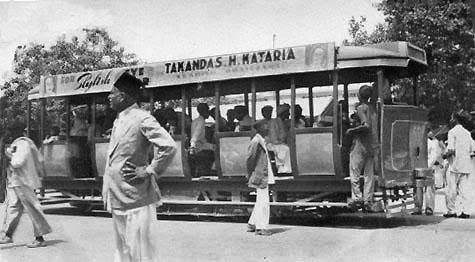
If you talk to any body who has seen Karachi up to 1975, they will talk about the tramways in nostalgic terms. The network was closed down in 1975 after traffic congestion in Saddar area was causing lots of traffic accidents involving Trams as well as older trams were proving difficult to maintain. What happened to the rolling stock and infrastructure is anybody’s guess. I couldn’t find any information on it. Growing up in Karachi however, I remember taking rides in Trams with my father as well as seeing the left over tram tracks which were left to rust in Saddar roads until 1980s.
Tram Car Number 139
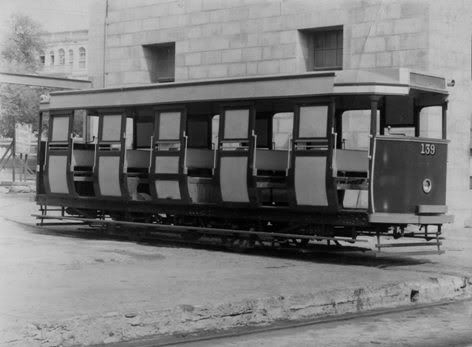
This photo is courtesy of Mr. Arshad Kazmi
The history of Karachi tramway spans 90 years (1885-1975). It owes it origin to the Municipal Secretary and Engineer, James Strachan who first conceived the idea for a Karachi Tramway. In 1881, Mr. Edward Mathews of London submitted the tender for building this tramway network. It took until 1883 to complete all the formalities and to get Government’s permission to use Steam as the locomotive power for the trams. Actual construction work started in October 1884.
Track Gauge of Karachi Tramway was 4 feet.
The Inaugural Ceremony
On April 10, 1885 the first tram line in Karachi was opened for public traffic. The track extended from present day Jinnah (then Napier Mole) bridge to Kimari.
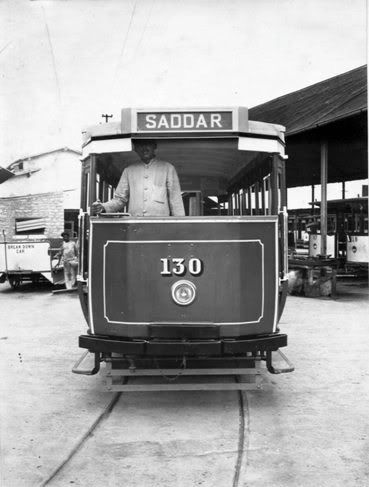
This photo above shows Tram Car # 130. The photo is courtesy of Mr. Arshad Kazmi
An imposing ceremony was held on this occasion. The dignitaries who attended the ceremony included Commissioner Sindh, Henry Napier B Erskine, Commanding Officer of Sindh District, Brigadier General G. Luck and his daughter, Assistant Commissioner Dr. J. Pollen and His Highness Prince Shere Ali Khan, ex-Wali of Kandhar, Afghanistan, with his staff. All these people were transported to Kimari and then back to Scotch Church on a convoy of Steam Locomotives and using the tramway track which they were going to inaugurate. The marquees of the project had been erected at the Scotch Church. Refreshments were given to the attendees here and Commissioner Sindh in his speech pointed out that Karachi Tramway was the “first steam tramway in Western India.” He also pointed out that the tramway was going to be used for passenger as well as freight service.
The tramway was needed for freight service as Karachi Port was not deep enough in those days. Ships were anchored at present day Kimari area and from there freight was brought to Merewether Pier (Present day Jinnah Bridge/Native Jetty area) by small boats. For this purpose some tram rails were laid in the Godowns of Messrs. Ralli Bros. A. McHinh & Co., Volkart Bros., and others, and also along the jetty, so that grain might be transported directly from their warehouses to the boat’s side.
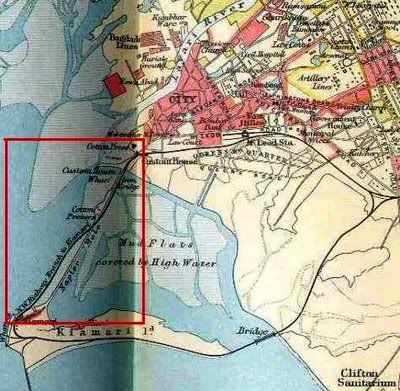
Tramway Map of 1893
The Map below shows Karachi of 1893. The Red rectangle towards left shows the first tramway track that was inaugurated. Also note how Karachi landscape has changed since then. Kimari is now part of the mainland as sea has receded a lot as well as land reclamation that has happened in the last 100 years. See where ‘bridge’ is written on a railway line towards bottom. This is where present day Boat-Basin is located.
Steam Locomotion got Replaced with Horses
In 1886, steam powered trams got replaced by horse drived tramways. This was to the great satisfaction of city residents because the steam engines proved to be too noisy in the residential and commercial areas. The frequency of Steam trams was once every 15 minutes in busy areas and that made the residents quite uneasy because of the noise. After horse trams were introduced, Steam trams were relegated to shunting in depots only whereas light one-horse tram cars took their space on Karachi roads.
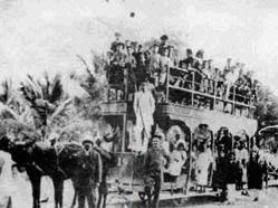 The photo to the left is an earlier version of horse-driven Karachi tram which used two horses.
Horse trams were much cheaper to operate as compared to the steam locomotives fired with coke. The coke had to be shipped from England at a great expense, as Karachi could not afford any supplies, and in Bombay local demands required the whole output of the gas works. Present day Sindh including the city of Karachi were under Bombay Presidency until 1912.
To date, there are some remains of water troughs near Max Denso Hall area as well as in Saddar which were built to feed and provide water to the tram horses.
The East India Tramway Company
Very soon the horse driven tramways became bigger than ever. Some of carriages were converted to light railways and the tramway started moving not only passengers but also freight across the city by using petrol engines. See Photo below. It is courtesy of Mr. Arshad Kazmi. It shows a petrol powered tram. The handwritten caption under the photo reads as:
The First Petrol Tram in the World – Karachi 1910. 46 seat —- type. 8 miles per gallon with petrol at 4 annas per gallon. Weight unloaded 3 tons. Designed by John Abbot, Chairman with J.P. Abbot Longfellow. Power unit —– valveless —– and Dixon Abbot patent Gearbox.
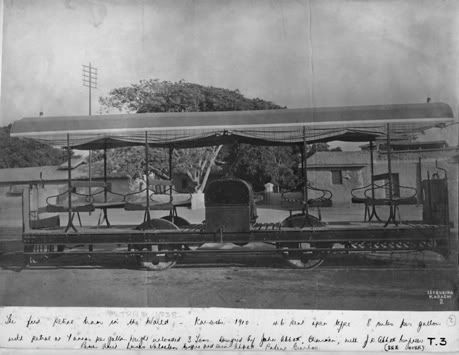
The company was now titled as ‘The East India Tramways Company’. The chief engineer of the East India Tramway Company was John Brunton, whose name was long known in Karachi in connection with the Karachi-Kotri railway line which was constructed under his supervision.
The permanent way materials for the Karachi tram network was supplied by Messrs. Bolling and Lowe of London. The weight of the rails used in the tramway was 70 lb(32 kg) to the yard. The engines of the tramway were supplied by Messrs. Kitson and Co. of Leeds, the rolling-stock was supplied by the Starbuck Car and Wagon Company, of Birkenhead and the contractors who carried out the construction work were Messrs. Mathews and Crawford.
The photo below shows a section of the tram tracks laid on Bundar Road (now called Mohammad Ali Jinnah Road) near Max Denso Hall area. This photo is circa 1900.
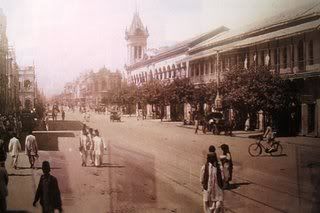
The career of Karachi tramway for freight business was short lived. Regular Railways took over the frieght business on the route from Napier Mole Bridge (now Jinnah Bridge) to Kimari.
In 1949, the whole system of Karachi tramway was shifted from the East India Tramways Company Limited to the Mohamedali Tramways Company (MTC). The tram company was bought by a Karachi resident Mr. Sheikh Mohammad Ali. MTC continued to operate the trams until its final closure in 1975.
Looks like all was not well in next few years. The service and cleanliness had seem to have deteriorated. In a book called ‘Karachi 1839-1947’ written by a Karachiite educationalist, Musician, School Principal and Social Worker Behram Sohrab H.J. Rustomji (1912-2002) in 1952, he writes:
The tramcars of Karachi have rendered yeoman service. But it is time they were removed. It is high time every part of the city was served by a service which we trust will be as clean and as efficient as that of the East India Tramway Co. of Karachi or better still of the BEST of Bombay.
Karachi Tram Video:
Here is a short 50 second video on Karachi Tramway which I made by combining the photos that I have available as well as a short video clip.
Chronology of Karachi Tramway
1879: John Brunton devised a special grooved bridge rail of inverted U-shape for four foot gauge horse to be later used in the tramways in Karachi.
1881: Karachi’s Municipal Secretary and Engineer, Mr. James Strachan conceived the idea of Karachi Tramway around this year and Mr Edward Mathews, of London tendered for the construction of the line in 1881.
February 8, 1883: Detailed plan for Karachi Tramway is made and settled. Permission is obtained from the Government for the use of steam powered trams in Karachi.
October 1884: Work starts on the construction of Karachi Tramway. Gauge of the track was 4 feet. John Brunton, formerly Chief Engineer of the Sind-Punjab and Delhi Railway, and engineer to the city of Oxford Tramways becomes the Chief Engineer of Karachi Tramway Project.
April 20, 1885: Steam Tramway was opened in Karachi. There was a ceremonial opening of the Main Line from Scots Kirk neat St Andrew’s Church (located on present day Abdullah Haroon Road and Shara-e-Liaqat intersection) to Kiamari. Goods line between McLeod Road (now I.I. Chundrigar Road) and Native Jetty were also completed. Steam traction with Kitson Locomotives was used for all traffic.
1886: Steam tramway of Karachi got replaced by horse-drawn tramway for both passenger and goods service.
1891-1900: During this period the Lawrence Road (now called Nishtar Road) route was opened. Also a short extension from Scots Kirk to Empress Market was opened. Exact dates are unknown.

The above photo is circa 1900 and it shows a tram near Max Denso Hall on then Bandar (now M.A.Jinnah) Road. Clicking on above photo will take you to its parent website and a larger image
1902: East India Tramway Co (E.I.T.C) Limited which was running trams in Karachi got re-organized with John Abbot as Chairman.
circa 1904: Light Steel-framed horse carts were introduced on the tramway.
March 23, 1905: Petrol Tram was inaugurated in Karachi.
1907: John Dixon was appointed as an Experimental Engineer on the Tramway.
1909: Horse drawn tramway of Karachi got shut down and was replaced by Petrol driven trams. Petrol trams had a capacity of 46 passengers each and could run up to speeds of 18 mph. Tracks were re laid for petrol driven trams.
The First two petrol-engined tramcars were built and tested in England and entered service in Karachi. These cars were the joint design of John Abbott and his son John Dixon Abbott, incorporating the Dixon-Abbott patent gearbox.
See photo of this petrol car above under the heading The East India Tramway Company.
1911: Mainline Tracks were doubled.
September 30, 1911: Frere Street (now called Dr Daud Pota Road) Route was Opened.
February 1912: Horse traction was completely suspended by the petrol motor cars
1913: By the end of this year, the number of Petrol run trams in Karachi was 37
February 17, 1916: Soldier Bazaar Route was inaugurated via Mansfield Street (now called Syedna Burhanuddin Road).
1928: Kerbside loading introduced at the Boulton Market.
October 22, 1928: Chakiwara Route was opened.
1929: Soldier Bazaar route diverted from Mansfield Street (now called Syedna Burhanuddin Raod) to Bunder Road (now M.A. Jinnah Road)
1931: Temporary Extension was made Eastward from Soldier Bazaar, especially for the Indian Nationalist Congress meeting. The Rails were removed after the meeting ended.
1945: First New-Built Diesel cars were introduced. Diesel engines were introduced into some existing cars before 1939.
1949: Transfer of the whole system from the East India Tramways Company Limited to the Mohamedali Tramways Company (MTC). The tram company was bought by a Karachi resident Mr. Sheikh Mohammad Ali. MTC continued to operate the trams until its final closure in 1975.
April 30, 1953: This news appeared in the daily Hindu about a strike at MTC:
A large number of workers of the Karachi Tramways in Pakistan had gone on strike to protest against what they called “the management’s policy of retrenchment and victimization.” About 700 striking employees were taken into custody. Labour leaders claimed that all but 80 employees had joined the strike. Only a few of the green and white painted trams were running in the capital city. Police lathi charged a large group of 800 employees who were picketing outside the gate of the premises of the Tramway Company.
1955: The number of Petrol Run Trams in Karachi had risen up to 64. These 64 cars were numbered from 94 to 157.
These were single deck 4-wheeled back-to-back cross bench cars.
These cars had 8 ft wheel base,
they were 28 feet long,
and 6 feet 8 inches wide.
These cars were built between 1924 and 1948. They were equipped with Perkins P.4 Diesel Engines and Simplex (Dixon-Abbott) Gearboxes.
Cars Number 145 to 157 were built as new Diesel Cars; The remained were converted from Petrol cars to Diesel Cars.
April 30, 1975: Karachi Tramway got closed down.
Two Historic Photos of Karachi Trams
Following two photos are circa 1900 and showa glimpse of Karachi trams. First photo is near Max Denso Hall. Clicking on these photos will take you to their parent website and a larger image.

In the following photo the back of a horse driven tram can be seen to the left. The photo is from outside Karachi Cantonment Railway Station.

The following photo is courtesy of Zain Yoonas. It shows a tram on Bandar Road (now M.A.Jinnah Road) in 1933.
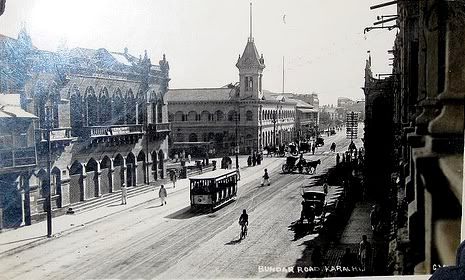
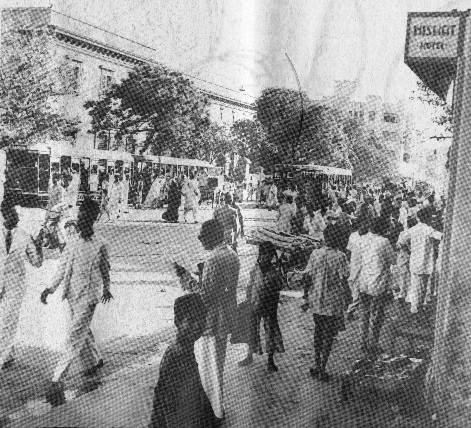
Following photo is courtesy of PPL and published by Dawn in their ‘all about Lifestyle’ series. It shows Saddar area circa 1950s and towards left, one can see atleast two trams. The signboard towards top right corner of the photo reads ‘Nishat Hotel’. Any reader who is familiar with Saddar of 50s and this Nishat Hotel locality should enlighten us more about this photo.
Route Map of Karachi Tramway in 1950:
On 70th anniversary of Karachi Tramway in 1950, following was the route map of this network. Make sure to click on the individual photos below to get their larger and more readable images.


Tram Car Number 128
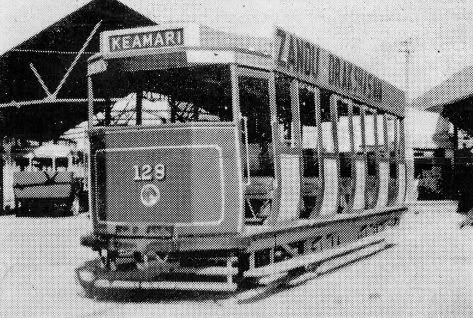
This photo is courtesy of Mr. Arshad Kazmi
References:
(1) Kurrachee, Past, Present, Volume II and Future by Alexander F. Baillie
(2) Karachi Travel Guide, 2000 by Yasmeen Lari
(3) PTV Drama: Mirza Ghalib Bandar Road Par
(4) Title Photo is from www.harrapa.com
(5) 70th Anniversary Souvenir Map of the Tramways of Karachi, Pakistan. Compiled and published by F. Merton Atkins.
(6) Karachi during the British Era – Two histories of a modern city: Oxford University Press – 2007
(7) Mr. Arshad Kazmi of etchlite.com for priceless photos of Karachi Trams
ATP’s Posts on Tramways and Railways in Pakistan:
1. Journeys to Remember: Quatta-Lahore by Rail in 1925.
2. Journeys to Remember: Karachi-Peshawar by Rail in 1950s
3. Ghora Tram: Historic Horse Tram Returns to Gangapur
4. Karachi Tramway of Yesteryears
5. Khyber Pass Railway
6. Bolan Pass Railway
7. The Trans-Balochistan Railway
8. Changa Manga Forest Railway
9. Lansdowne Bridge, Sukkur
10. Railway Bridge on Indus at Attock
11. Khojak Tunnel
12. Chappar Rift
13. Karachi Circular Railway (KCR)
14. Zhob Valley Railway (ZVR)
15. How the First Locomotive Reached Lahore
16. 3000hp Iron Horses of Pakistan
17. Lahore Rapid Mass Transit Rail Project
18. A Phoenix Rises From the Ashes of Bakhshapur
19. ek masla hai… A Railway Runs Through It
20. Ava Gardner in Lahore for Bhowani Junction
21. The Meter-Gauge of Sindh
22. Indus Flotilla Company
23. Karachi to Kotri: First Railways in Pakistan
24. Pakistan Railway on the West Bank of Indus
25. SPS#3157: Pakistan’s Gift to the People of Britain
26. List of Railway Stations of Pakistan
27. 150th Anniversary of Railways in Pakistan
Pakistan Railway Discussion Group:
If you want to learn more about Pakistan Railways, then feel free to join the Pakistan Railway (PR) discussion group. Everything and anything related to PR is discussed here e.g. preserving of Pakistan’s rail heritage, steam locomotives, sharing of photos and news, time tables etc. You can join the discussion group here.




I have come to know a full documentary was made by PTV’s producer Athar Wiqar Azeem in 1969-71 time frame about the Karachi Tramway. It is lying in PTV archives. Can anybody help me in getting more information about it?
What a wonderful past Karachi has! The more I see of this glorious city in pictures of years past, the more I feel deprived that growing up in the 80s and 90s, the memories of my generation have been limited to Islamization, sectarian strife, and corrupt leaders.
The Mohatta Palace is a good start but we need more museums where one can at least look back upon the relics of what a great city this used to be.
Excellent piece evoking lots of nostalgia. Thanks!
DID ANY BODY NOTICED THE BUBBLE UP SPONSOR ONTHE MOVING TRAM!! SO SExy!!
Owais:
Wonderful post. Please keep them coming.