Saleem S. Rizvi
By cleverly tiptoeing around the land mine of constitutional issues relating to General Musharraf’s electability in uniform and his second term as president, the majority of the nine- judge bench of the apex court has rendered a decision purely wrapped in legal technicalities.
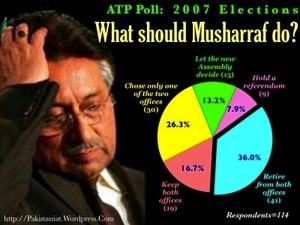 In simple words, the majority of the bench has said something to the effect that the legal questions pertaining to General Musharraf’s right to simultaneously retain the office of president and army chiefs, the constitutionality of his running for the second term, and whether he can be elected by outgoing assemblies is simply not our headache.
In other words, the Bench seems to be saying that the current political mess was created by the politicians in the first place, and it ought to be sorted out in political institutions not in the Supreme Court: This monster is not our creation.
Having used a technical term such as “non-maintainable”, the majority managed to pull the apex court out of a perilous situation between the rock and the hard place, but the real question is whether the apex court gave any consideration to pulling the nation out of even greater constitutional turmoil currently facing the country. History most probably will answer this question in the negative.
It is vital to understand that the majority opinion did not say that the petitions against Musharraf have no merits and therefore the general has the right to keep his uniform on, while getting himself elected by the expiring assemblies, as misinterpreted by many newspaper headlines, it simply said that under the Constitution, these sort of petitions may not be adjudicated on their merits in the Supreme Court. Doesn’t this type of constitutional short cutting raise more questions than answers? Does it mean the spirit of the Constitution has once again been sacrificed at the altar of constitutional literal fundamentalism?
In this back drop, various other questions beg for prompt answers. If the main issue was strictly about the maintainability of the petitions, then why did the Bench squander so much precious time on issues beyond the main issue? In plain language, if the Bench had any initial concerns and reservations as to whether these sorts of petitions can be filed and adjudicated in the Supreme Court, then why didn’t the Bench focus on such vital issues in the first place? Why did the Bench not direct the lawyers to address solely the maintainability issue, instead of allowing the arguments to be dragged on for almost two weeks and constantly dancing around the merit of the petitions, while seemingly enjoying exchanges of political remarks? Wasn’t time of the essence?
The current ruling of the nine-judge panel, being viewed as highly controversial, will certainly not be of any help to defuse the ever expanding crises in Pakistan. The political and constitutional storm currently engulfing Pakistan are a constant source of anguish and concern for Pakistanis living in the country and abroad. While the leadership in the neighboring countries is busy helping their people on the road to prosperity and development (By 2025, China and India will have the world’s second and fourth largest economies), the Pakistani government is negligently absent from foreign and domestic platform of public importance. The entire government machinery has been completely bogged down in a dangerous power game for many months, just to save the men currently in power, and leaving important national and international affairs unattended.
While world leaders, currently meeting and representing their nations at the United Nations, Pakistan’s absence at this vital event is indicative of how badly Pakistani external affairs are being handled. The situation with internal affairs is no different either. No new policies and initiatives are in sight to combat mounting national challenges. The costs of essential commodities are getting out of reach. Both foreign and domestic investors are scared to invest in the country. The law and order situation is at the brink of complete collapse, and insurgency around the borders is ever increasing . . . just to name a few. The people of Pakistan and the Pakistani Diaspora alike are increasingly becoming worried about the future of their homeland.
Pakistan, at the moment, is facing extremely dangerous constitutional and political crises of an unprecedented magnitude. In this context, it is equally disturbing that in the name of notions such as “ground realities†and “political transition†the government machinery, while fully deployed in pursuing ruthless tactics, still trying to convince the masses that all will be in order and they are taking decisions “in the best interest of the country and people of Pakistan.â€
Doesn’t this line of unilateral declarations sound familiar, frequently uttered before every national disaster in Pakistan? Aren’t the efforts to manipulate the system to produce a controlled outcome, in secrecy and behind the public’s back, inherently undemocratic and suspicious? Are we still living in a tribal society, devoid of any public accountability?
Pakistan and the people of Pakistan are not the personal property of the few in power, about whom they can go about making arbitrary decisions on their own without public engagement. The plethora of recently taken extra judicial actions by General Musharraf & Co. leaves no doubt that the days of preaching “Enlightened Moderation†are over. Doesn’t the Pakistani general along with his partners in power stand fully exposed? The mantra of “Enlightened Moderation†while being highly pleasing to the ears of its foreign clients, turns out to be nothing more than a deceiving veil obscuring the face of an inherently illegal and coercive regime. Evidence clearly suggests that what is now being practiced by the general and his regime is the brutal deployment of various unconstitutional measures, may collectively be called “Blatant Extremism.â€
There is a great degree of consensus among legal experts in Pakistan and abroad that the current political and constitutional crises in Pakistan are the direct consequence of Musharraf’s ultra vice actions. The current ruling of the Supreme Court did no address the main questions pertaining to his uniform and his second term as president, and the issues are still unresolved resulting in more confusion than ever before for the general public.
One of the hopes for finding a true solution to the recent constitutional crisis in Pakistan still rest on any future legal struggle for having Musharraf’s actions declared ultra vice by the Supreme Court. Once that is accomplished, his actions can be declared null and void and the nullification will be ab inito, that is, from the inception, not from the date of findings. It may be a long road, but it is probably the right one.
In the face of an informed public, the present junta will not be able to retain its illegal hold on power for long. One has to be a little patient to enjoy the fruit of the right struggle! The ruthless application of “the end justifies the means†dictum must come to an end. The hard working and patriotic people of Pakistan do not deserve the suffering resulting from the hostilities, turmoil and agony of the present situation.
The writer, after receiving a Master of Laws degree in International law from Columbia University, New York, has been practicing law in the US for over 17 years.




Aamir Ali, While I can put up with a lot of your crap, but not anything against the man who is the symbol of integrity and principles in an otherwise lawless society of ours. Wajihuddin was a Supreme court judge, one of the 5 who refused to take oath under the PCO of Military regime of Mush and was sent home. If he had taken oath under the PCO, he would have been the Chief Justice of the Supreme Court of Pakistan today due to his seniority at the time.
To learn more about Mr Wajihuddin, here is a link to Babar Sattar’s piece titled “A few good Men”, in “The News'” opinion section of Sep 29th.
http://thenews.jang.com.pk/arc_news.asp?id=9
Viqar:
I think people use danda to demonstrate their manhood, which is what the opposition and lawyer mobs are doing.
Whats so great about this Wajihuddin fellow? Nobody ever heard of him neither does he have any executive experience.
Those of you on this forum who are insulting army and justifying terrorism have no solution to Pakistani problems.
Well people there is still a ray of hope at the end of tunnel. I myself disliked the decision but somehow all supremecourt said in simple words is that ( although i disagree) Imran Khan’s and Qazi’s fundamental human rights have nothing to do with wardi. On the other hand Dr. ANwar was not allowed.. implies artilce 63 holds ;). So lets hope and work towards it that when Hon. Justice (Retd)Wajih ud din goes to court, the court does not deny him his FUNDAMENTAL RIGHTS
The Supreme Court did what it does best: bow to the wishes of those in power. Without the leadership of the CJ, did we really expect that the others would follow his lead into a world of wiretaps, attempted assassinations, public humilation, character defamation, you name it. Most of the Judges get where they are through a career path and are not given to putting country over personal interest.
Unfortunately, this judgement falls in line with the “doctrine of necessity”, Bhutto’s hanging, etc. Musharraf raised the ante significantly coming up to the judgement and the Court blinked.
The CJ is what? LFO oath taker? Mush is what? a general? politicians are what? puppets? This all drama is played by beurocracy and some puppets dancing on the trumpets blown by the great great Pak Army! countries have armies but unforunately our army has a country! the only unaccountable army in the world!! kill a elected PM! divide a country!live in mansions,build cantonments! etc! i have lived in Rwp and all i saw in 20 years was army building and building! goto lhr DHA now rwp has one as well khi has?what do u think they are protectors? no they are suckers and suckin everything like the politicians did!they never corrected them as if they do what reason will bring them back in a coup??
The recent killing of 25 SSG commandos is enough evidence for our military junta that “they have gathered venom for themselves” now if u wear uniform people laugh at u! in the past 60 years if pakistan not one general was treid not one beurocrate got trapped!but the blame goes to the politicians and that paves a way for army and same judiciary and buerocracy start working for them! get it people they are all here to enjoy on the expense of people!
Politicians no matter how corrupt go topeople and get votes!the army sends some jawans to get everything!and in battles u know what they do:) if they had been “angels” or “protectors” they would ripped corruption out!
Their only greatnes is that they have taught people a lesson a lesson of “learned helplessness” some few steps away from being a failed state!!
The decision of reinstating CJ was simple coz there wasnt anything so quietly they accepted coz Mush had bigger plans! His uniform and presidency!check the level and moral of this scum bag that says after ecoming pres he will shed it!what does it imply? coz he knows the same army will ditch him!like AAK Niazi was ditched!the same PML willl turn away and the biggest that he knows himself he has no chance! a person of stature would have done opposite!! Now SC has allowed him for what? if they hadnt there would have been martial law plain an simple!so every Tom Dick and Harry decided let him stay “5 saal he to hain tum bhi khaow hum hum ko b khilaien”
If u wana check the credibility of pakistan judicial system just go through the case of Z A Bhutto!and see how Army used them!they have the guns and the bullets!the one that will stand perishes!! apart from the bengalis that stood and with help from india got their country! Hats off to them!