Custom Search

The Past and the Future of Qawali in Pakistan

Posted on October 2, 2007
Filed Under >Adil Najam, Music, People, Religion
52 Comments
Total Views: 22081

Adil Najam
This post was originally posted on October 19, 2006. It is being reposted with the addition of some new Qawali video clips.
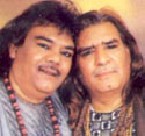
As I was driving back from work tonight, I had an old Sabri Brothers cassette playing in my car. The window was down, the sound was loud. As I stopped at a red light, my head still nodding to the rhythms, I noticed that the American woman in the car parked next to me was staring at me with a rather perplexed look (Bostonians don’t often get to hear the Sabri bradraan!). She shouted over the music to ask me what type of music this was and from where. I smiled and told her. I am not sure if she heard what I said over the noise because the light turned green just then and we went our different ways.

I guess she left wondering what the beat and sound was about. I left wondering what has happening to qawalli in Pakistan today? Who are the big names out there? Are there any? Is there any Ghulam Farid Sabri, Aziz Mian, Nusrat Fateh Ali equivalent out there? I know of Rahat Fateh Ali Khan, but he seems to be mostly re-rendering Nusrat Fateh Ali Khan’s work. Who else?

I was a qawalli fan while I was still in school; long before there was a Nusrat Fateh Ali Khan and long before it was kool to be a qawalli fan. I don’t know why I was a fan; no one else around me was. I guess the beat was enticing, the stories interesting, and the qawals colorful. I suspect that those around me thought it was rather odd that I liked qawalli so much; but then, people around me have always considered me odd!

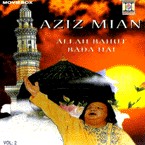
This was the era when the Sabri Brothers Qawall and Aziz Mian Qawall were at the peak of their prowess. They were both major innovators of the qawalli genre. Many purists consider them blasphemous not just because they moved qawalli from being predominantly religious - devotional to everyday-mundane. Remember, the ‘Paani ki qawalli’ and ‘Paisay ki qawalli’ (both by the Sabris) and the populist poetry extravaganzas of Aziz Mian (which often were more Munni Begum than Aziz Mian).

I guess I like qawalli for the same reason I like Johnny Cash and Waris Shah. They all have great stories to tell. And what could be more enticing than a good beat combined with a good story!

I found this video clip of this Sabri Brothers Qawall rendition of an old devotional qawalli. It is not the best recording but it is one of their most popular religious qawallis. And this being Ramzan - yes, I am sticking to Ramzan with a ‘Z’ - it is timely because it used to be a staple of the Sehri transmissions on PTV. Enjoy!


And while we are at it here is a clip of a classical Aziz Mian performance:

And, finally, here are a few additional Qawalli clips for Sabri Brother enthusiasts from various phases of their career.

52 comments posted

Comment Pages: « 7 [6] 5 4 3 2 1 »

  1. Harish Shah says:
    December 21st, 2007 6:51 am

    Salaam everyone. I’m too am looking for a Sabri bros recording that I used to have over a decade ago when I was young - it’s a mira bhajan - eri main to prem diwani, mera dard na jaaney koi. Does anyone know where I could find that? I can’t find it here in Ahmedabad - Indiawhere I live now.

    I hope that i get this recording

    Regards,

  2. T.M. Shahid says:
    November 28th, 2007 4:19 am

    For Fans of SABRI Brothers
    My attachement with qawwali started when I listened first time ..Sar-e-La Makan say talab huee….an since then (late seventies), I am a serious fan of Sabri Brothers. My collection includes almost all the qawwalies performed by Sabri Brothers which once entered the market. Besides these, many private mehfils and Radio archives, TV programs etc. I believe that most of their Master Pieces are still out of sight for genuine qawwali fans….like 30 min version of NAZAN HAY JIS PEH HUSN…..KHURSHEED E RISAALAT KEE SHUAAON KASAR HAY (not the commercial versions)…are perhaps their best performances. I would like to share my interest with genuine qawwali fans … T.M. Shahid

  3. Amra says:
    October 4th, 2007 4:56 pm

    Does anyone know any website where you could download Qawalis? Or an online cd shop where they might be sold. These are fantastic. Takes me back to my childhood. Driving long distances with my parents ( Europe, North Africa) and my parents putting on their favourite Qawalis. The atmosphere became magical and us kids would be lulled into quiet repose at the back.

  4. MQ says:
    October 4th, 2007 11:22 am

    [quote]Could you give me the surah and verse of where in the Q’uran music is prohibited?[/quote]

    Tina:
    You will never get a straight answer to your question. To the best of my knowledge there is none.

    You could have, in fact, re-phrased your question and asked: If music is prohibited by Quran then why the Qaaris, all over the world, try to excel each other in reciting Quran in the most musical voice?

  5. Naseem says:
    October 4th, 2007 10:48 am

    Assalamau Laikum Tina,

    It is good to talk to you Inshallaa.

    The references within the context of the Qur`aan Sharif along with the Hadith of the Prophet PBUH confirm that music is haraam.

    Interpreters of the Qur`aan have defined the term `lahwal hadith` which is mentioned in the Qur`aan as:
    1) Singing and listening to songs.
    2) Purchasing of male and female singers.
    3) Purchase of instruments of fun and amusement.

    When Sayyidana Abdullah Ibne Mas`ood , a very close companion of our Prophet PBUH was asked about the meaning of the term `lahwal hadith`, he replied
    “I swear by Him besides whom there is no other God,that it refers to ghinaa (singing ).”

    This statement, he repeated three times. This view is unanimously supported by the four Khalifas, the eminent Sahabaah, Tabi`een, the four Imaams and other reliable Islaamic scholars and authorities.

    Also One hadith from the Bukhari Shareef, the most authentic Book of Hadith, further confirms unlawfulness of music and singing :

    `There will be people of my Ummah who will seek to make lawful; fornication, wine-drinking and the use of ma`aazif ( musical instruments ).`

    Detailed analysis of the arabic word `ma`aazif ` shows that it refers to musical instruments, the sounds of those musical instruments and singing with the accompaniment of instruments.

    Closer analysis of the wordings of the Hadith establishes the prohibition of music. Firstly, the words `seek to make lawful ` shows that music is not permissible, as logically one can only seek to make lawful that which is not allowed.

    Secondly, if music was not prohibited, then it would not have been brought within the same context as fornication and wine-drinking.

    So you see my dear…in order to remain a good muslim we must not submit to the evils of music. When I walk round the streets of Lahore and hear music….I cringe…and normally carry ear plugs which I “istamaal”. …This however carries danger when crossing the road….twice I have come close to being run over because I was wearing ear plugs to avoid listening to music….equally I could not hear the cars.

    Still….I think it is a price worth paying to confrom with the teachings of the most Holy Koran….

  6. Tina says:
    October 4th, 2007 8:37 am

    Hello Naseem,

    Could you give me the surah and verse of where in the Q’uran music is prohibited? Seriously, I am interested in reading that. I wonder if there can be other ways of reading it, I feel there must be. Thank you, Tina

  7. Naseem says:
    October 4th, 2007 6:50 am

    Assalamau Laikum Tin, Chief Sahib,

    It is interesting how quickly the word death is mentioned with the word freedom. In a sense there is freedom and freedom. Who says that you cannot have freedom with out music….it is a particular form of freedom.

    The Quaran says that music is bad for us….and the words are divine….uncorruptable and cannot be wrong.

    To defy the holy suras are synomous

  8. Qadir says:
    October 3rd, 2007 11:36 pm

    Yes, that was the golden era of qawalli. I think the Sabri brothers did great work to popularize this art form.

Comment Pages: « 7 [6] 5 4 3 2 1 »


Have Your Say (Bol, magar piyar say)

Please respect the ATP Comment Policy.

Keep comments on topic; no personal attacks; don't submit indecent, inflammatory, slanderous, uncivil or irrelevant comments; flamers and trolls are not welcome; inappropriate comments will be removed or edited.

If you won't say it to someone's face, then don't say it here!

Readers who want to use a URL should please use the TINY URL program.

Thanks, and keep the comments coming!