Adil Najam
The News is now confirmed. Bilawal Bhutto Zardari has been named the new Chairman of the Pakistan People’s Party. His father, Benazir’s husband, Asif Ali Zardari will be the co-Chairman.
Seemingly credible reports suggest that Bilawal Zardari, Benazir Bhutto’s 19-year old son, now a student at Oxford University, is being considered as the new PPP Chairperson to succeed his mother – and before that his grandmother and grandfather. Later today he will read out a testament from Benazir Bhutto outlining the future of the party.
Repeating what is now being widely reported, but in more detail, a report from Christina Lamb and Dean Nelson of The Times (London) details:
BENAZIR BHUTTOâ’S 19-year-old son Bilawal will be thrust into a dangerous spotlight today as Pakistan’s most powerful political dynasty prepares to pass the baton to the next generation. Bilawal, a first-year undergraduate at Oxford University, is the heir to a blood-soaked legacy. He lost his mother to an assassin on Thursday; his uncles both died in suspicious circumstances; and his grandfather, Zulfikar Ali Bhutto, was hanged in 1979 after being deposed from power….
At 3pm today Pakistan time Bilawal will read out his dead mother’s political testament to leaders of the Pakistan People’s party (PPP), which his grandfather founded and the family has always controlled. “They have to show his face to reassure the party that there will be another Bhutto leader in the future,” a diplomat said. Bilawal is expected to play a leading role in the campaign for elections, still scheduled for January 8 despite the riots that have followed the assassination. But he will return to his studies at Christ Church early next year. Under Pakistani law, parliamentary candidates must be at least 25 years old.
Benazir Bhutto wanted Bilawal to complete his education before becoming involved in politics. Although she would have liked him to lead the party, she did not want him to feel compelled to do so or to make the kind of sacrifices that she had to make when her father was executed. Her widowed husband, Asif Ali Zardari, will make a bid today to lead the PPP in order to keep power firmly in the hands of the Bhutto family and to ensure that Bilawal can eventually inherit his mother’s political mantle.
Party leaders grieving for her began discussing the succession last night. The talks took place in Bhutto’s ancestral home at Garhi Khuda Bakhsh, where she was buried on Friday in the mausoleum that she built for her late father. Early this morning 10 villagers were keeping vigil by her grave, reciting the Koran. There were two fresh wreaths from the new army chief General Ashfaq Kayani.
…The prospect of Zardari returning to frontline politics has horrified several members of the PPP central executive, who blame him for embroiling Bhutto’s two short-lived governments in corruption allegations. Zardari became known as Mr Ten Per Cent because of widespread allegations that he received kickbacks on government contracts. Many in the party would prefer to see the PPP taken over by Makhdoom Amin Fahim, head of another feudal family, who ran the party while Bhutto was in exile.
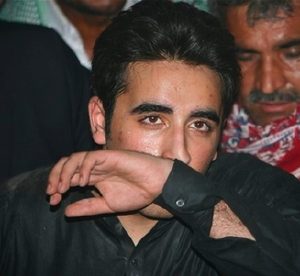
If, indeed, he becomes the Chairman – now or in the near future, nominally or actually – the Bhutto family legacy will continue. While the last name changes – as it did in India when Jawaharlal Nehru’s daughter Indira Gandhi took over – the reins of the Pakistan People’s Party (PPP) will remain in the Bhutto clan.
I must confess that my own immediate feelings on this are rather mixed.
I do not think this is a burden (given the weight of the responsibilities or the dangers) to be thrust on one so young. I have never met Bilawal but hear from those who have that he is an impressive young man. I have no doubts that he is but it is neither fair on him nor the party nor the cause of democracy for this to happen at this moment or in this way. More that that, I wish (even though I know it was unlikely) that the Party would open up its leadership and internal democracy process. Also, there is the fear that if he is anointed many will try to manipulate him and he will be turned into a “puppet prince.” I do hope that none of this will happen.
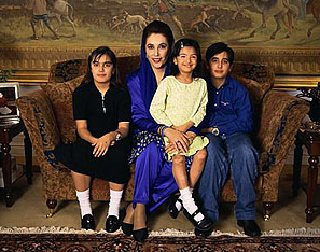 If indeed a role is thrust upon him, even as a figure head whose appointment is meant to hold the party together, this is clearly a big responsibility. It is probably something that he probably anticipated in his future. His mother clearly did. But probably not as soon as this and certainly not in these tragic circumstances.
Whatever happens in the next hours I wish young Bilawal the best. This must be an immensely trying time for him. Whatever happens, I hope and wish and pray that even if he comes to this position because some consider it to be his ‘ancestaral right’ that he will think always of what is good for Pakistan. That he will remember that this is not a privilidge but also a responsibility. There are, of coruse, grave dangers that come with the mantle that some might want him to take on. And I pray earnestly that his fate will not be that of his mother and grandfather.
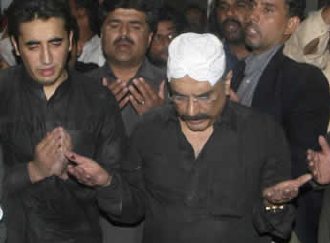 Finally, no matter what is decided, I pray that he will be guided by the purity, optimism and ideals of youth and not by the self-serving interests of those many who will flood to ‘advise’ him. Leadership is to be judged not only by what leaders do but by who advise they seek and listen to.
My advise to him – not that he asked – is that he should listen always to his heart and mind, well before he listens to anyone around him. Let him be guided by his own idealism, rather than the political ‘pragmatism’ of those who will soon (if they have not already) surround him. Let him follow that which was best in Benazir Bhutto and Zulfiqar Ali Bhutto and avoid their follies.
I wish Bilawal well. But I will wait on my judgement of him, as will history.
[NOTE TO READERS: We had earlier posted a story suggesting that Bilawal Zardari had already been confirmed as the new PPP Chairperson. Realizing that at that point it had not been confirmed, we then took this post off and replaced it with a note of apology saying that this news was not yet confirmed. Given that Bilawal Bhutto as PPP Chairperson was clearly a possibility (either immediately or in the near future) and that a number of still-relevant comments had been made, we then merged the two posts (including relevant comments) but with appropriate changes in the original post to reflect the fact that as of this writing this was a ‘likelihood’ and not a confirmation. It now turns out that our original sources were correct and Bilawal has been named Chairman.]




I am deeply impressed by Zardari’s press conference. He said all the right things at the right time.
I hope past may be past. I hope he is a changed person now and may shed his past which was tainted by allegations of corruption.
Irritated Pakistani
agree with you. headline news should be how to calm pakistan and main posts on boards should be same.
visit http://www.longlivepakistan.com for truth.
I do not like this one bit, especially the role of Zardari (although I agree he said all the right things at the press conference). But I am with Adil Najam, I wish Bilawal well and hope he will follow Adil’s advice. It is good advice.
People do sometimes change. Jinnah changed his positions many times. Lets judge him on what he does and not just on who his father is.
PPP’s present is quite certain… MAF will lead the party while BBZ goes back to complete his education and learn a little bit of broken Urdu to help communicate with his ‘poor’ people which this party claims to come from.
It’s the future that worries me. 10 years down the line, maybe more, when he returns, we will not have forgotten him certainly and he will return, like his mother, a triumphant hero, who is destined to lead Pakistan and if we have any form of democracy then, he might be voted into power.
10 years is enough for a corrupt father to corrupt his son. He’s no angel right now… and I highly doubt any oxford education can make him so. He will be groomed and trained in the art of politics (which also includes corruption and nepotism).
I personally have no hope from PPP and certainly no desire to see another Bhutto on top.
This is last election which this party will win under these Fake Bhutto and time will prove next only real Bhutto’s Party will be PPP or there will be no PPP founded by Shaeed Bhutto ( please note it and cheak after 5 year it will become true)