 ATP is always searching for tips on good Pakistani food (see here), and as I have a long history with food experiments myself (see here). So here is my new discovery.
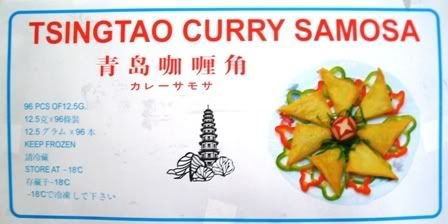
On our last trip to buy oriental grocery we were surprised beyond words to find ‘Tsingtao Curry Samosa‘ and ‘Paratha – which taste like authentic Indian’ in a refrigerator.
Both of these items were made in China. We immediately bought both items and I must confess they both tasted very good. Samosa filling was made of Chinese curry and Parathas were puff Parathas. You gotta taste them to believe me.
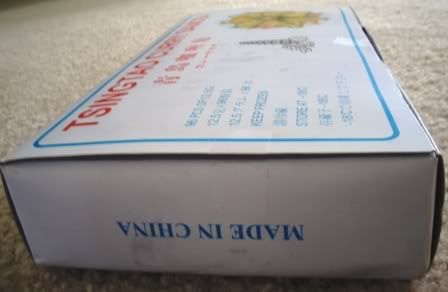 Today I couldn’t resist and took these photos of ‘made in China’ samosa box to share with all of you.
For those who are really interested in knowing the recipe’ of this Chinese samosa, here are the ingredients which I am faithfully copying from the box:
Cabbage, Wheat Flour, Water, Potato, Mushroom, Onion, Carrot, Vegetable Oil, Sugar, Salt, Soy Sauce and Curry powder.
I believe there is a big food export business going on between China and South Asia. On a trip to China in 2001, I met a businessman from Mumbai who was manufacturing ‘Chinese dumplings’ in India and exporting them to China.
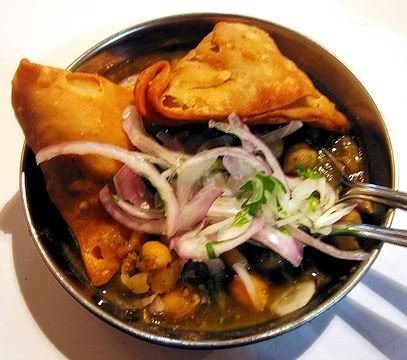 Now after writing all this I must also state that – with all due respect to China or India – no one can beat the taste of Samosas sold in United Bakery, Karimabad Chowrangi Karachi.
As the poet says:
jo maza chajjoo de chobaaray
O na Balkh na Bukhaaray
The enjoyment that one gets on a native street corner
cannot be found in either Balkh or Bukhara




Rabia:
Delhi is a veritable treasure trove of such streets. Particularly old Delhi. Paranthe wali gali is a narrow street just off Chandni Chowk, with the first published references I have found for it dating back to the period just after independence. The current character of the street was probably established by refugees from (West) Punjab, as was that of numerous other markets around there. It has a large number of shops, each of which is a parantha shop. Each shop has its own special type of parantha.
The oldest sweet shop in the Chandni Chowk area (and perhaps anywhere in the subcontinent) is a shop called Ghantewala in Chandni Chowk. It is more than 300 years old now and their sohan halwa made of desi ghee is particularly famous (though it is not for those with weak teeth!). You can find sweets of that quality elsewhere, but not the feeling that comes from the realization that Ghalib, on his way to the Red Fort from his house would have passed this shop and perhaps even bought sweets there.
Another old favourite in that area is Karim’s, just behind Jama Masjid (though the options are usually quite limited for a vegetarian like me). It is a particularly popular haunt during the month of Ramzan, in the night, of course. It has been in existence since 1912, if I remember correctly.
And then, who can forget the parantha walas on Bahadur Shah Zafar Marg who start their business in the middle of the night and wrap up at dawn. For those unfamiliar with Delhi, BSZ Marg is Delhi’s fleet street, with most of its newspaper offices/presses and the journalists plus students from the Maulana Azad Medical College across the street and many others (like me) who drive long distances just for the paranthas provide them roaring business.
Enough of this trip down the lanes of (gastronomical) nostalgia for now!
While on the topic of Samosas, how about also including some great locations for Chhola-Bhatura (another Delhi claim-to-fame favourite)!?
I highly recommend the Khokha behind Scindia House in Connaught Place, Delhi. You have to negotiate some real pothole-infested gallis befroe you can find it…but ask as you go and they’ll be enough people to point you in the right direction.
Accompanied with fresh onions and their trademark “khatti arbi ka aachar” this is definitely what I always head for when I am in Delhi.
Happy eating!!
@Dakter: I love that khokha! Your comment has brought some fine memories when I used to savor those samosas :)
@Sridhar: The name ‘Parathe Wali Gali’ sounds very interesting. I bet Delhi stores great flavors and would love to try Delhi’s street food whenever I get a chance to visit India.
I tried samosas from a nearby International Grocery Store but they sucked! I don’t remember the name of a shop in Devan Street Chicago but they have excellent samosas in there too. No match to our desi khokhas and samosas though!
I am joining Sridhar’s chorus. If you want samoosas, the place to go to the khokha right across from Gordon College, Rawalpindi. Get the ‘teen samoosa, double masala’ plate, and lick your fingers!
Nice post. I must take exception to one thing though, with due respect. No United or Divided bakery can match the samosas and street food of places in Delhi like Ajmal Khan Road or Panchkuian Road (sadly these extremely popular 50s era shops have been displaced by the metro) or Bengali Market (Bengal Sweet Shop and Nathu’s). Or the parathas of Parathe Wali Gali in Chandni Chowk. Eat the street food of Delhi and you will forget your old favourites. ;-)
Just kidding. :-) I am sure United Bakery makes excellent samosas!