Custom Search

Gen. Pervez Musharraf Resigns: Video and Pictorial

Posted on August 18, 2008
Filed Under >Adil Najam, Politics
204 Comments
Total Views: 17127

Adil Najam


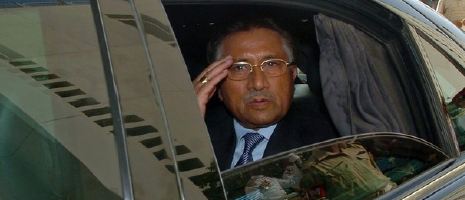
In a nationally televised speech, Gen. Pervez Musharraf, President of Pakistan, has just announced his resignation, pre-empting a move to impeach him by the parliament.

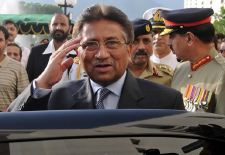
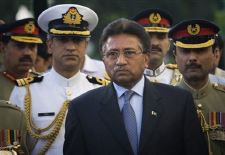
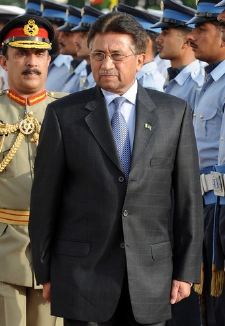
This post has been updated to add news photos from this momentous day in Pakistan’s political history. The pictures speak eloquently of the moods and thoughts of the day. (Scroll down to see the video of Gen. Musharraf’s resignation speech).

Participate in a poll on what might be Pakistan’s future post-Musharraf, here. Watch the video of the speech below.


Your Ad Here

Here is a Pervez Musharraf time-line, published in The News:

August 1943: Born in Delhi, India

1964: Joins Pakistani army.

1998: Becomes army chief of staff.

October 1999: Seizes power in a bloodless military coup, overthrowing the prime minister, Nawaz Sharif. In response, the Commonwealth suspends Pakistan’s membership.

June 20 2001: Makes himself president, replacing Rafiq Tarar, while remaining head of the army. Tarar is forced out of office when the parliament that elected him is dissolved.

July 2001: Holds first meeting with the Indian prime minister, Atal Bihari Vajpayee, at Agra in India. No progress is made because of differences over the disputed territory of Kashmir.

September 2001: George Bush courts Musharraf, asking him to join him in his “war on terror” and help defeat the Taliban in neighbouring Afghanistan. The US president promises Pakistan $1bn in aid.

April 2002: Wins a referendum giving him another five years in office. Observers criticise the referendum as blighted by irregularities.

May 2002: Pakistan test fires three medium-range surface-to-surface missiles capable of carrying nuclear warheads. Musharraf insists his country would not be the one to initiate war.

August 2002: Consolidates his power still further, giving himself the right to dismiss an elected parliament.

October 2002: Pakistan’s first general election since Musharraf seized power in 1999 results in a hung parliament.

November 2002: Mir Zafarullah Jamali becomes the first civilian prime minister since 1999. He is a member of a Musharraf-supporting party.

November 2003: Pakistan’s National Assembly meets for the first time since 1999.

December 2003: Musharraf promises to step down as head of the army by January 2005.

May 2004: Pakistan is readmitted to the Commonwealth.

December 2004: Musharraf announces he will stay on as head of the army.

August 2005: Pakistan tests its first nuclear-capable cruise missile.

March 2007: Musharraf suspends the chief justice, Iftakar Mohammed Chaudhry, triggering a wave of anger across the country and the first joint protests held by the parties of exiled former prime ministers Benazir Bhutto and Nawaz Sharif.

October 2007: Signs a corruption amnesty, opening the way for Bhutto’s return and a possible power-sharing agreement. Within hours of Bhutto’s arrival back in the country, bombers attack a Bhutto rally in Karachi, killing more than 100 people.

November 2007: Declares a state of emergency, rounding up opposition leaders at gunpoint. In the same month, Musharraf quits as head of the army, becoming a civilian president.

December 15 2007: Lifts state of emergency and announces plans to go ahead with parliamentary elections scheduled for January 8.

December 27 2007: Benazir Bhutto is assassinated at an election rally in Rawalpindi.

January 2008: Elections postponed until February 18.

February 2008: The two main opposition parties gain a clear majority in the elections.

August 2008: The two main parties strike a deal to impeach Musharraf if parliament backs the move.

August 18 2008: Musharraf announces his resignation

204 comments posted

Comment Pages: « 2624 23 22 21 [20] 19 18 17 161 »

  1. Usman says:
    August 19th, 2008 10:25 am

    People wanted democracy so here it is, with the two beloved politicians Mr 10% and Liar(Nawaz). Their parties have twice ruled Pakistan in democratic way and they both bankrupted Pakistan or killed opposition or set them up in false cases and manipulated the system.

    Pakistan is now doomed

  2. Zafar says:
    August 19th, 2008 9:38 am

    This is a very balanced and thought-out piece on Musharraf’s legacy, in DAWN.

    ———

    Musharraf’s mixed legacy

    By Zaffar Abbas

    At a time when almost everyone in the country, including many of General Musharraf’s one-time trusted friends and beneficiaries, is busy condemning his nine-year rule, to mention some of his achievements may be like committing blasphemy. Still, it’s only fair to talk of some of the big, controversial and even bold decisions he took in an attempt to change the destiny of the country. Whether he succeeded in doing so, or became a victim of sycophancy or self-serving propaganda, may remain part of a never-ending debate. But this in itself shows that General Musharraf’s may well be a mixed legacy.

    Gen Musharraf’s opponents and enemies are many, and understandably so. In the last decade or so some of the most divergent social and political groups turned against him, but often for different reasons. In fact, in most cases they had diametrically opposite views on issues ranging from the Kargil conflict to the seizing of power in Oct 1999, from Nawaz Sharif’s trial to allowing him to go into exile, from keeping Asif Zardari in jail to allowing Benazir Bhutto to return, or from taking the country to the brink of war with India to initiating a peace process with it.

    There were political parties like the PPP or many women’s, rights and liberal groups that saw in the October 1999 military coup a positive move to block the then prime minister Nawaz Sharif’s use of his brute parliamentary strength to introduce his own brand of Islamic shariah in the country.

    In the early years of his military rule, Gen Musharraf was praised by the country’s liberal political and social circles for reversing the obscurantist policies of General Zia-ul-Haq. There was a time that many women’s rights groups thought he was the best thing that had happened to the country in decades. But then the same people turned against him when he struck a deal with the religious right to legitimise his rule after the 2002 election.

    The religious and many other politicians like Imran Khan ignored his move to overthrow an elected government, and even backed him in a fraudulent referendum that allowed him to rule for the initial five years. However, when in the aftermath of the events of September 11, 2001, he turned his guns towards the Muslim militants, whom he had been backing in the past as the army chief the religious and political right became the vanguard of the anti-Musharraf campaign. The contradiction among his opponents was also seen in the last year of his rule. He was being criticised by the liberals and women’s groups for allowing Lal Masjid and Jamia Hafsa Madressah clerics to spread extremism in Islamabad, and by religious groups for killing ‘innocent’ people of the seminary.

    Similarly, some condemned him for launching a military operation against militants, while a few others thought he was not being sincere in eliminating the pro-Taliban fighters. And if the militants were opposed to him for using the military against the Taliban, the secular Baloch nationalists hated him for using the military might against them, and for killing the veteran Baloch tribal leader Nawab Akbar Bugti.

    But what brought all the disparate political groups opposed to him on to one platform and triggered a chain reaction that ultimately culminated in his ouster was the imposition of emergency, the sacking of dozens of judges and the muzzling of the broadcast media. On the other hand many businessmen and industrialists remained his supporters till the very last, and thought it was largely because of his policies that the economy remained in an upswing during the last many years.

    It’s largely because of such contradictions in the character and policies of the man that for most people Gen Musharraf remains an enigma. In fact, no one seems to know who the real Gen Musharraf is? Was he a hawk disguised in a liberal cloak, or a moderate and progressive man whose military training had in the past turned him into a trigger-happy leader? Was he really sincere about the progress of this country, or were his policies only targeted at perpetuating his rule? These and many other questions about the man may remain unanswered for a very long time, more so because over the past year or so the propaganda campaign from rival camps has made the line between fact and fiction somewhat blurred.

    However, speaking from personal experience as a journalist I have absolutely no hesitation in stating that he was probably the best interviewee I ever came across. And I have met and interviewed quite a few top politicians, including many presidents and prime ministers. At times his answers were not at all convincing, but unlike many popularly elected politicians, he was never shy of taking some of the toughest questions about his person and politics. Even during a number of private conversations, and much to the annoyance of his aides and advisers, he listened to criticism and tried to argue his case.

    He was also a unique military ruler who, instead of imposing censorship at the time of seizing power, liberalised the media, and at a later stage allowed dozens of private television channels, many of whom spent most of their airtime in attacking him and his policies. It was only for a brief period during the emergency period that there was a media blackout, and a number of TV anchors were banned from broadcasting. But once private televisions were back on air, they returned with more venomous broadcasts against the beleaguered president.

    Many others who saw and worked with him say that although he was no visionary, he always tried to work hard with a view to understanding an issue, and rarely shied away from taking on a challenge. Even some of those who left him after political expediency compelled him to take Chaudhry Shujaat Hussain and others as his major allies, still regard him as a sincere leader. His biggest mistake, they say, was not being able to work out an exit strategy. In fact, after being encircled by sycophants and vested interest groups, Mr Musharraf had started to regard himself as indispensable for the country. And the way he sacked more than half of country’s superior judiciary simply showed he had no love or respect for the rule of law.

    But then in the end, he was a military man who should have never intervened in the country’s political affairs. For some General Pervez Musharraf may well have been a well-meaning person, but all his positive work becomes meaningless when compared with the way he overthrew an elected government and subverted the Constitution, and towards the end of his tenure tried to destroy the judiciary, only to keep himself in power.

  3. Altaf Raja says:
    August 19th, 2008 9:21 am

    I was just going through our beloved patriot dictators list of achievements since he came into power.

    Found an interesting fact:

    > Declares a state of emergency, rounding up opposition leaders at gunpoint.

    What a wonderful democracy the general made.

    God Bless Musharraf

  4. Naadia Sultan says:
    August 19th, 2008 9:15 am

    I feel proud as a Pakistani today because for the first time people power and democracy removed a dictator through votes in the four provincial assemblies. No shots first, no one killed, no one arrested, no coup, no violence on the streets. All we did was to tell the tyrant that the people of Paksitan will no longer tolerate his lust for power.

    This is the difference between those like Musharraf who snatch power through violence and treason an breaking the constitution and those who believe in democracy and the constitutional way.

    The real winner here is Pakistan, democracy and Pakistanis and the rule of law and constitution.

    Congratulations, Pakistan.

  5. Qasim says:
    August 19th, 2008 9:12 am

    > Well I got news for you, its democracy in Pakistan now thanks

    Democracy democracy democracy. Do Musharraf supporters even know what it means? Some say that they would prefer a “democratic dicatator” (whatever the *bleep* that is), others would prefer an outright dictator and others act like he was some godsent messiah who overthrew the democratic government of Pakistan and made it heaven on Earth.

    So, why is it that Musharraf’s supporters claim that there was democracy in Pakistan? There was no free press, there was no accountability for his crimes and corruptions, and he removed the judges and judiciary at his will, instead instating his own cronies. Musharraf literally SOLD Pakistan civilians to America for cash. All of these points go virtually ignored by his supporters as if they never happened. And yet they go on to talk about a democratic Pakistan. Unless we learn from history we are doomed to repeat it! Please don’t ignore the facts and accept it! I have nothing against Musharraf personally, he is just another crook who looted the Pakistanis - the only difference is that this time it is much worse for Pakistan to get back on track.

  6. Pakistani awam says:
    August 19th, 2008 8:37 am

    Here is the saddest thing to note in the comments here.

    Most of the people who supposedly “support” Musharraf, read their comments and they are saying also that they hate Pakistanis and Pakistan. They speak of Pakistanis and Pakistan as if they are someone else (maybe they are). They have no sense of identity and pride in Pakistan, just in their dictator.

    That was Musharraf’s problem too. He did not care about Pakistan or Pakistanis too, only his own power. His supporters are exactly the same.

  7. Qurban says:
    August 19th, 2008 8:32 am

    Like others I am also struck by how motivated people are by their hatred for democracy and how little faith they have in Pakistanis and the electoral choices Pakisatnis have made.

    Their support for Musharraf comes only from their hatred for democracy and for ordinary Pakistanis. I guess it is those few who are willing to sell of Pakistan and Pakistanis that support Musharraf.

  8. BUNTY says:
    August 19th, 2008 8:30 am

    I am amused at the demented logic of the MUSH-Haters on here…

    If you like Musharraf you must be ISI or the devil itself!

    Well I got news for you, its democracy in Pakistan now thanks primarily to……yep…….you guessed it…….Musharraf! and my right to differ from you is as important as your right to differ from me. I do not remember having that or a free media prior to 1999…..do you?

    If you go with the formula of MAJORITY IS ALWAYS RIGHT! well majority of Pakistanis also elected BB and Ganja Khalifa twice and look where it took the country in the first place in the1990’s…….corruption, bankruptcy, bad fiscal management, declaration of Pakistan as a a failed state, we almost became a khilafat to be ruled by a civilian ganja khalifa! Lets hope that democracy is here to stay and that these politicians act their part sensibly and not like the intolerant Mush-hating twits putting their posts on ATP!

Comment Pages: « 2624 23 22 21 [20] 19 18 17 161 »


Have Your Say (Bol, magar piyar say)

Please respect the ATP Comment Policy.

Keep comments on topic; no personal attacks; don't submit indecent, inflammatory, slanderous, uncivil or irrelevant comments; flamers and trolls are not welcome; inappropriate comments will be removed or edited.

If you won't say it to someone's face, then don't say it here!

Readers who want to use a URL should please use the TINY URL program.

Thanks, and keep the comments coming!