Custom Search

1 US Dollar ~ 80 Pakistani Rupees

Posted on October 7, 2008
Filed Under >Owais Mughal, Economy & Development
75 Comments
Total Views: 26431

Share

Owais Mughal

Do you remember an old adage:

‘ye cheez to Takkay ki nahiN hai’ (This thing is not worth a Takka).

Well, today the tables have turned. What was once true of BD Takka is now true for a Pakistani Rupee. As of today 1 Bangladeshi Takka equals 1.14 Pakistani Rupees . The phenomenal slide of Pakistani Rupee, which started around January 2008 continues unabated. Pakistani rupee is now trading at very close to 80 Rupees to a US dollar. Yahoo Finance was quoting Pakistani rupee at Rs 78.375 to a US dollar on October 6, 2008.
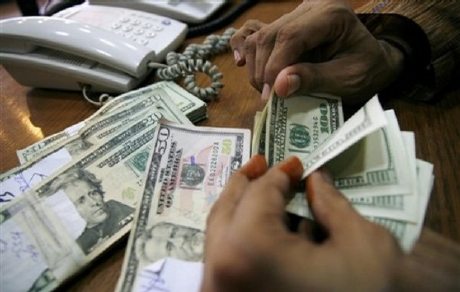
Pakistan Rupee v U.S. Dollar


We also had a post on this topic back in May 25, 2008 when Rupee had slid down to Rs 68 for a dollar but this time slide in Rupee’s value seems like the steepest in history of Pakistan. Rupee has lost almost one third of its value in the past 10 months.

The question that everyone is asking is whether current Government is capable of controlling this situation or is it beyond anybody’s control.
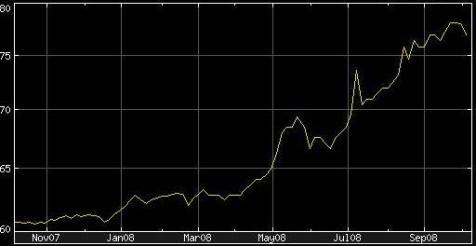
Pakistan Rupee v U.S. Dollar
Pakistan’s finance Minister (since May 12, 2008) is Mr. Naveed Qamar and atleast I’ve not heard anything from him about what are Government’s plans to bolster Rupee’s value or to stop fast depleting foreign exchange reserves of Pakistan (now down to approx $8.1 bn).

What is happening to a common person among all this turmoil is depicted well in a sher by Anwar Masood.

“jo dil pe guzarti hai raqam karte raheN ge”
kal tum ko bata deN ge raqam kitni bani hai

Reference:

1. Yahoo Finance

Related Posts with Thumbnails

75 comments posted

Comment Pages: « 10 9 [8] 7 6 5 4 3 2 1 »

  1. Aqil Sajjad says:
    October 12th, 2008 9:37 pm

    Mr. Banker:

    I think you misinterpreted some of my statements so let me clarify.

    1. I did not say that the govt borrowed an additional amount of $17b; what I said was that the debt increased from about $18b to $37b, so the net increase in the external debt was about $19b. However, in the same period, Pakistan also spent about $30b or so on servicing its foreign debt. This shows that most of the new debt in this period was used to service old debts and could therefore not be spent within Pakistan.

    2. You apparently interpreted my use of the words ‘non-concessional’ as commercial debt. That’s not what I said. What I meant was that the terms of the debt were not very easy. For example, you can check the piece by Aslam Sheikh

    HERE

    3. I did not claim that the $11b provided by the US was all aid. Yes, some of it was indeed the expense for the military operations. However, if the money is spent inside Pakistan, it does become a part of the gdp and also has the usual spending multiplier effect too.
    (For those not familiar with the money multiplier and still interested in following this discussion (doubt there would be that many:)), here is an easy to understand explanation:
    http://en.wikipedia.org/wiki/Multiplier_(economics  ) )

    4. The forex accounts: the govt did give rupees in return for those dollars, though the exchange rate was less than the market rate by several rupees per dollar. So the entire amount was not a complete ‘mufta’ for the govt as was the case for the $11b provided by the US after 911.

    5. The external debt was $45b on March 31, 2008, which was when power shifted from the Mush led set up to the new one. Check

    this link

  2. Rafay Kashmiri says:
    October 12th, 2008 3:12 pm

    @Owais Mughal,

    one can see what kind of a bull-fight is going on
    62 posts to prove I don’t know what, I am just watching
    French TV2 prime-time News, among the titles
    concerning the World wide Bankruptcy due to the
    USA & EU, they succeded in inserting you know what ?
    guess? Salman Rushdie !!!!!! to divert our attention !

    Arz kia hae (Azaad)

    Wahan ku’tt rahi hein gardan’ein,
    aur ran hey Ghams’aan ka,
    Banker-o-Nabankeron ki,
    Khaslat-e-shauque-e-behess,
    Mualmela sood dar sood ka,
    qarzon ka, aur dealon ka
    Jaib-katray jab, ch’ala’en bankon ko,
    Loote’nge woh, auron key noton say, mazah
    Nehein ma’aloom, Hamein loota kisney ?
    Han ! zikr hota hay to sirf,
    Kambakhet, Salman Rushdie ka !!

    Rafay Kashmiri

  3. mr_banker says:
    October 12th, 2008 4:41 am

    aqil sajjad,

    i am sorry but you analysis does not make sense to me and nor do the numbers you give provide an accurate picture.

    1. during the 1990s, gop borrowed a total of about $27bn instead of $17bn that you claim. in addition to $17bn acquired from external sources, the govt also borrowed another $10bn from pakistani foreign currency depositors which the govt then ended up stealing when it froze foreign currency accounts. this $10bn in essence ended up being a foreign currency grant by the citizens of pakistan to gop and the amount is almost equal to funding provided by uncle sam after 9/11. please note that all pakistan had to show on the asset for the $27bn increase in external debt in 1990s was $500mn in reserves. btw of the $11bn or so provided by uncle sam post 9/11, $5bn was for military expenses for operations by army in tribal areas. this money was not aid as claimed by you.

    2. you claim that half the borrowing in the 1990s was from commercial sources which contradict your claim that external environment was less favourable in 1990s compared to this decade. for a country to borrow on commercial terms, it has to show lenders that the country is solvent and it has not defaulted on its previous debt. when musharraf came to power, pakistan had defaulted on its debt which meant that pakistan could not take commercial loans unlike in the 1990s. also u.s. was the only country applying sanctions on pakistan in the 1990s. u.s. however did not prevent pakistan from borrowing from multilaterel agencies. as you yourself point out, half the amount borrowed by pakistan was on concessional terms clearly indicating sanctions were not a restriction. please also note that in the 1990s, japan was the largest aid donor to pakistan while currently uk is pakistan’s biggest aid provider.

    3. the rate of external debt build up in 1990s unlike anything witnessed in the history of pak. pakistan’s fcy debt after 41 years of existence amounted to $18bn. in the next 11 years this amount increased by 150% including fcy deposits. debt burden faced by govt of shaukat aziz was far far greater than that faced by govts in the 1990’s. restructuring after 9/11 did help but the amount restructered was $12bn which meant that govt still had to service unstructred debt to the tune of $24bn - an amount which was far greater than that at the start of 1990.

    3. pakistan all through its history has run huge trade and current account deficit and will continue to do so for a long time to come. however pakistan external position by the end of fy2007 had been much stronger than it had been over the last two decades. note also that pakistan’s debt stood at $41bn at the end of fy07 and not $45 as you claim:

    http://www.dailytimes.com.pk/default.asp?page=2008 %5C02%5C07%5Cstory_7-2-2008_pg5_1

    External debt and liabilities (EDL) at the end of FY07 were $40.17 billion.

    ..The external debt and liabilities (EDL) declined from 51.0 percent of GDP in FY02 to 25.7 percent of the projected GDP for FY08 by end-September 2007. The EDLs were 297.2 percent of foreign exchange earnings at the end of FY00 but declined to 122.5 percent by end FY07. The EDLs were over 19 times of foreign exchange reserves in FY00 but declined to 2.5 times by end 2007…”

    btw almost all energy deficient developing countries currently run current account deficits including countries like india, tukey, vietnam, sri lanka etc. due to spike in oil and commdodity prices, all these countries have been dealing with rising current account deficits. in terms of magnitute, pak falls in the middle of these countries. like pakistan, all these countries have been financind their deficts through private capital flows. difference between pakistan and these other countries going forward will be that govts in those countries will be able to attract foreign capital unlike pakistan. and who could blame investors not putting money in pak?

    i certainly would not invest in a country headed by the likes of zardari and n.s. other pakistanis are welcome though. word of caution however: both zardari and ns keep most of their wealth abroad. and for good reason. who better themselves to know how corrupt and incompetent these leaders really are? investors like myself however always win. i made money investing under musharraf and now i am making money being short pakistani rupee and stocks. thank you voters of pak for giving me such a fool proof opportunity.

  4. Banker says:
    October 12th, 2008 4:11 am

    Aqil,

    Very true. Whenever we have the military governments, a reason comes along that opens up doors to foreign aid. During Zia, it was Afghan war and during Musharraf’s tenure, it was 9/11. The amount of Foreign Exchange received during this time whether as aid or remittance was misspent on military expenditure. And when these dictators leave, its time to repay these loans.

    Despite all the corruption of BB and NS, we have to thank BB for her IPPs and NS for the resilient banking system. Otherwise we would have been in the stone age without the US bombing us.

  5. Aqil Sajjad says:
    October 11th, 2008 10:22 pm

    Mr. Banker:
    Thank you for your response. However, I find it hard to agree with the claim that Pakistan was in a more favourable external environment in the 1990s. Here are some points.

    The foreign debt increased from $18b to $37b or so in 11 years under the political govts as you point out. So extra debt of about $19b. However, note:

    (1) This was not all concessional; in fact, by the mid-1990s, about half of the new debt was non-concessional.

    (2) A substantial portion of the external debt in the 1990s was short-term.

    (3) Most of the new external loans in the 1990s went into servicing previous loans and therefore, could not be injected into the economy. This can be scene from the fact that in the 1990s, the total amount repaid as interest and principal was somewhere around $30b compared to the $18b or so of increase in the external debt in this period. The political govts in the 1990s inherited the debt burden accumulated during the Zia period and the anual debt servicing cost was already about 40% of the budget in 1990.

    Now, Under Mush, The external debt has increased from around $37b to $45b or so. So $8b extra over an 8 and a half year period.
    Moreover, note:

    (1) In December 2001, Pakistan received a substantial rescheduling for about $12.5b of its debt. This immediately reduced Pakistan’s anual debt servicing expenditure by a billion or so. The political govts in the 1990s were working under sanctions, and did not receive such generosity which gave them such a sudden relief.

    (2) The $11b or so from the US, which you also mentioned. This was a ‘mufta’ which does not have to be paid back.

    (3) Foreign remitances, which averaged about $1.5b in the 1990s, sharply jumped after 911. From 2001 to 2007, the average amount of anual remitances was about $4b, thus Pakistan received an extra inflow of $15b through remitances alone in this 6 years after 911.

    So all in all, it is hard to deny that Mush was operating under a very favourable situation compared to the govts in the 1990s.

    Also, while you have addressed the external environment in your post, you have not talked about the saving rate, revenue/gdp, the current account deficits, and the portion of FDI going into new businesses as opposed to buying existing ones. These are important indicators of the sustainability of growth.

  6. PatExpat says:
    October 11th, 2008 7:14 am

    @Zia

    Has the PKR ever regained the state it lost?

  7. Zia Ahmed says:
    October 11th, 2008 6:55 am

    I don’t know where this discussion is going to now.. but the question is: Will pkr gain the state back which it has lost in last 3 months ?

  8. mr_banker says:
    October 11th, 2008 4:14 am

    actually economic conditions in the 1990s were much more favourable for pakistan than those prevailing under much of musharraf’s rule. in the 1990s, pakistan obtained more concessional funding than under musharraf’s rule. during the 1990s pakistan’s external debt went from $18bn to around $36bn. most of the debt was obtained from multilateral agencies on favourable terms. yet despite $18bn increase in debt and another $8-$10bn stolen from foreign currency depositors, pakistan was left with $500mn reserves and country had defaulted on commercial debt by the time nawaz sharif was kicked out from power in 1999.

    in comparison, under musharraf’s rule pakistan’s debt increased from around $36 to $40bn. musharraf did benefit from 9/11 but this benefit was in the form of debt rescheduling rather than direct aid which is the common perception in pakistan. restructuring of debt put pak economy on a neutral footing and gave breathing room to the govt to put the economic house in order which was in complete mess due to mismangement in the 1990s.

    as far as u.s. aid provided to musharraf, that amounted to around $11bn over a 6 year period or approximately $2bn per year which is a pittance when compared to the total foreign inflows in pak. for the financial year 2007 pakistan recieved $29bn of inflows in the shape of exports +remittances+fdi. anyone who can do basic math can see the significance of u.s. aid to pakistan’s economy.

    pakistan did face increasing trade deficit during the last two years of musharraf’s rule but that was completely due to rising oil prices - a factor beyond musharraf’s control. yet despite rising trade and current account deficit, pkr/usd managed to stay around the 61 level mark. there are couple of reasons for this: 1. importers had become used to currency stability and were not booking forward cover 2. investors continued to pour money in pak until earlier this year. now however fdi has stopped and local investors are shifting money abroad which is causing a slide in pkr.

    going forward, i continue to see weakening in pkr despite the massive fall in oil prices over the last few weeks which has greatly improved terms of trade for pakistan. pakistan will also be able to obtain imf funding which should provide some stability. however corruption, mismanagement and political instability will mean that any benefit of foreign loan will be wasted and we will have a situation akin to 1990s.

    my advice: if you trust zardari and co to do the right thing, keep your savings and investments in pak. if you dont, convert your money to $ and keep your money in dubai. this is exactly what most rich pakistanis have done.

Comment Pages: « 10 9 [8] 7 6 5 4 3 2 1 »


Have Your Say (Bol, magar piyar say)

Please respect the ATP Comment Policy.

Keep comments on topic; no personal attacks; don't submit indecent, inflammatory, slanderous, uncivil or irrelevant comments; flamers and trolls are not welcome; inappropriate comments will be removed or edited.

If you won't say it to someone's face, then don't say it here!

Readers who want to use a URL should please use the TINY URL program.

Thanks, and keep the comments coming!