Custom Search

Pakistan’s Moment of Economic Opportunity

Posted on October 30, 2008
Filed Under >Yasser Latif Hamdani, Economy & Development, Politics
73 Comments
Total Views: 45440

Share

Yasser Latif Hamdani

Ours is a mismanaged country but one with potential to amply fulfill the needs of its citizenry. In so far as our economy goes, there is nothing that is wrong with it structurally.

Prima facie Pakistan’s current economic difficulties emerge out of high import bill and corresponding lack of investment.  The huge rise in the oil price internationally over the last few years along with an international crisis of agriculture production has affected this country just like it has affected all countries around the world.   For us, it also has to do with the unique geo-political role that we are forced to play without an effective negotiator on the top.

The recession in the West has given us breathing space. The oil price is now back down into the US$60 to a barrel range on the international market.  This is – as with all capitalist systems- an automatic correction of what was an unusually high increase in the costs of fueling the global economic system.


As it stands right now, Pakistan’s policy makers shall find a greater cushion than they expected.  If some of the price decline is passed on to the consumers in Pakistan, it will slow down the inflation rate considerably. The 30% to 50% food inflation rate over the last few weeks will go down to 12% to 16% in the coming months.  Even if it isn’t passed on, the correction vis a vis import bill is going to be substantial.  The policy makers thus have a menu of options available.

An important factor would be increase the tax base to include agricultural income.  Similarly, selective weekend taxes for petroleum products, as much as several hundred percent, will help bring both the burgeoning fuel demand and reduce pollution.  Similarly for power, instead of load shedding during the work week, it would be better to increase the tariff by significant amount on Sundays.  At the very least our policy makers should heavily tax imported products and luxury items for which there are local alternatives.

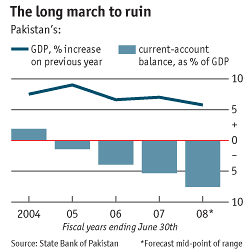
Pakistan’s economic growth will slow down from between 6 to 7 percent to between 4 to 5 percent.  To achieve a growth rate between 4 to 5 percent in times of a global recession is no mean achievement and it reaffirms the point made earlier.  Similarly, the State Bank’s decision to increase money supply by cutting in interest rates and cash reserve requirement indicates that the policy makers tend to agree that Pakistan’s current crisis is not demand pull (since the economy is slowing down) but is cost push due to external factors.  The immediate and possibly temporary reaction to State Bank’s decision was the appreciation of the Pakistani rupee which has generally been seen as welcome. Pakistani rupee will stabilize as the situation globally favors the developing world.

Ultimately the real solution for our economic woes, to use the hackneyed phrase, lies in increased foreign direct investment.   Since 2001, Pakistan had received only up to US$ 64 billion inflows, which is – no matter what people say- a pittance compared to our potential.  As an English-speaking nation of 165 million industrious and talented people, Pakistan presents an excellent opportunity for any foreign investor but for three major drawbacks.

One, we assume and project the same assumption on to foreign investors that that investments in Pakistan and India are mutually exclusive and since we view everything in comparison to our giant neighbor, we tend to underestimate ourselves increasingly so in the last decade and a half. Second, and more conclusively it is terrorism that has dulled Pakistan’s foreign investment in every sector including sport and tourism. In 2004-2005, Pakistan was an exciting tourist destination with Basant festivals, Polo matches and Cricket.  Today foreign sports teams are very rightfully apprehensive of visiting the country and almost every Western embassy has a travel advisory out. The Marriot bombing has all but completely brought not just international but domestic commercial activity to a halt.  And finally, it is the infrastructure.  For all of the last government’s purported achievements in the economic sphere, their inability to create power solutions for an annual demand for electricity growing at 7-10 percent.

How does one do it though is a tricky one. The first two are political issues. India’s existence as a bigger nation in our neighborhood need not be a threat to us. Indeed if Pakistan were to play its unique role as a neighbor of one emerging global economy like India, while courting Asia’s foremost power house China and manage to keep its ties with the US as its Major Non-Nato Ally at the same time, it is highly probable that under a democratic regime, Pakistan can manage to create a trillion dollar economy in two decades or less.

But this means a solutions or management of all existing disputes but most importantly the water crisis.  The most crucial issue however will be what role Pakistan plays in the Iran-US. Instead of waiting for the time where US gives Pakistan an option similar to the one it was given in 2001, Pakistan should play a pro-active role in bringing Iran and the US together by playing exactly the kind of role it played in the 1972 between China and the US. It would not be out of place to attempt once again to revive the long dead Regional Cooperation Development organization or the RCD between Turkey, Iran and Pakistan which would guarantee greater regional stability and economic options for Pakistan. Winning the war on terror is going to be essential but the war itself ought to be fought on several fronts one of which has to be economic.

The fall out of the war on terror has been economic and our allies should compensate us for our losses. But perhaps the most important thing any of our allies can help us with is in the power sector. Ideally the US should have boosted us by providing us the same kind of civil nuclear deal that it has offered India but much of that is impossible at present because of the history of nuclear proliferation and now that Dr. A Q Khan has rescinded on his earlier confession.  We still might get a nuclear deal from China. This is not all though.

Pakistan must make dams and make them quick. If Kalabagh is out of the question, then alternatives must be looked at and a quick decision taken on. Similarly the Iran-Pakistan pipeline is also essential and if India joins in, this pipeline might just be a pipeline of peace and prosperity in the region. All in all, if this democratic government was to play its cards right, it could raise up to another US$ 30-40 Billion in direct investment over the next 3 to 5 years and that would be more than enough to sustain and develop it.

The late US President Richard Nixon, one of the 20th century’s greatest statesmen, wrote in 1991 that Pakistan as a democracy, an important “modernist” Muslim state and a US ally was one of the most important countries in Asia, close relations with which were imperative for US’ own interests in Asia and the greater Islamic world. Unfortunately the policy makers in the US in the 1990s did not listen to him.  Now more than ever it is clear that our allies need us more than we need them – it is this essential premise on which we should deal with the world with our head held high.

Indeed if nations were judged by how hard they were hit and still managed to move on, Pakistan has given a good account of itself going from one crisis to another in quick succession.  But nation states, as with individuals, are judged not by how many crises it takes to bring them down but how far they travel on the road to progress and towards their stated aims and objectives. Without getting into ideological pretensions, the consensus that all major players in Pakistan’s politics have is that Pakistan ought to be: an economically viable state run by constitutional democratic means which was the original aspiration of the people of this country.

Our rulers have bungled up opportunities and have let the people down far too many times in the past. It is time for the current democratically elected government to take a long hard look at the situation and refrain from mock tough rhetoric that does no one any good.

Pakistan must seize the moment and take this as an opportunity to catch up.

Related Posts with Thumbnails

73 comments posted

Comment Pages: « 10 [9] 8 7 6 5 4 3 2 1 »

  1. January 14th, 2009 7:04 pm

    Patriotism of Pakistanis could be tested any where in the world by asking them to help their country in rainy days but what about super class of people (richest fuedals, industrialists, drug lords and above all the politicians who successfully run the highly profitable business of politics in the Pakistan. An estimated rate of profit in Pakistani politics is 1000 to million per cent, details can be calculated by politicians increasing wealth. Majority of Pakistanis living abroad are labor class and highly skilled professional. No body give them money for nothing. They have to work hard for it. Some of them are businessmen who also work very hard to earn their fortune. There is no favor or nepotism in open markets of the world. After all these hard work, they should give money to the country because few people of super class have taken country wealth abroad. I have lived and worked in Middle East and visited Europe and now living in USA for last 10 years, I found average Pakistan more patriotic that upper class of the country. We are ready to come forward again and will help/ invest in the country but this upper class should be stopped to taking national wealth abroad and participate accordingly in saving and investing in the country. At present two richest group of politician in power, they should provide the biggest share instead of going for begging to the rich nations. The richest nations are not rich by begging but by hard work. The upper class should go and observe how hard Chinese are working, come to USA and observe how people work and live here.The government of Pakistan should imediatly issue foreign currency investment bond offering good rate of return still better than IMF and world Bank, We Pakistanis abroad will buy with our savings and is a great help. The bonds should be gaureneted by international authorities The editor of Pakistan Times is a talented lady who invite us to write these comments. Her services are highly appreciated by Pakistanis living abroad. Pray for the country where majority population is helpless in front of few exploiters of supper class of rich politicians and defense forces have no choice but to defend them in the system. All the best. KHWAJA AFTAB ALI, Advocate & I.P. Attorney

  2. Watan Aziz says:
    November 15th, 2008 8:09 pm

    @Jusathot

    Your response forced me to dust off “The Muqaddimah”. It had been long and I wanted to go back to the context of ibnKhaldun. And hence an apology; I had misquoted him. The correct quote is, “It should be known that at the beginning of a dynasty, taxation yields a large revenue from small assessments. At the end of the dynasty, taxation yields a small revenue from large assessments.” (pg 230)

    ibnKhaldun is considered the forerunner of several social scientific disciplines: demography, cultural history, historiography, the philosophy of history, sociology and modern economics. (Source:Wiki). Before there was Adam Smith and Keynes, there was ibnKhaldun. Before there was Toynbee, there was ibnKhaldun. He discusses the civilizations, their rise and fall. And his focus was not limited to Islamic world but the cause and effect of actions of groups, dynasties and civilizations. His books covered what was up to then the known history of the world.

    The context of the quote was certainly in reference to Muslims but in context of each dynasty’s own comings and goings. And you can certainly transpose this across all civilizations and you will agree that principle is valid and applicable.

    Ronald Reagan, as president, pursued this idea of tax rate reduction to a level of religion. He first quoted it ibnKhaldun in his first press conference on Oct 1, 1981 and then later many times more. The last quote from him that I found was in NY Times on Feb 18, 1993 directed towards the then incoming president Clinton.

    Reaganomics’s wonder-boys were Kemp, Laffer (of Laffer curve, the credit of which he gives to ibnKhaldun) and Waniski. The longest expansion of prosperity was heralded by Reagan’s tax rate cuts. Not that these tax rate cuts actually increased revenues, but they created a perception of prosperity which in turn created the expansion of the GDP. This growth in the GDP is what brought truckloads of increased revenues. Kennedy and Coolidge tax rate cuts also triggered an expansion that increased the GDP and hence the tax revenues.

    That said, the spending under Reagan went out of control and thus the deficits. That was his single biggest disappointment by his own admission.

    Which brings us back to Pakistan.

    As much as economists would like to think that economics is a science, it is really an art in the hand of a master craftsman. While economic activity is quantified, the policy in reality is a matter of perception. When people trust that the state is just, the revenues and revenue base will increase. When the state is unjust, as is the case, Sunnis will claim to belong to fiqa Jafferia to avoid zakat tax going to government coffers.

    Government in Pakistan and those who propose more taxes should reconsider how much to milk this cow. People are patient, but they too have a limit. Each successive “corr’ept” government has brought the people to present unbearable suffering.

    Reversal of this is the only way.

    Taming the inflation to under 6%, increasing the public expenditures in productive resources, reducing the income and sales tax rates, reducing the governing expenditures, expanding the revenue base and above all, providing speedy justice is the only way left.

    The choices are simple and limited.

    Pakistan Zindabad
    Pakistan Paindabad

  3. Jusathot says:
    November 15th, 2008 10:41 am

    My dear compatriot, ending the thread with the insight from the legendary scholar Ibn Khaldun was most appropriate. One final comment on this as I can’t resist adding to what Ibn Khaldun said (“In the beginning of the empire, the taxes were low and the revenues were high.”) – comparing it with tax revenues of conquest days. In other words, in this case: increase in revenues was from conquests and business prosperity. As such during its zenith days, the Empire tax assessments on the subjects were low, which created the vitality and desire to do more and be enterprising. When they started the route of excesses in their lifestyles and behaviors – the gravy train also stopped as their Empire started to crumble (“In the end of the empire, the taxes were high and the revenues were low.”)

    The moral of this quote and the logic is the same: When you give tax-breaks to the captor (or the “rich” or the “holy-cow” in our case) and shift to the path of excesses than the only way to increase revenue (when the gravy-train derail) is to increase taxes on those possessing less – eventually the taxes will weigh heavily on the subjects and overburden them. He also said “expropriation is self-defeating for any government because it is a form of oppression, and oppression ruins society.”
    May Allah Bless & Protect Pakistan!

  4. Watan Aziz says:
    November 14th, 2008 5:17 pm

    “In the beginning of the empire, the taxes were low and the revenues were high. In the end of the empire, the taxes were high and the revenues were low.”

    This statement was the core principle of the conservative revolution that heralded the prosperity for one of the longest runs in the modern history.

    You will be surprised on who said it, when and where he famously uttered these words and whom from the history he was quoting. (I will leave this off so that those who are really interested will look it up on their own.) {As a footnote to this, those who would want to detract from the strength of this statement due to current economic conditions; we have to have another conversation; and it is long.}

    What has caught my attention is the sales tax (consumption tax) amount is almost the same as the Income tax. I did not expect this. Consumption tax unfairly taxes the salaried and the poor. It impacts them adversely as it is a larger component of their income. So, if the poor buys an electric fan, that may be his one week’s salary. Whereas a rich may be for an hours worth of work (that someone else toiled for him anyway). Thus the sales tax the poor paid is much larger portion of his income.

    This reconfirms that the poor are carrying the country on their backs. The rich are not only riding the poor, they are actually getting richer.

    And for now, never mind the income tax and it’s arrangements of collection or lack of collection.

    That brings us to customs tax. As it shows, it is a smaller portion of the total tax collection and is also out of line considering the exchange rate of Rupee. The goods are purchased in Dollars values and the rate of tax is computed on Dollar amount but collected in Rupee amounts. Consider a car; it’s purchase is in Dollar amounts, it’s collection rate is high and is computed in Rupee value. Thus even a smaller portion of the imports would be a huge item for the taxes if collected properly.

    Thus, with customs tax not in line and the income tax not in line leaves the country running on fumes out of the salaried and the poor.

    IMHO, there is nothing wrong in borrowing money from IMF or WB. It is however, the **use** of the money that is the problem. And here, not a word needs to be said; we all know what really happens.

    Finally, add the inflation tax, the sales tax and the salaried person’s income tax; do we really need a “weekend tax”? How for the love of Pakistan, can you say that the inflation is only 30% for certain items and it will come down to 15% and all will be well? Just because the rate changed (if changed at all); did the resulting inflation disappear in thin air? Are we smoking and inhaling too?

    I have a new word that I want to start using; “Corr’ept”. It means, we do not know if you are corrupt or inept; we know you hurt just as well. (I suppose this word can be used in 100+ countries.)

    How do we save ourselves from the Corr’ept? Well, that is another topic.

    I salute the salaried and the poor of Pakistan. You are indeed amazing folks; making the rich, richer!

    Pakistan Zindabad
    Pakistan Paindabad

  5. Jusathot says:
    November 14th, 2008 1:15 pm

    @ Watan Aziz
    So long as our successive corrupt and incompetent ruler take the easy route of borrowing a.k.a begging – they will never go through the harkwork process of stabilization of our economy.

    Our tax base is very narrow as a percent of GDP since only a little over one million pay taxes. Our tax/GDP ratio has been stuck at 14%. Furthermore, agriculture sector and certain capital gains are considered ‘holy cows’. On the expenditure side, the outlays for debt-servicing, heavy defense take and extravagance expenditures on pet projects take a good portion of the pie. And if that wasn’t enough a good potion of the borrowed money is siphoned off at different levels of our Establishment. The better understanding of the nature and state of taxation is to look at the big picture alongwith as a percent of GDP

    Successive government takes the easy route of financing the deficit by borrowing – both from internal banks and IMF/World Bank and other aid agencies. Outfits like IMF/World Bank put a lot of demands like increase of taxes, etc and the vicious cycle continues every decade or so. Until and unless we may our own adjustment plan – we will only increase the constituency of Edhi Welfare – more folks will join the category of those below poverty line!
    PS: Thanks to you and Adil sb. for allowing so much band width for my two cents.

  6. Watan Aziz says:
    November 14th, 2008 9:14 am

    @Jusathot

    Here are the numbers form the 2008 budget:

    Income Tax: Rs.477,000M
    Sales Tax: Rs 472,000M
    Customs: Rs. 170,000M

    Could you comment on state and the nature of taxation?

    Thanks

  7. Jusathot says:
    November 13th, 2008 10:18 am

    @ Watan Aziz
    Nothing new or surprising here – albeit dumbfounding!

    That’s what we have been talking about - such methods only reward the perpetrators of this debt crime (while they shift their looted funds in the banks of IMF-donor countries) without alleviating the suffering of the working people. What the hell IMF and our bigwigs care about how the real Pakistan lives? Who ends up paying for all the corruption and incompetence by our opportunistic ruling class? The little guy - and they just casually push the problem of default onto him.

    Undoubtedly, improving the methods of collection of taxes and taxing the so-called “holy-cows” would boost revenues. But that’s not the way it’s done.

    All I can say, my friend – eat biscuits (even if it may taste like dog-biscuits, it is exempted from tax) and avoid chewing-gums and buying electric fan (tax/duty increased).

  8. Watan Aziz says:
    November 13th, 2008 4:28 am

    @Jusathot

    I am rendered mute, deaf and dumb. Help me!

    To those who come up with ideas of weekend taxation; please take a long R&R leave and forgive the Pakistanis from your “amazing ideas”. At 30% inflation rate, Pakistanis are being catapulted (being driven is too slow) into poverty.

    The taxation of inflation combined with direct and indirect taxation has left the salaried person naked; the poor, poorer (as if that was a state that needed a new bottom).

    I like to add a lot but I am afraid it will only be profanity. (I have marked the Exhibit numbers so that one day these brain dead people can receive medical treatment.)

    Exhibit 1

    The rate of sales tax has been increased from 15% to 16% to meet revenue requirements.

    As general rate of sales tax is being enhanced from 15% to 16%. Therefore, the same rate should be applied on the goods and services subject to FED in sales tax mode.

    To generate additional revenue for meeting dire national needs, rate of FED on telecommunication services is being enhanced to 21%.

    To generate revenue from well to do people, FED @ 5% has been levied on import as well as locally manufactured cars having engine capacity exceeding 850cc.

    In order to bring the remaining telecommunication services in the tax net, all telecommunication services has been being subjected to FED except those which are already exempt.

    Due to revenue crunch, rate of sales tax and FED has been increased from 15% to 16%. As sales tax on Provincial services is charged under the Sales Tax Act, 1990. Therefore, all provinces have been requested to increase the rate of sales tax on Provincial services from 15% to 16%.

    Exhibit 2

    Cement is subject to federal excise duty @ Rs. 750/- per tonne since July, 2003. Being a fixed rate, it does not indexes inflation. It has been enhanced to Rs. 900/- per tonne.

    In order to keep the rate of default surcharge higher than the interest rates of banks to avoid short-filing by the taxpayers, it has been enhanced from 1% to 1.5% per month.

    Exhibit 3

    In order to meet the revenue requirements and to keep this levy in line with the rates prevalent in the neighboring countries, the rate of FED on these services has been increased from 5% to 10%.

    The above is from http://www.fbr.gov.pk/budget2008-09/sf/cmp.pdf

Comment Pages: « 10 [9] 8 7 6 5 4 3 2 1 »


Have Your Say (Bol, magar piyar say)

Please respect the ATP Comment Policy.

Keep comments on topic; no personal attacks; don't submit indecent, inflammatory, slanderous, uncivil or irrelevant comments; flamers and trolls are not welcome; inappropriate comments will be removed or edited.

If you won't say it to someone's face, then don't say it here!

Readers who want to use a URL should please use the TINY URL program.

Thanks, and keep the comments coming!