Adil Najam
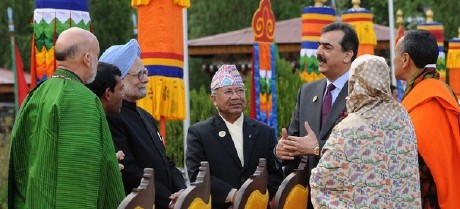
Let me confess that the real reason for the post is this photograph above. It shows the leaders of the South Asian Association for Regional Cooperation (SAARC) leaders in an informal moment of exchange at the 2010 SAARC Summit (L to R): Hamid Karzai of Afghanistan, Mohamed Nasheed of Maldives, Manmohan Singh of India, Madhav Kumar Nepal of Nepal, Syed Yousuf Raza Gilani of Pakistan, Sheikh Hasina of Bangladesh and Jigme Yoser Thinley of Bhutan.
I just love the picture: the colors, the composition, the symbolism. Maybe it will turn out that all of the above are exaggerated. So be it. Sometimes you want to hope.
And speaking of hope, I just published a short op-ed (co-authored with Moeed Yusuf) that reports on the deeper academic research paper we had written in Third World Quarterly which analyzes all the proposals made on the resolution of the Kashmir dispute between India and Pakistan. This is not different from facts that we keep finding out about how close India and Pakistan were to at least a partial resolution, how recently. As in the original paper, and as I have noted here before, we also note in the op-ed in The News that “Windows of opportunity, by definition, are temporary. Unutilized ripeness can turn into staleness and, ultimately, stalemate”:
… the events surrounding the Kashmir dispute have been transpiring – for some time – in a manner that makes the situation ‘ripe’ for resolution. Ripeness increases the potential for conflict resolution and occurs when the subjective perceptions of all parties converge to create a window of opportunity; the latter represents moments in policymaking processes during which breaking the stalemate becomes possible. Ripeness does not guarantee resolution, but it does mean that there is an opportunity and the potential for possible headway.
…Having analyzed nearly 50 proposals recommended throughout the dispute’s history, the research has highlighted an emerging trend in opinion among policy experts. We find that the zone of convergence has increased significantly since the 1990s. Perhaps the most consequential dimension of convergence is the emerging trend on the issue of autonomy as the central pillar of any final resolution. Since the onset of the insurgency in Indian Kashmir in 1989, granting autonomy to all or part of the state has by far been the most recurrent theme in the proposed solutions. This reflects the realization that the current context does not allow either India or Pakistan to dominate Kashmir through a tightly monitored, centralized formulation.
…The general findings highlighted in this article are only to stress that although the issue may be ‘ripe’ today, it will not remain ripe forever. Like other windows of opportunity that have existed in the past, this too will have an expiry date. The key challenge is to move quickly from the broad consensus around autonomy towards specifics about the nature of autonomy, means of actual implementation, defining the precise roles of India, Pakistan, and Kashmiri authorities in an autonomous Kashmir, and mechanisms for future dispute resolution.
…Ultimately, ripeness can only be translated into resolution if the political leadership on both sides can muster the political will required to conceive and implement an agreement on the basis of the latent zone of convergence. Our research finding is that the zone of possible agreement clearly exists and is evident to all sides. Whether the political leadership on the two sides has the political will to capitalize on this ripeness remains to be seen.
The idealist in me would like to believe that the picture above is cause of hope. But there is also a part of me that is realist enough to realize that history is not judged by photo-ops, but by the real actions that those photo-ops signify.
It is good – very good – that the leaders of India and Pakistan are talking. The next step, of course, is to turn talk into action.




Since there has been no “annoyance” from our Army regarding the so called talks..
… so we should abandon all hope..
Its only when our Army feels threatened of peace between the two nations, that we can hope something REAL is happening..
What impressed me most is that Gillani is speaking and others including Manmohan Singh are listening.
1. Javed Naqvi who is Dawn.com’s India-based journalist asserts that Indians and Pakistanis are not ‘intelligent’ enough to make peace possible. Perhaps, but I also think the territorial disputes between India and Pakistan has yet (thankfully!) to force them to the disastrous wars similar to the Europeans of the 20th century.
2. It looks Pakistan has moved far away from its insistence on the UN Resolutions regarding Kashmir, starting with Musharraf. Similarly, Manmohan Singh has also publicly called for making the borders ‘irrelevant’. Perhaps something like the Andorra solution is going to be found?
3) Are the supposed ‘peace-dividends’ really that great for the whole South Asia should India and Pakistan bury the hatchet? I would like to think they are?
4) Water is emerging as the bigger concerns for Pakistan–more than the territorial claims or ideological associations with Kashmiris. If that water is indeed the dispute of the highest concern then lets discuss it objectively–it will perhaps help in reducing some of the ‘heat’ which inevitably creeps in when ‘religion’ becomes the major topic.
http://www.dawn.com/2002/01/06/top1.htm
You will find another colourful picture of 2002 SAARC meeting when Musharraf offered sustained talks and had a very warm Handshake with Vajpayee the then Indian Prime Minister. Does any body remember what happened after?
AHsn, Strasbourg
Adil with all due respect, your thesis is a lop-sided triumph of hope over reason and experience.
Symbolism is good. But what the Indian leader should have been saying to the Pakistani representation is “Take me to your Leaders” …