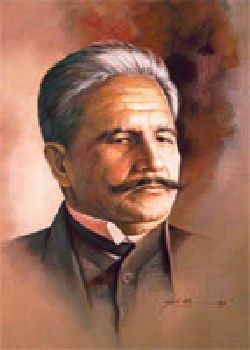
 Adil Najam
To me, the 23rd of March is a day to reflect on the message of Mohammad Iqbal, just like the 14th of August is to ponder on the legacy of Mohammad Ali Jinnah.
We, as Pakistanis, have not really been kind to the legacy of either man. We turned both into idols. And once we convinced ourselves that these were ‘supermen’ we conveniently absolved ourselves of the responsibility to learn from – let alone emulate – either. We are fond of celebrating but incapable of incorporating either the actions of Mr. Jinnah nor the thoughts of Mohammad Iqbal.
After all, once we turned Mr. Jinnah into the ‘Quaid-i-Azam’ and conferred near-divine status on him it became all too easy to say that we, mere mortals, could not be expected to act in the way – or even on the principles – that he did. His blemishes were to be denied, not just because we hold him in reverence but also because to acknowledge them is to accept that maybe ordinary – even flawed – human beings can stil have principles worth following. We have done the same to Iqbal. Because his the ‘the’ Allama, he is to be put on a pedestal. His work read with respect and honor; to be savored, but not really to be understood. Certainly not to be questioned, and absolutely not to be allowed to influence that we do. After all, he is an Allama; and we are not.
The Allama-ization of Iqbal, just like the Quaid-i-Azam-ization of Jinnah has been a disservice to both. For ultimately it has turned these two giants into mere statues; the iconography of the ‘Allama’ and the ‘Quaid’ have enabled us to turn them into dieties of reverence while at the same time distancing ourselves – if not outright disowning – the thought of the first and the actions of the later.
We at ATP have been rather remiss in not paying enough tribute to Mohammad Iqbal. This is a mistake I have been wanting to rectify. Today, the eve of Pakistan Day is a good time to begin doing so. The events and the idea behind the 23rd of March owes more to Iqbal than anyone else. And as a first offering of tribute to Iqbal I offer you this wonderful video. I found it on YouTube:
I do not really know who produced it although for some reason the voice sounds familiar. The selection of poetry as well as the pictures are excellent. Indeed, I wou urge you to focus on both. The pictures are not the ones you usually see of him and many of them evoke a humanness that is lost in many of our ‘official’ portraits on the man. But also focus on the ideas. This is a work less known that, say, Shikwa and Jawab i Shikwa, but it has ideas that are so contemporary that he may as well have been talking about the events of last week. For example:
anpay watan meiN houN kay ghareeb-ud-diyar houN
Darta houN daikh daikh kay iss dasht-o-dar ko meiN




Thank you Adil for such a nice column on Iqbal. I agree with the argument that instead of understanding the personality, struggle, philosophy and peotry of Iqbal, we (Pakistanis, his people) made him larger than life figure and ended up in idol worshiping. Iqbal(1877-1938), was a poet-philosopher with a universal message to “lay the foundation of a new world by wedding intellect with love.” But inspite of his abiding universal outlook and his compelling international concern, he was intensly preoccupied with the future of his own people and with the spirit of his own times. We worship his poetry but international world celebrate him (more) as philosopher. He was educated at the Universities of Punjab, Cambridge and Munich and became a symbol of what was best in the East and West. Do we know that his Ph.D degree was in PHILOSOPHY and his doctoral dissertation was titled “Development of Metaphysics in Persia”, which opened new doors in philosophical sciences. These doors took western philosophers to eastern/muslim phiosophies? His philosophical research articles were published in his famous book titled “Reconstruction of Religious Thought in Islam”. To me, these philosophical writings are more powerful than his peotry!!! This is the reason that he is still being taught as a subject in University of Heidelberg, Munich, Homboldt Berlin, Tehran, Cambridge, Oxford, Penn State, Michigan, Utrech, Istambul and many more- all these universities teach IQBALIAT.
Dear Critic
Please do not disrespect Ghalib by calling him a drunk. Maybe he was, but he was a great philosopher in his own right and I certainly do not need to go into details about his contributions to Urdu poetry. Even Iqbal took a great deal of inspiration from Ghalib and admired him in the utmost esteem. Sad to see the only thing you mentioned about Ghalib was his drinking and getting paid for writing poetry. Feel free to read him.
“We are very fortunate that we have solid, hisortically proveable facts spanning last 1400 centuries”.
hmmmmm…1400 centuries ! But to be fair, all “provable” history is replete with inaccuracies such as these. So, I’ll give it a pass.
…And by Gujrat I mean Indian Gujrat.
Iqbal with his farsighted vision and Quaid with his high moral principles and strength were giants among men.
Unfortunately after their death we haven’t produced any one (except may be Mr Edhi) who even came close to their greatness.
And please don’t compare Ghalib with Iqbal. Ghalib was a drunk who used to make money by writing for nawabs and and the sort where as Iqbal’s poetry has inspired three generations towards philosophy and religion. Iqbal’s poetry really lights up the soul. Specially his following verse.
Taqdeer ke paband hain nabataat-o-jamadaat.
Momin faqat Ihkam-e-Ilahi ka he paband.
As for creation of Pakistan, It was the best thing that could have happened to us. Although we haven’t valued our country and protected our freedom (i.e. of speech, religion, financial independence etc) the way we should have yet the fact remains that have we been still part of India we would have been living a life of animals. A case in point is the plight of muslims in Gujrat.