Adil Najam
I am most pleasantly surprised that readers have so quickly figured out the mystery man in our latest ATP Quiz. Since they have, let me add a little more information and let the discussion continue.
I am not sure, however, how many readers know of Muhammad Asad or of his connection to Pakistan. Let me confess that until fairly recently I did not; at least not of the Pakistan connection. As I have gotten to know more about this connection, I have gotten more and more intrigued – all the more so because there is relatively little in his own writings or that of others about this.
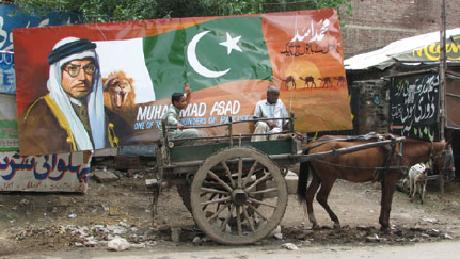
But lets start from the beginning.

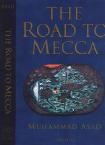 Asad was born in 1900 as Leopold Weiss to Jewish parents in Lvov (then part of the Habsburg Empire, now in Ukraine). He moved to Berlin in 1920 to become a journalist and traveled to Palestine in 1922. It was there that he first came into contact with Arabs and Muslims and began a long journey into Muslim lands and minds that eventually led to his embracing Islam in 1926. His bestselling autobiography Road to Mecca (published 1954) recounts these years in vivid and captivating detail., including his adventures in Arabia and in working with King Ibn Saud and the Grand Sanusi, amongst others.
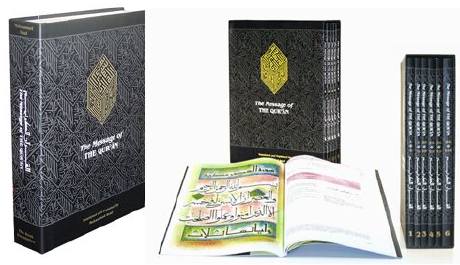
Later in his life, after retiring in Spain, he spent 17 years working on an English translation of the Quran which was first published in 1980. Many consider this to be one of the finest English translation of the Quran – some argue this is because he himself was fluent in bedouin Arabic which is closest to the Arabic in the Quran, others suggest that since he was himself a European and wrote in more understandable idiomatic English his translation is most accessible to non-Arabic speakers.
As a lay-reader who ver the years has read a number of English translations, including his, I do find Asad’s translation – The Message of the Quran – to be easier to read than those by Abdullah Yusuf Ali or Marmaduke Pickthall which are amore formal and literal translations. Unlike the translations by Prof. Ahmed Ali (my particular favorite) and by Thomas Cleary which are also in contemporary idiom and very readable, the Mohammad Asad translation has the added virtue of also having commentary and explanations, and the new edition is wonderfully presented, printed in the highest quality, and with tasteful calligraphy. All in all, Mohammad Asad’s The Message of the Quran is the translation that I now recommend to friends, Muslims as well as non-Muslims.
But I digress. Much as I like Muhammad Asad’s translation of the Quran and especially in its new printing, that is not the subject of this post. The subject of the post is his ‘Pakistani connection’ and also why we do not find much about that connection in his writings. Here is what we know.
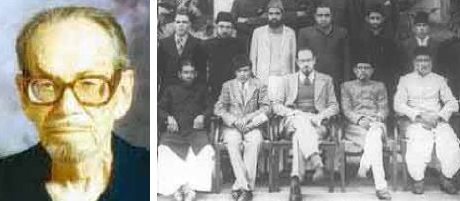
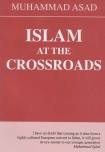
By the early 1930s Asad had gotten rather disenchanted by King Ibn Saud and his religious advisors (see Road to Mecca) and had begun travelling Eastwards into other Muslim lands. This brought him to British India and there he met and became a good friend of Dr. Mohammad Iqbal. Indeed, Iqbal encouraged him to write his book Islam at the Crossroads (published 1934); whose cover has the following testimonial from Iqbal:
“I have no doubt that coming as it does from a highly cultured European convert to Islam, it will prove an eye-opener to our younger generation.” Muhammad Iqbal.
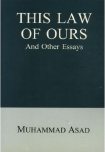
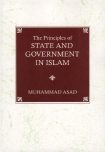

During World War II imprisoned him in a camp for enemy aliens (because of his Austrian nationality) while his father was interned by the Nazis because he was Jewish. After the War he fervently threw his all behind the demand for Pakistan. Upon the creation of Pakistan, he saw himself very much a ‘Pakistani’ as did those he worked with (reportedly even took to wearing the achkan). In 1947 he became the director of the Department of Islamic Reconstruction in West Pakistan and worked on a treatise with ideas for the Constitution of Pakistan. Many of these ideas (which were mostly related to creating a multi-party parliamentary democracy) were reproduced in his later books but he was not very successful in getting them implemented.
 In 1949 Asad joined the Pakistan Foreign Ministry as head of the Middle East Division and eventually in 1952 came to New York as Pakistan’s representative to the United Nations. Here he met the woman who would become the last of his wifes (Pola Hamida). Whether it was the fact that he married her and divorced his earlier wife or the messiness of Pakistani politics, it was in this period that he fell out with the powers in Pakistan and resigned from the Foreign Ministry. He decided to stay on in New York to write Road to Mecca, which became a major success. He never really returned to Pakistan (although, supposedly, Gen. Zia ul Haq tried to get him back) and died in Europe in 1992.
It was his estrangement with the Pakistan government that pushed him back into writing and produced two amazing works – Road to Mecca and The Message of the Quran. However, here once again is a story of one who wished to give his all to Pakistan and we did not let him.




I also find his translation of the Quran to be wonderful and have a copy. It is beutifully produced, easy to understadn and teh commentaries are extremely helpful.
I love the dedication at the beginning : “FOR PEOPLE WHO THINK.”
Thank you Adil for introducing or rather reintroducing the late Muhammad Asad. I knew the existence of his books (mostly at the Internet) but not of his Pakistani connection. And also ‘PatExpat’ thank you for the link to his sixty years old essay: “What do we mean by Pakistan”. It is clear from this essay that Asad belonged to the group that desired Pakistan to be a theological or at least “Islamic-ideological” state. Seeing his personal journey from Europe to Middle East to Pakistan, and from Judaism to Islam, his pan-Islamic views are not surprising. The Urdu translation of the heading of his essay would be the most familiar slogan: “Pakistan Ka Matlab Kia. La Ilaha Ill’Allah”. The tussle between ideology of ‘theological or semi-theological Pakistan’ on one hand, and ‘secular or semi-secular Pakistan’ on the other is alive and well even today. I am sure this post is going to generate a lively debate on this subject here at ATP. One only hopes that this debate will not degenerate into personal attacks and will not drag in non-relevant topics. We only hope.
Patexpat,
The point – I think- was not an agreement with Asad’s ideas per se… but simply that here was a famous man forgotten.
One can disagree but the point is to give it its historical due. Muhammad Asad is a famous Islamic scholar who associated himself with Pakistan. That should suffice as a reason for him to be mentioned here.
As you can imagine, I disagree with almost all of what Asad has to say about Pakistan and its genesis. Pakistan’s creation was borne out of cultural nationalism and the masses responded to the call of Muslim identity, history and culture. Had the language that Asad employs been used, Pakistan would have never have come into being because the Muslim masses, though united in their Muslim national identity, were deeply divided when it came to doctrinal and theological issues.
Jinnah was- in my view- quite clear on this issue. For example he held Turkey to be the greatest example of a Modern Muslim Country and held Kemal Ataturk to be the greatest Muslim of the modern age…
Jinnah declared:
“He (Kemal Ataturk) was the greatest Musalman in the modern Islamic world and I am sure that the entire Musalman world will deeply mourn his passing away. It is impossible to express adequately in a press interview one,s appreciation of his remarkable and varied services, as the builder and the maker of Modern Turkey and an example to the rest of the world, especially to the Musalmans States in the Middle East. The remarkable way in which he rescused and built up his people against all odds has no parallel in the history of the world. He must have derived the greatest sense of satisfaction that he fully accomplished his mission during his lifetime and left his people and his country consolidated, united and a powerful nation. In him, not only the Musalmans but the whole world has lost one the greatest men that ever lived.“
(Quaid-e-Azam and the Islamic World, Rizwan Ahmed, Published 1981 on the occasion of OIC Foreign Ministers’ conference in Karachi)
This is in complete contradiction to the ideology that Asad propounds… Asad- for his own reasons- holds Turkey to be an “unIslamic” government. So there is considerable divergence in the interpretation of the words “Muslim”, “Islam” and “Pakistan” between those who actually were part of the Pakistan Movement and ideologues like Asad.
Cultural Nationalisms based on religio-cultural identity often tend to have this dichotomy … Zionism and the creation of Israel is a clear example… where secular and even atheist Jews were in the forefront of the creation of Israel (i.e. Ben Gureon etc) while religious Jews were opposed to it. I think Asad might have been conscious of the similarities that may emerge between the two states.
Seems like Pakistanis have a habit of abandoning the people of logic and reason and Mr. Mohammad Asad is one more in the list.
Adil,
Being familiar with ATP’s policy, I am not sure whether Muhammad Asad would fall under the personalities you would like to cover.
I believe you are not familiar with his view apart from his translation. Here is his article ‘What do we mean by Pakistan’ which he wrote in Feb 1947
http://YesPakistan.com/people/pakistan_asad.asp
which is as profound today as it was at that time.