Pervaiz Munir Alvi
Muslims first arrived in areas now constituting southern half of Pakistan – mostly Sindh and Balochistan in Eighth century A.D. when ships of Arab general Mohammad bin Qasim landed somewhere near the mouth of the Indus river and then traveled upriver all the way to the important city of Multan in lower Punjab. Thus bringing most of the commerce routes from the Indus valley to Mesopotamia through Balochistan and Persia under their control.
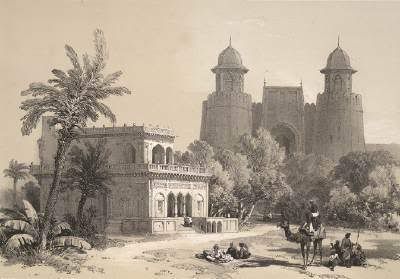
The areas now constituting northern half of Pakistan – Punjab, Kashmir and Frontier did not come under the Muslim control till the beginning of the eleventh century when the armies of Sultan Mahmood of Gazna, present day Afghanistan, came down through the mountain passes demolishing temples and the statuary within, unfortunate enough to be in their way. The newcomers, along with a new religion, also introduced new forms of visual arts and architecture to this land and its people.
Mosques were built, forts and palaces were erected, mausoleums and garden cemeteries were created where no such structures existed before. The old temples and ashrams, stupas and monasteries ultimately became the relics of history. So significant was the introduction, and later on the proliferation, of this new art form that in historical terms the architecture of the areas now constituting Pakistan could be designated to two distinct periods— the earlier as pre-Islamic and the later as Islamic period.
By the middle of the eighteenth century Muslims lost control of the areas now constituting northern half of Pakistan to the Sikhs of Punjab. Even though they made architectural contributions of their own, the Sikh period also saw, not unlike their predecessors, destruction, stripping and neglect of the earlier buildings of the Islamic period. Particularly affected were the Muslim religious places such as the historical mosques and mausoleums.
The areas now constituting southern half of Pakistan fortunately remained under Muslim control long after the fall of the Mughals and therefore did not experience the similar fate. However invaders from Persia and Afghanistan routinely damaged the historically significant structures and looted whatever they could on their return trip home.
 The mid nineteen century saw the start of another short but architecturally significant period. By now the British had successfully taken over all the territories later to become Pakistan and set upon building new administrative institutions and infrastructures of their own. They were going to built collages, hospitals, post offices, museums, court houses, assembly halls, city halls, libraries, country clubs, parks, stadiums, cantonments and residential bungalows, railway stations and yes architecturally significant bridges and tunnels.
In one century of British rule hundred and hundreds of new significant public structures were commissioned throughout the country. This was a period of not only European and English architecture but also of unique hybrids created by fusing the elements of English with the local Islamic architecture. Most of these colonial buildings are still standing and in use in Pakistan. British also help restore and some times deface some of the old historical buildings. In balance British period is the most significant period for Architecture in Pakistan.
The year 1947 is the beginning of the post colonial Pakistan period. British had left behind a running administration and infrastructure for the new rulers of the new country. In the first decade very few new architecturally significant buildings were added in any sphere of the society. The first major architectural surge took place when the national capital was moved from the commercial port city of Karachi at the Arabian Sea to the newly designed modern city of Islamabad located at the foothill of picturesque Margala ridge.
 Almost all major buildings in the city were designed by the foreign firms with some local input. These designers have often tried to create modern functional structures with infusion of their perceived local styles and traditions. The result is another hybrid architecture which over the time will be known as Pakistan period. Other than Islamabad every major city in Pakistan has also added few new structures in the mix. These are mostly educational and administrative buildings, hospitals, commercials centers, hotels, mosques and national monuments. Lately new airport terminals and sea ports are also added too.
Outside Islamabad no new major library is built. Other than those left behind by the British there has been no new world class museum or art gallery built in the last six decades. There are no opera houses, night clubs, significant theater halls or palaces to host performance events. None of the new bridges over major rivers or canals have any architectural values to them. The country has no internationally renowned architects or architectural firms of its own and thus heavily depends on foreign based designers. It is possible that with time a distinct Pakistani Architecture, like French or Italian Architecture may evolve. But it might be by default and not by conscientious design.
(See an earlier ATP post on architectural neglect in Pakistan, here and here).
Pervaiz Munir Alvi is a Ravian and trained as a Civil and Geo-technical Engineer with a deep interest in buildings and architecture in Pakistan.




partially true adil..have a look at sethi mohallah here
http://www.geocities.com/scn_pk/sethi.html
At the rate peshawars historical places are being turned into plazas these pics might be the last lol
On another note, my understadning is (please check me if I am wrong) that the Sikh architectural influence is as strong, if not stronger, in the old parts of Peshawar.
Pervaiz Sahib, thank you for this insightful post. I do wonder, however, if your assessment in the last paragraph is a little too harsh. It seems to me that in recent years we have seen the beginnings of an authentically ‘Lahore school’ – characterized most visibly by the use of red brick and more gemetrical shapes (including a lot of tall and straight lines) but also focussing on the revival of some more traditional building features (the return of the ‘roshan daan’, use of clay and mud as insulation, appropriate window placement and sizes, etc.) It may be nascent but it seems that with some semi-monumental works (Alhamra and LUMS campus) already out there and a lot of architects (and home builders) gravitating towards this style we may be seeing the emergence of a ‘Lahore style’ that is increasingly apparent as you drive through certain parts of the city. A number of Pakistani architects (Nayyar Ali Dada, for example) do seem to have also begun establishing their own style and following. Kamil Khan Mumtaz, for example, seems to have also done much for the ‘return of the jharoka’, although the jury may still be out on the future of the Kharoka.
Pervaiz Sahib very nice topic. My favourite buildings from post colonial Pakistan period are:
PNSC, Habib Bank Plaza and FTC buildings in Karachi for their symmetry.
Aga Khan university campus in Karachi for its earth-quake proof architecture,
Serena Hotel and Baluchistan Assembly building in Quetta for blending local architecture into modern architecture.
Wapda House Lahore for modern architecture.
Supreme Court building in Islamabad for modern architecture
Alhamra Arts Center in Lahore for using bricks for outside architecture.
Ones that I don’t like are the National Assembly building as well as the presidency in Islamabad. They Look like lots of big rectangles on top of eachother.
I also do not like the MCB building in Karachi. It is currently the tallest building but is outright ugly. The top two floor are so unaesthetically unsymmetric. Looks like when a family adds an extra room on the roof without getting the map passed as the family size increases :)
Very nice topic. I have always wondered what the fascination is with all the ‘White Houses’ in Islamabad. Big pillars. Horizontal triangle at teh back. But sqeezed in a tiny space with no sense of proportion. A statement of ‘I am wallait pallat’ rather than of any aesthetic value.