Guest Post by Athar Osama,
The idea of Study Circles to promote ‘informed’ community participation in decision-making originated in Sweden in the 19th Century. Today, study circles are used around the world in a host of different settings ranging from collaborative ‘self-education’ devices to motivate learning and learning from each other, to a to means for working on complex community projects in a participative manner, to creating grass-roots awareness of and practice deliberative democracy.

The concept of Study Circles is not new to Pakistan, or its politics either. While we’re not among the most intellectual-minded of the nations, study circles have been used in religious and political contexts before. There are instances where political parties in Pakistan have used study circles to educate and evolve collective understanding of different issues among their workers.
Read Full Post
Owais Mughal
We first saw this photo at Metroblogging Lahore and found it very appealing to share it here:

This photo is of a banner seen at the gate of a factory on Multan Road, Lahore. The banner reads in English as:
“Less literate, illiterate and hardworking but dedicated boys are required urgently for work in the factory.”
Credits: >man!< at Metroblogging Lahore
Owais Mughal
Last month there have been several news items about the Lahore Rapid Mass Transit (LRMT) Rail project. We have tried to gather key information from many of these news items and will present it in the following as one concise post on the topic.
The proposed rail service is the main part of the Lahore Mass Transit System (LRMTS). Other components of this project include the now under construction Lahore Ring Road Project.
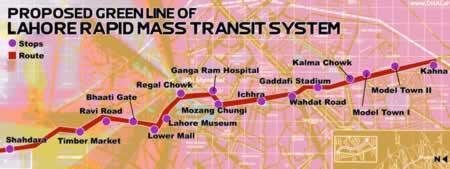
The Photo above shows the Route Map of LRMT Phase I – Green Line
The LRMT is a Two-phase, 97 kilometes long project. A Hong Kong based company called MVA Asia Consultancy was hired the government of Punjab as consultants to prepare the project feasibility. The study of MVA Asia Consultancy completed 5% of project design and proposed four Rail lines in the city to share the traffic burden. The proposed capacity of LRMT is going to be able to move 35000 passengers per hour in the city. Funding for the project will be provided by the Asian Development Bank (ADB).
Read Full Post