Adil Najam
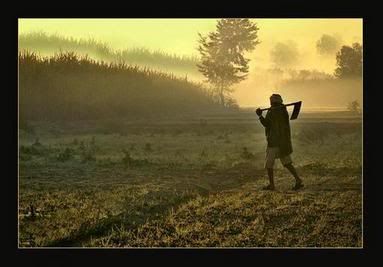
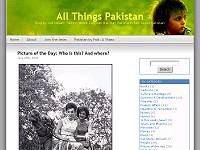
We are in the process of making some important changes here at ATP and I thought this picture captured very well the mood of these changes. A mood of accomplishment; and of possibly having sown some seeds that might just take root if the conditions are right.
Regular readers would remember that from the beginning the goal has been to turn ATP into a team-blog (here). When I first started the blog on June 11, I was not sure anyone would even come to visit. Today, just over two months (68 days) into the experiment, this is the 158th post and we have had over 60,000 visits. In many practical ways Guest Posters but even more so for the active discussion from all of you.
Now its time to take the next step.
Please welcome Bilal Zuberi and Owais Mughal who are joining me in the day-to-day management and editing of ATP.
Most of you are, of course, very familiar with both Bilal (on Naii, on Ishtiaq Ahmed and Inspector Jamshed, on Mueen Akhter, and on The Greeing of Pakistan) and Owais (on Goth Alla-Bino, on Chai, on Fountain Pens, and on Rickshaws) who have been been regular and frequent posters of ATP. They have already been very active on ATP and now kindly agreed to take on major responsibilities in its management. They will, I am confident, bring even greater variety and diversity to ATP.
We will, of course, continue to have Guest Posts from the wonderful bloggers who have been contributing in the past and, hopefully, from more new ones. I believe that these have been a central element of how ATP has developed and we want to continue on this path. I would like to thank all who have been contributing Guest Posters and also invite our readers to consider contributing Guest Posts (see here).
Unfortunately, none of the above means that I will disappear. Getting rid of me will not be that easy. I am having too much fun doing this to let go. While you will see a little less of me (as I actually start doing work for those who pay my salary), you will probably still see more than you want to; at least for a little while longer.
And, finally, about the photograph at the top of this post. Titled ‘The Farmer’ it is part of the portfolio of Razaq Vance. Razaq sahib is in the same profession as me – a teacher – but is immensely more talented and his photographs always leave me entirely mesmerized. I plan to do a proper feature on his photography soon, but along with Umair Ghani (where work we presented on ATP here and here), Razaq Vance captures the grandeur of life in rural Punjab like few others. Thank you Razaq Sahib.
[By the way, the second post I did with Umair’s photogrpahs – about the rural-urban divide in Pakistan – was one of my most favorite posts on ATP; both because of the topic and becasue of his photographs].
By Bilal Zuberi
All city dwellers know the problem of traffic jams well, but when it comes to Pakistan, these traffic jams take on a unique meaning. Imagine the traffic, from trucks, cars, rickshaws, motorcycles and bicycles to horse carriages and donkey carts, all jammed up back to back (sometimes neck to neck) and cursing the moment they decided to take that road.

Karachi sees traffic jams regularly and not too long ago I once again experienced being stuck in a highway parking lot on Sharah-e-Faisal, the main highway in the city. I was trying to rush to the airport but on that day a trip that usually takes under 20 minutes took me over 2 hours. Needless to say I missed my flight, but I also suffered spending over 2 hours in the high heat, humidity and soot & dust pollution on the road.
Read Full Post
Adil Najam
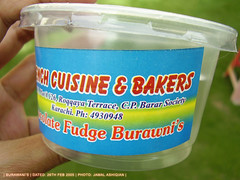
A couple of people have emailed to remind me that we have not had a post on Pinglish for a while. Maybe I got scared by sabizak’s reminder (here) that I should be more careful in my determination of what is or is not Pinglish. Must confess that I am still not sure what it is, even thought I offered a provisional definition of Pinglish (here); of course, this is very closely related to Hinglish. (More Pinglish posts here).
So, off I went in search of a better understanding of this thing I was calling Pinglish. What I found – hidden deep inside the crevasses of the Internet – was a delightful post on a forum called CyberMurid by someone going by the name bandali under the title ‘Pinglish, Urdish or Engdu.’ (Addition: Although I had originally found this material at the said website, we have since been informed that much of this material was part of an articel by Dr. Rauf Parikh in Dawn magazine, March 10, 2002.)
Here are the ‘techical essentials’:
A prominent feature of ‘Pinglish’ in the use of obsolete (in some cases even archaic) words and expressions. Local coinage is quite common. In some cases, this local coinage, though it may occasionally sound legitimate, would be incomprehensible or even hilarious to native ears. Sometimes, the local variety of the language sounds bookish (they ‘felicitate’, they don’t ‘congratulate’), too formal (‘do the needful’, for instance) or even ‘Un-English’. Many terms and phrases used in this part of the world are not part of the English language but have rather been ‘concocted’ and packed in a phrase-like expression. For example: pin-drop silence, cousin-brother, cutpiece and out of station (away from one’s home town). Grammatical liberties are quite interesting and pronunciation poles apart from what is known as RP (received pronunciation).
The writer goes on to give a hilarious list of examples. many of these are not ‘wrong,’ they are things that you will hear in Pakistan but those outside of our region may not understand them the way we do. Let me just share a few:
 ‘What is your good name’?
This may sound strange to the native ears since this is literal translation of ‘Ism-i-sharif’ in Urdu.
‘How is your good self?’
This also has a ring of Urdu. Perhaps ‘mizaj sharif’ translated.
Hotel:
It refers to an eatery as well as to any place meant for boarding and lodging. [ATP: Many of us still say ‘hotal meiN khana khana’ when we really mean restaurant].
Colony:
Forget colonialism and imperialism; in ‘Pinglish’ this refers to a large area comprising of residential blocks, for instance: Jinnah Colony, People’s Colony, Shah Faisal Colony, etc.
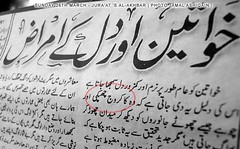
Cheater:
Used in colloquial Urdu (and local ‘English’, too) instead of ‘cheat’.
Bearer:
A waiter.
Affectee:
In desi English this means ‘someone affected,’ but it is not to be found in the dictionary (English dictionary, that is).
Cent percent:
Used instead of ‘a hundred per cent’ (‘per’ and ‘cent’ are put together).
Moot:
Used by some local newspapers instead of ‘meeting’.
Optical:
Used (especially by shops) in place of ‘eye glasses’.
Nullah:
Ravine; usually buses fall into ‘nullahs’ and ‘khuds’.
Dacoit:
A robber, perhaps from Urdu dakait.
Cutpiece:
A small, leftover piece of cloth; a local coinage. [ATP: See our ganderi discussion here and here].
Diggy:
The trunk of a car.
Black money:
Refers to money amassed through unfair means; another local usage, perhaps a literal translation of kala dhan
Toast:
A slice of bread whether toasted or not.
Kutcha:
Made of mud or clay, for example, a kutcha road, a kutcha house. Antonym is pucca.
Peon:
The dictionary says peon means a day-labourer; in India it meant a foot-soldier. But now, in Pakistan and India, it means ‘a messenger or office boy’.
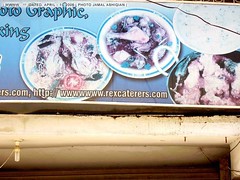 Eve-teasing:
Sexual harassment.
Keep fast:
Instead of ‘fast’ (for roza); literal translation from Urdu.
Give exam:
Instead of ‘take exam’; literal translation from Urdu.
New, new things:
Literal translation from Urdu involving repetition of adjectives, such as ‘big, big cars’.
All of the original post if very well written and, importantly, is not trying to poke fingers at anyone:
This scribe is very much part of the mundane majority of Pakistanis that uses desi
At a more substantive level, bandali offers this useful and informative analysis:
Some linguists believe that a kind of ‘indigenization’ does occur when the speakers of other languages use a particular language and, according to them, when a language is used as a foreign language some ‘deviation’ may take place (because of the local milieu) and this ‘deviation’ should not be termed as a ‘mistake’. Rather, linguists like to refer to such versions as ‘regional variety’.
I do agree with this point of view, but in the case of desi English, they are not deviations or even mistakes; sometimes these are downright atrocities. I feel that if somebody wants to take revenge on the British for what they did to us during the British Raj, they should think of some other and better ways – for instance, ‘exporting’ some of our politicians to the UK for good (it will, in turn, benefit our country as well).
Some linguists, Dr Tariq Rehman, for instance, are of the view that Pakistani English is the new regional variety of the language and, therefore, should be viewed as such; i.e., something like South-Asian English or African English. This may be true, but in some instances, the ‘Urduization’ of English reaches such lengths that it sounds something like ‘Urdish’ or ‘Engdu’.
P.S. I have been unable to locate bandali and this writeup was originally posted on CyberMurid in March 2002; If someone knows who bandali is please convey to him (I assume it is ‘him’ from the name) that he has fans at ATP.
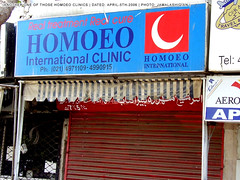
P.P.S. The photographs are from Jamsh; look at them carefully and enjoy. His photo collection is at Flickr.com and who blogs here. More Pinglish posts here.
P.P.P.S. Since having posted this, we have been informed that much of the material we had found on the CyberMurid website (now no longer functional) was part of an article by Dr. Rauf Parih in Dawn magazine (March 10, 2002).