Guest Post by A. H. Cemendtaur
 In the history of South Asia, 1947 was a blood-soaked year – hundreds of thousands got killed while millions were uprooted from their ancestral lands. Prior to 1947 Sikhs lived everywhere in North-Eastern area of what is today Pakistan. I hang my head in shame knowing that presently there is only a small number of Sikhs left there.
I have been a great fan of Sardars – more so after a community of them saved my life in Lusaka, the year was 1992. I got sick while traveling and sojourned at a Gurdwara (Singa Singa Mesquita). The family that took care of the temple took me to the hospital and fed me. I don’t recall their names, but I remember there was a young man who pursued a modeling career and wanted to go to the US.
Compared to followers of other faiths, a practicing Sikh must find it very hard to conceal his identity. And that is the reason I always wondered what professions Sikhs in Pakistan took, and how they kept a low profile in the rising tide of hollow religiosity of the majority.
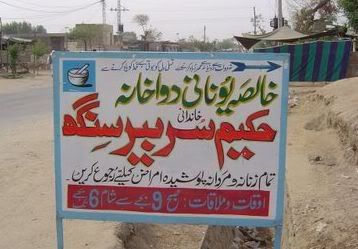
In my last trip to Pakistan I ran into a very colorful Sardar. He was a hakim who ran a Yunani matab called “Khalsa Dawakhana.”
Here is video footage of Hakim Sarber Singh.
“Waheguru ji ka Khalsa, Waheguru ji ki Fateh.”
Besides writing fiction, A.H. Cemendtaur writes on contemporary issues, both in Urdu and English. This post was originally posted at Karachi Photoblog; thanks to iFaqeer for suggesting it for ATP.




One sees quite a few sikhs on the roads and streets of Lahore but one assumes that they are Indian sikhs…
About the armed forces… apparently, after partition was a foregone reality and the Congress was imposing a partition of Punjab and Bengal … as a last ditch effort to keep Punjab united… the Muslim League had offered Sikhs quid pro quo vis a vis having an autonomous and independent Sikh homeland within a Pakistan… this included the defence ministry and the position of the Army chief to the Sikhs…
Not to hijack this discussion, but as far as i know the armed forces have never had a restriction on non-Muslims joining the ranks. It is just a question of how many non-Muslims aspire to become part of the ranks. You need to take a number of factors into consideration, the most important one being socio-economic standing and the traditional means of sustenance.
Please continue.
Cemendtaur: nice post. Thanks.
BD: I don’t think there has been any “dwindling” of numbers over the years. Their population in Pakistan was reduced to pretty much zero in 1947, except a few left in Nankana Sahib (the second holiest Sikh pilgrimage spot) and very small numbers here and there. There was a small increase in number of Sikhs during the troubles in (Indian) Punjab in the 1980s (mostly transitory militants, but some retired militants live in cities like Lahore now). Some Sikhs from Afghanistan also migrated to Pakistan during the troubles in Kabul after the fall of Najib’s Govt. and again during the Taliban rule, but almost 100% of these Sikhs have made their way to India.
The feeling expressed here about the great ethos and work culture of the Sikhs is quite accurate. The most telling evidence of their hard working nature is that I have lived for long in areas with large Sikh populations, yet have never seen a single Sikh beggar in my life. Not even one.
Sikhism is also one of the most rational religions in the world (if there can be such a thing as a “rational” religion), accepting good features of both Hinduism and Islam and rejecting the negative aspects of both. Also, one of the most egalitarian religions of the world. It rejects caste, promotes gender equality and does not even discriminate between believer and non-believer. It is not perfect in these respects, but was far ahead of its time when it came into existence as a faith.
BTW, I wouldn’t really say that Sikhs are being increasingly inducted into the Pakistan army. Of course, the statement is technically true since it is an increase from zero to one. But one cadet recruited in 59 years, with none before him and none in the pipeline for the future, is hardly an evidence of “increasing numbers”.
I’ve come in close acquaintance with only a few Sikhs, and they happen to be the most hardworking and honest of all the people I’ve come across.
I agree, their lifestyle, attire makes them unique and at times vulnerable (be it post 9/11 USA or 1984 riots in India). But then, their ethos and values make them command instant respect no matter where they are. They can make any place home.
Regarding dwindling numbers of Sikhs, do you have any census report on how their number reduced over years? I’ve heard Sikhs are now increasingly being hired in the Pakistani army. We need more steps like these!
For the benefit of our non-Urdu reading readers. The board featured in the photograph reads something like:
Heridetry Hakim Sarbir Singh
Contact for all female and male hidden ailments.
Please suggest otherwise if I got the translation wrong.