 Adil Najam
 One of the great untold stories of 2006 may have been how economic existence for poor and middle class Pakistanis continued to become harder (here, here and here) even as a number of macroeconomic indicators seemed to do well. Some would say that eventually the benefits of macroeconomic growth will trickle down. But eventually can come too late for some.
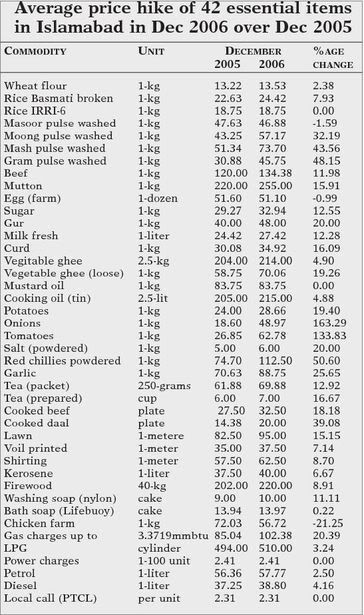
A survey conducted by Dawn in Islamabad reports that “the prices of 36 daily-use items witnessed an upward trend compared to last year [2006].” (click on image for larger view)
…the prices of pulses registered a phenomenal increase during December 2006 over the corresponding period last year. The prices of moong (washed) went up by 32 percent, mash (washed) 43 percent and gram (washed) by 48 percent. This increase was despite the government’s subsidies announced a few months back to stabilise the rates of the commodities in the market.
Among other items, the prices of onions and tomatoes increased by 163 percent and 133 percent, respectively. Prices of salt, red chillies and garlic also increased by 20 percent, 50 percent and 25 percent.
Energy prices were, of course, another major area that broke the back of the poor and middle class:
The prices of gas rose by 20 percent, petrol 2.5 percent and diesel 4.16 percent during December 2006 compared to the corresponding period last year. Ahsanullah, a lower division clerk, said his utility bill had increased from Rs300 to Rs2,000 � a good half of his whole salary.
As we wrap up the year 2006, looking back at how the prices of these essential commodities went up is sobering. These are commodities that everyone needs and the price hike demonstrates the burdens on the poor. ‘Inflation’ is the word that many have thought of but few have dared say in 2006. It may be a word that we will continue to whisper in 2006. Whether this is inflation or not can be debated, but it is still an indication of the economic challenges for the middle class.
Speaking of 2006, we are about to close our ATP Poll on the Impacts of 2006. The results till now are as follows (more detailed analysis later). If you have not voted yet, please do so.
{democracy}




A very interesting review, goes to show how the rich continue to get richer and poor slowly getting crushed under the weight of inflation. The rich are able to afford Beamers, Mercs & jaguars least worried about the rising cost of petrol. But the daily wages have remained at a standstill.
The one other thing to mention is the cost of housing. It has become impossible to buy for ordinary Pakistanis and rents are crazy also. It is these things more than either religion or foreign affiars with Afghanistan or America or anyone that effects the real lives of people and what they really worry about.
it is interesting to see ther rates of essential items in Pak and compare them with the rates in India. While most of the items are around same rate after allowing for value of pak rupee viz a viz INR. But in case of some items the rates in pak are 2 to 5 time of rates here. I will give the items below;
Mutton Rs 120/Kg
Potato Rs 4-6/Kg
Onion Rs 10/Kg
LPG 14.7 Kg Rs 298.00
tomatos Rs 10/kg
my good wishes and happy eid and a happy new year to all the people of pakistan
Since its winter in Karachi and many people love to eat dry fruits, I was visiting Gol Market Nazimabad yestereve and I asked the rates of chilghoza[pine nuts] which were Rs.1200/Kg and chilghoza[washed] Rs.2000/kg, Akhroat Rs.850/Kg. These are rates of a wholesale market. In retail shops cost of chilghoza is Rs.1500/Kg.
I believe the State Bank is giving high priority to at least maintaining, if not reducing, the current rates of inflation. As macroeconomic theory would tell you, price-stability or even a reduction in prices usually comes with some sacrifices like reduced growth of output, high borrowing rates and possibly some employment. I don’t really know the current mechanics of the policy being followed by the Central Bank, but it appears to be one of the very few institutions at the top level that are at least concerned about the rising burden on the poor. It still, though, is appearing relatively powerless in trying to reduce this burden.