Mast Qalandar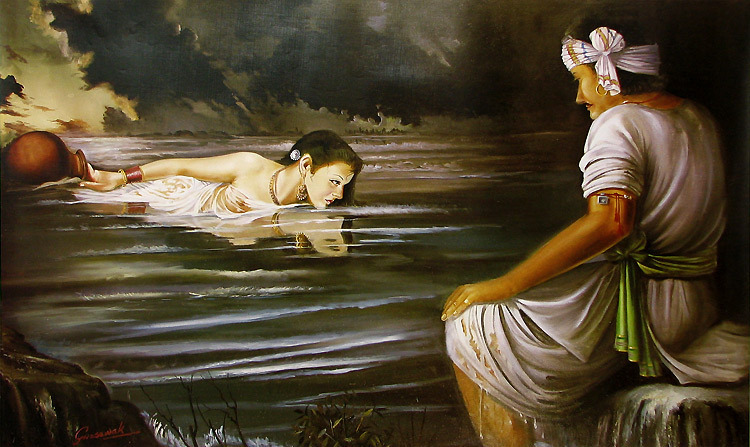
Pakistan, like every other culture, has its share of folklore. In fact, a very generous share — particularly of the love tales.
Folklore is a mixture of beliefs, facts and fiction. The stories are told and retold by successive generations, embellished by poets, sung and celebrated by common folks and enacted and filmed by entertainment industry. Over time, the facts and fiction get so interwoven that often it becomes difficult to separate one from the other.
It is always a poet, though, that immortalizes a love story. But a poet chooses to sing a particular story, and not the other, because of its inherent beauty and poignancy. While the Persian poet, Nizami, introduced Layla-Majnun to the world, Shakespeare immortalized Romeo and Juliet. Waris Shah cried a river over Heer and made her a household name in Pakistan and Northern India, and Sohni and Mahiwal first captured the imagination of Fazal Shah and, through his poetry, got embedded into popular imagination.
I chose the story of Sohni and Mahiwal for this post because I find it so touching, so tragic, and so real. Even though Sohni and Mahiwal lived, loved and died, relatively recently there is no one consistent account of their story. However, there is an unmistakable common thread that runs through the different versions.
Sifting through different accounts and glossing over some, here is, briefly, what I could gather of this beautiful and enduring story:
Sometime during the late Mughal period, there lived in a town on the banks of the Chenab, or one of its branches, a potter (kumhar) named Tulla. (The town is identified either as present day Gujrat or one of the nearby towns.) Tulla was a master craftsman and his earthenware was bought and sold throughout Northern India and even exported to Central Asia. To the potter and his wife was born a daughter. She was such a beautiful child that they named her Sohni, meaning beautiful in Punjabi.
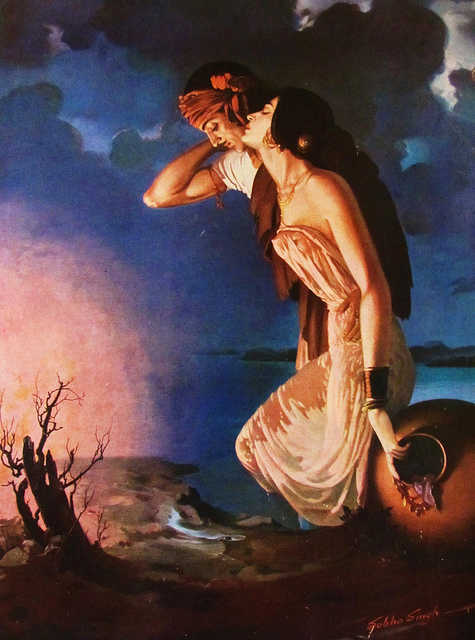 Sohni spent her childhood playing and observing things in her father’s workshop. She watched clay kneaded and molded on the wheel into different shaped pots and pitchers, dried in the sun, and then fired and baked. Sohni grew up not only into a beautiful, young woman but also an accomplished artist who made floral designs on the pots and pitchers that came off her father’s wheel.
Sohni’s town was located on the trading route between Delhi and Central Asia, and trading caravans often made a stopover here. One such caravan that stopped here included a young, handsome trader from Bukhara, named Izzat Baig. While checking out the merchandise in town, Izzat Baig came upon Tulla’s workshop where he spotted Sohni sitting in a corner of the workshop painting floral designs on the pots. Izzat Baig was taken by Sohni’s rustic beauty and charm and couldn’t take his eyes off her. In order to linger at the workshop, he started purchasing random pieces of pottery. He returned the next day and made some more purchases at Tulla’s shop. His purchases were a pretext to be around Sohni for as long as he could. This became Izzat Baig’s routine until he had squandered most of his money.
When the time came for his caravan to leave, Izzat Baig found it impossible to leave Sohni’s town. He told his companions to leave, and that he would follow later. He took up permanent residence in the town and would visit Sohni at her father’s shop on one pretext or the other. Sohni also began to feel the heat of Izzat Baig’s love and gradually began to melt. The two started meeting secretly.
 Izzat Baig soon ran out of money and started taking up odd jobs with different people, including Sohni’s father. One such job was that of grazing people’s cattle — mainly buffaloes. Because of his newfound occupation people started calling him Mahiwal, a short variation of Majhan-wala or the buffalo-man. That name stayed with him for the rest of his life — and thereafter.
Sohni and Mahiwal’s clandestine meetings soon became the talk of the town. When Sohni’s father came to know about the affair he hurriedly arranged Sohni’s marriage with one of her cousins, also a potter, and, ignoring Sohni’s protests and entreaties, bundled her off to her new home in a village somewhere on the other side of the river.
Mahiwal was devastated. He left town and became a wanderer, searching for Sohni’s whereabouts. Eventually, he found her house and managed to meet her in the guise of a beggar and gave her his new address — a hut across the river. Sohni’s husband, meanwhile, discovering that he could not win Sohni’s heart no matter what he did to please her, started spending more time away from home on business trips. Taking advantage of her husband’s absence, Sohni started meeting Mahiwal regularly. She would swim across the river at night with the help of a large water pitcher (gharra), a common swimming aid in the villages even today. They would spend most of the night together in Mahiwal’s hut and Sohni would swim back home before the crack of dawn. On reaching her side of the river, she would hide the pitcher in a bush to be used for her next trip the following night.
One day, Sohni’s sister-in-law (her husband’s sister) came visiting. Suspecting something unusual about Sohni’s nocturnal movements, she started spying on her. She followed Sohn,i one night, and saw her take out the pitcher from the bush, wade into the river and swim across. She reported the matter to her mother (Sohni’s mother-in-law). Both of them, rather than informing Sohni’s husband, decided to get rid of Sohni. This, they believed, was the only way to save their family’s honor. The sister-in-law quietly took out Sohni’s pitcher from the bush and replaced it with sun-dried, unbaked pitcher.
As usual, Sohni set out at night for her meeting with Mahiwal, picked the pitcher from the bush, as she always did, and entered the river. It was a stormy night. The river was in high flood. Sohni was soon engulfed in water. She discovered, to her horror, that the pitcher had begun to dissolve and disintegrate.
What shall she do now? Different thoughts rushed through Sohni’s mind. Abandon the trip? Or continue trying to swim without the help of a pitcher — and drown? Her inner struggle at this point is best expressed in a saraiki song made memorable by Pathanay Khan in his inimitable voice: Sohni gharray nu aakhdi aj mainu yaar mila gharrya
Roughly translated and paraphrased the song runs as follows:
Sohni (addressing the pitcher):
It’s dark and the river is in flood
There is water all around me
How am I going to meet Mahiwal?If I keep going, I will surely drown
And if I turn back
I would be going back on my promise
And letting Mahiwal downI beg you (O pitcher!), with folded hands,
Help me meet my Mahiwal
You always did it, please do it tonight, too
(The pitcher replies):
I wish I, too, were baked in the fire of love, like you are
But I am not. I apologize; I cannot help
Hearing Sohni’s cries, Mahiwal, from the other side, jumped into the river to save her. He barely managed to reach her. As the story goes, their bodies were washed ashore, and were found the next day, lying next to each other.
With their death, Sohni and Mahiwal entered into the world of legends and lore. And, in their death the sinners became saints.






На этом самом сайте удастся почерпнуть много полезной информации.
https://u4.superpodium.com/uIk5n2AnCc0e/
ИИ-агенты служат компьютерные решения, умеющие осуществлять операции без постоянного вмешательства пользователя.
Данные системы обладают способностью обучаться посредством информации и вырабатывать автономные предложения.
Подобные решения повсеместно используются в разных отраслях, например поддержку клиентов, оптимизацию бизнес-процессов, личных ассистентов и научные проекты.
https://news.rambler.ru/tech/56850486-32-polzovateley-ii-stali-tratit-na-pokupki-menshe/
Их достоинствами считаются высокая эффективность действия, непрерывная доступность и способность анализировать значительные объёмы данных.
В перспективе ИИ-агенты окажутся более самостоятельными и умными, что предоставит новые возможности для общества.
На данном портале есть шанс обнаружить полезную информацию.
https://pilot-club.ru/info/2026-07-10-trudovye-migranty-i-pustye-polya-pochemu-ovoshchi-vyrashchennye-v-rossii-obkhodyatsya-pokupatelyam-v-troynuyu-tsenu/