 Adil Najam
[UPDATE: Unfortunately the story of Gulab Singh has not been a pleasant one since the great start that this post originally reported on. Current, and still evolving details, here.]Â
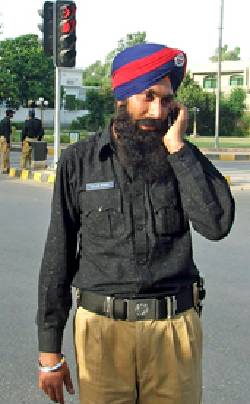
A few days ago a reader sent me a link to a BBC story about Dr. Gulab Singh Shaheen who has been inducted into the Pakistan Punjab traffic police and has become a celebrity on the roads of Lahore where he is quite literally stopping the traffic as Lahoris stop to embrace and greet him.
I felt real good about the continuation of this trend towards reintegrating minority communities who have been systematically sidelined in the past, and even more about the wonderful reception Lahore is giving to Sub-Inspector Gulab Singh. And, of course, my fascination with traffic cops is well known to ATP readers (here, here, here, here, and elsewhere).
However, I hesitated because I wanted an on the ground confirmation. That came today from the Lahore Metroblog (yes, in general, I have more respect for the three Pakistani Metroblogs than for BBC!).
(By the way, I am intrigued by the fact that he is a homeopathic doctor since we had earlier carried another post and video report on the Khalsa Dawakhana and Hakim Sarbir Singh; of course, Sikhs have a long history in what is now Pakistan – here and here – but I wonder whether and why this community has a particular focus on traditional medicine studies).
It turns out, in fact, that Daily Times had a wonderful story on him last week which I had missed earlier. Here is what it said:
“Since yesterday, I have been hearing different greetings, such as sat sari kaal, jo bolay so nihal and ballay ballay from car and bus drivers, motorcyclists and children. Lahoris are really very loving people and these are unforgettable moments for me,” remarked Dr Gulab Singh, the first-ever Sikh to be appointed traffic police warden in Pakistan, in an exclusive interview with Daily Times.
Gulab, the 25-year-old Sikh traffic warden, who hails from Nankana Sahib and now lives in Defence Housing Authority, said that joining the force as a sub-inspector was a dream come true for him. Pledging to do his duty wholeheartedly, he said that the loving welcome he had received from the public had added to his joy. He said he had joined his duty station on Wednesday, and by the second day, dozens of children had forced their parents to stop the car so that they could meet him. Singh is deputed on Alif Laam Meem Chowk on Aziz Bhatti Road in Cantt.
Gulab said he was born in Nankana district in January 1982. His father, Manna Singh, is a farmer and a father of seven – five boys and two girls. Gulab is the youngest of the siblings. Gulab completed his matriculation in Nankana district, graudation in Lahore and then received a doctorate in homeopathy from Bahawalpur. Gulab said he also operated a homeopathic clinic, which he might have to shut down because of his new and demanding posting.
Gulab said he applied for the sub-inspector post when announcements inviting applications appeared in newspapers, but did not tell his family. He informed them only after he was appointed, which translated into a delightful surprise for them, he added. Commenting on his training process, Gulab said, “The attitude of my fellow trainees and officers was very good towards me. Nobody ever forced me to do anything against my religious beliefs.” He said he had no problems wearing his kara (bangle), or keeping his kirpan (dagger) on him. He added that, as he was a vegetarian, green meals were arranged for him in the mess during the training period. “I am very grateful to my officers for this gesture,” Gulab said.
Gulab is multilingual and has command over Urdu, Punjabi, Pashto, Seraiki, and Sindhi. He added, “I can also speak English, but not very fluently.” Gulab also said that he was fond of Punjabi bhangra music and that his favourite singers are Abrar-ul-Haq, Harbajhan Maan and Waris Baig. In terms of the future, Gulab said, “I will do my duty honestly, work like a true and dutiful citizen, and dream of a corruption-free atmosphere.”



Nasir: In your rebuttal you have left out some of my comments that I made to Mr. Umar Khan. Since your concerns seem to be mostly regarding the Ahmadia group, let me copy it down here.
“umar khan: You are right. Ahmadis in Pakistan indeed have been treated very wrongly. I have personally witnessed this wrong. I hope we do not digress here into ‘Qadiani’ debate but I do sympathise with you and your family and indeed with your group. Take it for what ever its worth. But in general, non-Muslims in Pakistan, and by that I mean Hindus, Sikhs, Christians and Parsis do have a normal and peaceful coexistence with Muslims.”
I stand by my comments regarding ‘peaceful coexistence’ between various religious groups in Pakistan. But that is not to say there is no room for improvement.
About the external pressure on Pakistan government. It has much to do with the threat of terrorism, christian missionary programs and some time just international politics in general. Pakistan being a Muslim country and at the same time a recipient of economic aid will always be under pressure from the aid donor christian west. Don’t think that external pressures are just for the humanitarian reasons alone. There is more than that what meets the eye.
[quote post=”688″]Un ko Islam kay lut jaanay ka dar itna hai
Ab woh kaafir ko musalmaN nahiN karnay daitay[/quote]
Wah, wah, maza aa gaya. MQ, thanks for the Faiz quote. I would like to read more of Faiz Ahmed Faiz’ works, but I can’t read Urdu. Do you know if the works of Pakistan’s most famous poets are available in the Devnagari script (i.e., Hindi)? Would be grateful for any suggestions. Maybe some publishers in our own sweet Dilli publish such books, but I haven’t heard about them.
Slightly off topic but relevant in the light of some of the comments above, Daily Times reports today (May 3):
[quote]PESHAWAR: Leaders of Ansarul Islam (AI), a religious group in Khyber Agency, have expelled a convert from the agency for converting to the “Lashkar-e-Islam’s untrue version of Islamâ€
Pakistan is the best thing to happen to minorities. It is only that they don’t acknowledge how fortunate they have been. Generally they are financially prosperous, in fact they hog all wealth, dominant in politics, socially active, control media and occupy best positions, often out of merit, in public and private sector. These minorities have formed a closely-knit clique of their own. It is a highly exclusive club, which accepts entries primarily on the basis of on religion, of course, but gender and age also form the criteria.
No, I am daydreaming or hallucinating. Neither am I a blindly loyal Pakistan.
I am talking of the biggest minority group: Adult Muslim Male – socially conservative, insensitive and sexist, civically negligent and indiscipline, religiously ostentatious, self-righteous and ritualistic, politically intolerant and non-democratic, morally hollow and mendacious, intellectually base and so on. This minority group has no qualms in kicking the fallen, ganging up against the weak and exploiting the vulnerable.
Why I regard AMM a minority group? This group has no place for women, which form about fifty-percent of Pakistan. Rather they are one of the most exploited and oppressed group in the country (perhaps in the world). A non-Muslim man at least is safe in his home. No such luxury for Pakistani women though. Next comes the non-Muslim population. Well, they should be thankful for being able to breath. They live in a state of constant fear. Fear of the mullahs, fear of discriminatory laws, fear of a failing State, fear of injustice. Constant fear. It does not end here. Children are also excluded by the AMM. Children perhaps are the most ignored group when it comes to the right to love, respect, education, nurturing, food, health. In many homes they end up eating leftovers while their father gets the choicest morsels, while facing constant verbal and physical abuse.
There is more. It is not enough for one in Pakistan to proclaim his faith as Islam be admitted to the exclusive AAM club. The level of acceptance and tolerance bestowed by the AMM depends on which Islam one believes in. In fact, it won’t be wrong to say that the Islam one believes in determines how far the AMM will go in targeting you with all of his ruthlessness. Thus, non-AMMites have the ranking of social untouchability and exploitability: Shia, Ismaili, Khoja and the last Ahmadi in that order.
The minority group rules, while majorities are suppressed.
[quote comment=”46090″]I 100% agree with Mr Alvi, may be someone agrees or not but Pakistanis have always shown big hearts for minorities. [/quote]
1. have u ever experienced teachers asking u why u r not muslim?
2. have u ever experienced fellow students calling u names bcoz of yr faith, ofcourse not 2 ur face?
3. have u ever experienced the mullas loudspeakers’ threats in ur locality?
4. have u been jailed at the age of 4?
5. has ur dad been jailed twice and attacked infront of the police outside the courts?
6. had ur dad had 15FIRs against him?
7. have u ever wondered why preaching is banned?
obviously, u havent experienced such treatment and hence your easy-going loving caring pakistan dream will continue as part of a deep slumber. perhaps its time2wake up.