by Raza Rumi
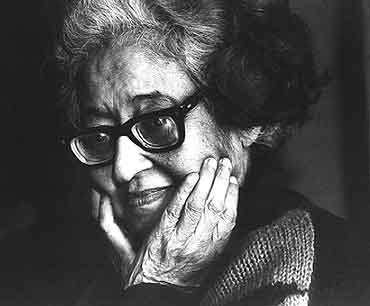 I have been upset the entire day. Perhaps it does not matter in the larger scheme of things. But this is a sad, sad day. Qurratulain Hyder, the literary giant of our times is no more. At a personal level it is not just the death of another literary figure but it is far greater and deeper than that. Ainee inspired generations of Urdu readers and there is not a single Urdu writer of post-independence era who has not been influenced by her.
Ainee had a civilizational consciousness that took us beyond the nation-state identities that we are so familiar with in our everyday lives. And, of course there was romance – the notion of eastern and Indic romance – that touched our lives. As I wrote earlier, that the way I have understood the world and perhaps parts of myself were deeply influenced by Ainee.
And  now her death is a blow that this source of inspiration is not there anymore; as it is we are living in barren times where literature is about marketing and packaging and catering to consumers.
Ainee primarily wrote for herself but reached out and made her mark – and in the process she connected with millions of readers. And I am just one of them. My friends and I have talked today and we recounted how she shaped our inner lives.
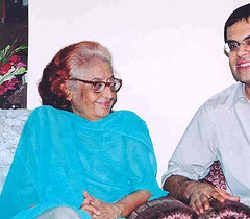 I have at least avoided a regret – I met her after years of longing. Met her twice at her house in her frail state and enjoyed the hours. The impressions were indelible. Of course, the ambitious self had planned a meeting later this year.
But there will be nobody in that Noida house. That little temple opposite her house will remain and the sound of Azaan from a neighbouring mosque will also heard. But the hearty laughter, quick witted lines and inimitable writings will not be there.
However, as a friend said – writers die, their stories don’t -makes me a little content.
Farewell, Ainee Apa. May God keep you happy wherever you are…
Photo Credits: The black-and-White photo in this post is courtesy of Prashant Panjiar




Thanks Raza for the additional information. It will be great if you or some one else would write a comprehensive and unbiased essay about her work and life in Pakistan between years 1947 and 1961. Also thanks for the link to ‘The Annual of Urdu Studies’. For few years I myself had subscribed to this journal coming out of Center For South Asia, University of Wisconsin, Madison, editor, Muhammad Umar Memon. It is a good source of reference in English about Urdu Literature.
Slight mistake in my comment above: Ainee migrated to India in 1961 not 1967 as was inadvertently stated above.
Well the irony is none of the mainstream pakistani channels did a special segment on this great writer.
They can do that for TV Film and. Stage actors why can’t they do it on these famous writers and poets.
Shahran
Pervaiz Bhai:
Thanks for your comments and the questions.
Ainee Apa never married. She migrated to India in 1967. I had tried to address these issues in my earlier comment:
“She left everything in India and migrated to Pakistan in 1947 with her family. As our wise friend YLH said that her departure from Pakistan was due to the censorship under Ayub rule and witch hunting that started after the publication of Urdu language
Qurrat-ul-Ain Haider was a great Urdu writer. Her stature as such was established half a century ago. Reading comments here it is also obvious that she was a popular writer as well. Even though all news sites have covered her passing away, we are thankful to Raza Rumi for posting his tributes to a women he has affectionately referred as ‘Aini Appa’. She definitely has a face of a loving ‘Khala Jan’. However I can not help noticing in some of the comments here that she was not treated well or she was less welcomed by the Government of Pakistan. We know she, most likely with her family, migrated to Pakistan in 1947 as a young woman. We also learn that in 1958 she moved back to her native India. Would Raza Rumi, or Yasar Latif Hamadani or other learned folks here throw some light on her life and work within that time period. Was she really unhappy in Pakistan or with Pakistan and was left with no choice but to move back to India. Did she do so all alone or along with her husband and children. I hope folks here do not get upset with my line of questioning. I raise these questions with utmost respect to the writer and her followers and only in the interest of truth. Before we start blaming Pakistan for the personal decisions of individuals let us separate fiction from the facts. After all there are millions who were born in India and found happiness in Pakistan. Some even rose to the level of Presidents and Prime Ministers. Thank you all.