by Raza Rumi
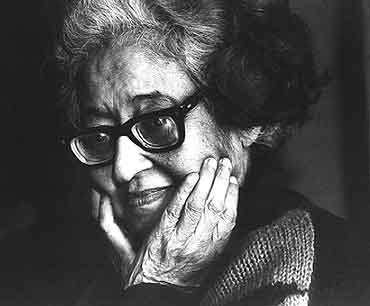 I have been upset the entire day. Perhaps it does not matter in the larger scheme of things. But this is a sad, sad day. Qurratulain Hyder, the literary giant of our times is no more. At a personal level it is not just the death of another literary figure but it is far greater and deeper than that. Ainee inspired generations of Urdu readers and there is not a single Urdu writer of post-independence era who has not been influenced by her.
Ainee had a civilizational consciousness that took us beyond the nation-state identities that we are so familiar with in our everyday lives. And, of course there was romance – the notion of eastern and Indic romance – that touched our lives. As I wrote earlier, that the way I have understood the world and perhaps parts of myself were deeply influenced by Ainee.
And  now her death is a blow that this source of inspiration is not there anymore; as it is we are living in barren times where literature is about marketing and packaging and catering to consumers.
Ainee primarily wrote for herself but reached out and made her mark – and in the process she connected with millions of readers. And I am just one of them. My friends and I have talked today and we recounted how she shaped our inner lives.
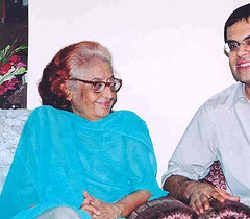 I have at least avoided a regret – I met her after years of longing. Met her twice at her house in her frail state and enjoyed the hours. The impressions were indelible. Of course, the ambitious self had planned a meeting later this year.
But there will be nobody in that Noida house. That little temple opposite her house will remain and the sound of Azaan from a neighbouring mosque will also heard. But the hearty laughter, quick witted lines and inimitable writings will not be there.
However, as a friend said – writers die, their stories don’t -makes me a little content.
Farewell, Ainee Apa. May God keep you happy wherever you are…
Photo Credits: The black-and-White photo in this post is courtesy of Prashant Panjiar





It indeed is a great loss to the wold of literature. RR you re one of the few lucky ones to have met her in person. Now you inspire all of us who have not yet emabrked on the journey to read Ag Ka dariya-
Its sad how Pakistani establishment has alwys turned away intellect from the country-resulting in chaos that is Pakistan today.
Ms. Hyder, the great writer, was quite old and living alone. She had written her best novels. I guess by now she must have lived a full life. And though she is gone,her stories will remain with us till we die. So Reza, cheer up.
But I do regret that she spent the last years of her life in NOIDA. NOIDA is a Delhi suburb. I live quite close to it.
It is a kind of pretentious place with lots of glitzy malls and upcoming apartments and fancy mansions and snooty golf courses. It lacks the charm and elegance of old world Delhi. It is difficult to relate Ms. Hyder’s persona with NOIDA. She should have been living in Nizamuddin East or in a Mukherjee Nagar mansion or even in some decrepit three-room house in Daryaganj or Chandni Chowk.
I’m sorry the great Urdu author had to live in that ugly place
Raza, I am glad you wrote this piece on the sad occasion of Qurratulain Hyder’s passing away. She is indeed one of the greatest Urdu prose writers in history.
My father, whom you know, is visiting me here in the US these days and told me something amusing that later in her life Quarratulain Hyder would become somewhat irritated when people only praised Aag ka Darya as she wanted people to move beyond that great work and assess her later writings as well. My own favorite work is Aakhir-e-Shab ke Humsafar and having an attachment to well written family histories I have always thoroughly enjoyed Kaar-e-Jahaan Daraz Hai (which is described by her as “Ek Sawanihi Novel”)
Literary rankings are really just a fun parlor game and very personal but I believe that in Urdu prose she is the very best amongst the novelists, Manto the best short story writer and Mushtaq Ahmed Yusufi the finest humorist. Their canvasses are large and no single country, language or culture circumscribes their work. Their writing despite being deeply rooted in India and Pakistan is universal, non-ideological and deeply humanistic. These are the characteristics of truly great literary works all over the world.
It is diffucult to gauge the loss by someone who has not been into Urdu literature (I am very ashamed to say that, but I am trying to get over this shortcoming).
Inna lillahi wa inna ilayhi raaji
I am one of the readers who has cherished Qurrat ul Ain Hyder’s writings for years. I felt sad on her demise as if someone close to me had passed away.
My favourite novel is Aakhire Shab ke Ham Safar as its themes, mood and characters left a deep impression on me. In particular, the romance of Bengal and idealism of its characters has inspired me for years.
I spent my evening looking at her books and reading bits of them..this was my way of consoling myself..
May she rest in peace !