Adil Najam
The frustration and anger that one finds in the comments on the Emergency imposed by Gen. Musharraf in Pakistan is mirrored everywhere. In every conversation one has with any Pakistani anywhere. I was in Pakistan till last weekend and this pent-up feeling of frustration was evident in every conversation even before the Emergency was imposed.
It is, of course, a complex feeling emanating from the complex dynamics of our complex politics. At its very core, however, is the burning desire to be able to “do something” about what is happening made all the intense by a sense of helplessness about exactly what it is that we as citizens might, in fact, be able to do that might make a difference.
Since Saturday every conversation I have had with Pakistanis ends in exactly this question. What can we do? I have an in-box full of emails asking me to sign a petition, attend a meeting, say this or that to the media if I speak to them, join a protest, pass on a message, do this or that on ATP, join a conference call to plan a strategy, send out notes to my contacts, and so much more. There have been call after call from friends and acquaintance many of whom not even Pakistanis who just want to talk and share the intensity of their disgust at how the events are unfolding.
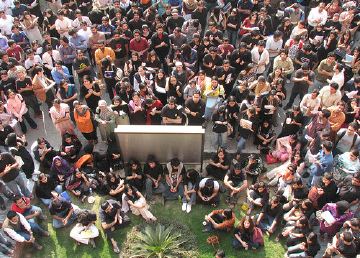
Of course, at the basest level doing anything - anything at all - has a cathartic effect and makes one feel that at least we did not do nothing. But the desire to do something is more intense. The desire not to just be a spectator to history. The desire to have contributed something, somehow. As one watches the heroic struggle of the lawyers, and now the students, to stand up and speak out - despite the brutality they are met with - makes this desire even more intense.
We each do what we can. We speak out to the media (I have had more than a dozen media interviews and comments already, we give talks (I have been giving multiple talks on this a day), we send out messages of support to those on the front lines in Pakistan to let them know that they are not alone, we sign petitions, and above all we hold hands in solidarity and vent our feelings where ever we can - on blogs, on phone calls to friends, in gatherings. All of this helps some, but one keeps wondering if it really makes a difference to the big picture?
Even if it is not, it is clearly worth doing. But can more be done? What? How? We would like to hear from our readers on that. Please let us know what is already happening as well as suggest what more could happen.
Are there to many petitions going around; so many that they might lose their efficacy? Are some of us crossing the line between that which is anti-Musharraf and that which is anti-Pakistan? Even if they mean the same thing, strategically would a message that is pro-constitution, pro-democracy, pro-Pakistani resistance be better than one that is anti-individual? How can one best support those lawyers and students and others who are on the front-line of action, especially those who are not physically there? What, if any, are the dangers of focusing our attention too much of external actors rather than those in Pakistan itself? How does one explain to the media and policy-makers abroad that the events we are seeing is not the failure of a nation (the Pakistani people) these are the failure of a person and a particular government? (I personally have been saying to friends and to the media that I remain bullish on Pakistan and bearish on Musharraf).
These and many others are the questions that boil in ones head. There must be other questions too. Share these with us, but more importantly point us towards answers. Share with our readers what you are doing. How others can help. What should be done.
Note to commentors: My own views on the subject have been pretty clear and I feel no compulsion to either defend them or amend them. While I consider thsi emergency an anti-Pakistan and anti-Pakistani act, I do not doubt the patriotism or integrity of those who disagree. Pakistaniat is based on the premise that there can be, have to be, multiple views and they all must be respected, even when we disagree with them. Those of us who resent the emergency because it has tried to silence certain voices cannot then silence or disempower those who disagree with our views.
I say all this because over the last few days we have had to moderate out too many comments. More, in fact, from people we might agree with than those who we do not. One realizes that the moment is tense and passions are flared, but we stand committed to implementing our comment policy as best as we can. We have moderated, and will continue to do so, not because of content but because of infringements of our comment policy. We are, and will remain, especially careful about inappropriate language, personal attacks, inflammatory and disrespectful tactics, uncivil and slanderous language, and irrelevant diatribes. Please help us in not moderating your comment out by resisting these things. (And, please stop sending us notes about why you can misbehave because someone else did; we try to catch these things as best as we can and even if we miss them sometimes that does not give others a liscence to misbehavior). We remain committed to having a civil discourse and no matter whether we agree with you or not, no matter if you are an old friend or anew acquaintance, we will do our best to maintain that civility. If and when we feel that we are unable to do so, we are more likely to just close down the blog then to give in to people’s tantrums and badtameezi.




We wish if it were that simple to ask one person to go as if it were a magic bullet and all the problems would be solved. Yes it is imperative and the students have injected much energy to the protest that was largely led by lawyers…
But as again, we must fight for civilian rule and f0r a common goal that the army must go to the barracks. By targetting a uniformed individual, we should not allow another adventurer to step in.
Mishbah: you are absolutely right about the sufferings of people in Swat and Waziristan. Admittedly the lawyers and the deposed judges were focusing on Gen Musharraf as he represents army rule that must go now - there is no solution for Swat or Waziristan without political participation and dialogue led a genuinely elected federal government.
Therefore do not belittle the lawyers movement - it may be lopsided but they have mobilised the whole nation. Even more than those judges who have become heroes after providing legitmacy to Gen Musharraf’s rule and giving him the right to amend the constitution in 2000. Our collective memory is very short, alas.
Its good to see that students blongss to upper class (mummy daddy group) are also protesting against this Mush regime. In Lahore students of FAST & LUMS organized the protest within Campus.
Protest in Islamic University, Islamabad, where hundred of student gathered, same information is with reference to the Quaide-eAzam University Islamabad, where also students boycott the classes & participated in a huge demonstration in campus, Police also reached at both the campuses & successfully performed his duty to arrest some students.
Similarly, from Punjab University -Islami Jamiat-e-Talba launched a huge protest. In Peshawar news are same. In Karachi students observed ‘Black Day’
Now, its one sentence, one voice, one target, one aim, one nation AGAINST one general
GO MUSHARRAF GO
Pakistan
OR
Might Is Right…
Asalaam O Elikum Respected All. Today am really embraced when I heard in News that National Assembly’s Session is been held on today Nov 7th 2007…
Then I bite my Nails what’s this … Because as I and all of You know well that a emergency plus (+) been imposed on Pakistan on 2nd November 2007 By Our Great Atta Turkk follower General Mushraf and Constitution of Pakistan 1973 is suspended and a New PCO issued and judges sworn oath under this PCO and Mr. Justice Dogar took oath to loyalty to President of Pakistan and as well to support all of his future Acts what so ever he done for prolong his Rule over Gold mine Pakistan. and starts as “An eight-member bench of the Supreme Court Tuesday nullified a seven-judge bench ruling that had directed the government to abstain from impositing of emergency in the country and asking judges not to take oath under Provisional Constitutional Order (PCO).
The present composition of the bench constitutes full court of the Supreme Court as its total strength of eight judges till Tuesday was made part of the bench.
Headed by Chief Justice Abdul Hameed Dogar, the bench set aside order issued by a bench chaired by his predecessor, Chief Justice Iftikhar Muhammad Chaudhry, only three days ago.
The fresh ruling has been given on a request moved by Attorney-General Malik Muhammad Qayyum on behalf of the federal government against the impugned judgment.
Besides Chief Justice Abdul Hameed Dogar, other members of the bench are Justice Muhammad Nawaz Abbasi, Justice Faqir Muhammad Khokhar, Justice M Javed Buttar, Justice Ejaz ul Hassan, Justice Muhammad Qaim Jan, Justice Muhammad Musa K Leghari and Justice Muhammad Ejaz Yousaf.
In a short order disposing the plea of government, the bench said the PCO had come into force when the seven-member bench of apex court, presided over by former CJP Iftikhar Muhammad Chaudhry, had delivered verdict against imposition of emergency.
These judges were not authorized to give any decision against proclamation of emergency, the short order further said, adding that the same decision may not be considered as a court verdict.
The main reason to insatiate me wrote these line Dear just thought on one hand the constitution of Pakistan is suspended and on other hand how can National Assembly’s Session been processed wow “hai na Mazay ki baat” and as well Federal cabinet approve Mushraf’s act of Emergency. No media personal been allowed to cover the Session and only the only PTV Spreading the Dream News “Kushaal Aur Pur Amnn Pakistan”.
Might Most of you know?
And here also I mention Constitutional provisions as under about emergency……
Emergency Provisions
________________________________________
232.
(1) If the President is satisfied that a grave emergency exists in which the security of Pakistan, or any part thereof, is threatened by war or external aggression, or by internal disturbance beyond the power of a Provincial Government to control, he may issue a Proclamation of Emergency.
(2) Notwithstanding anything in the Constitution, while a Proclamation of Emergency is in force,
(a) Majlis-e-Shoora (Parliament) shall have power to make laws for a Province, or any part thereof, with respect to any matter not enumerated in the Federal Legislative List or the Concurrent Legislative List;]
(b) The executive authority of the Federation shall extend to the giving of directions to a Province as to the manner in which the executive authority of the Province is to be exercised, and
(c) the Federal Government may by Order assume to itself, or direct the Governor of a Province to assume on behalf of the Federal Government, all or any of the functions of the Government of the Province, and all or any of the powers vested in, or exercisable by, any body or authority in the Province other than the Provincial Assembly, and make such incidental and consequential provisions as appear to the Federal Government to be necessary or desirable for giving effect to the objects of the Proclamation, including provisions for suspending, in whole or in part, the operation of any provisions of the Constitution relating to any body or authority in the province:
Provided that nothing in paragraph (c) shall authorize the Federal Government to assume to itself, or direct the Governor of the Province to assume on its behalf, any of the powers vested in or exercisable by a High Court, or to suspend either in whole or in part the operation of any provisions of the Constitution relating to High Courts.
(3) The power of [Majlis-e-Shoora (Parliament)] to make laws for a Province with respect to any matter shall include power to make laws conferring powers and imposing duties, or authorizing the conferring of powers and the imposition of duties upon the Federation, or officers and authorities of the Federation, as respects that matter.
(4) Nothing in this Article shall restrict the power of a Provincial Assembly to make any law which under the Constitution it has power to make but if any provision of a Provincial law is repugnant to any provision of an Act of [Majlis-e-Shoora (Parliament)] which ][Majlis-e-Shoora (Parliament)] has under this Article power to make, the Act of [Majlis-e-Shoora (Parliament)], whether passed before or after the Provincial law, shall prevail and the Provincial law shall, to the extent of the repugnancy, but so long only as the Act of [Majlis-e-Shoora (Parliament)] continues to have effect, be void.
(5) A law made by [Majlis-e-Shoora (Parliament)], which [Majlis- e- Shoora (Parliament)] would not but for the issue of a Proclamation of Emergency have been competent to make, shall, to the extent of the incompetency, cease to have effect on the expiration of a period of six months after the Proclamation of Emergency has ceased to be in force, except as respects things done or omitted to be done before the expiration of the said period.
(6) While a Proclamation of Emergency is in force, ][Majlis- e- Shoora (Parliament)] may by law extend the term of the National Assembly for a period not exceeding one year and not extending in any case beyond a period of six months after the Proclamation has ceased to be in force.
(7) A Proclamation of Emergency shall be laid before a joint sitting which shall be summoned by the President to meet within thirty days of the Proclamation being issued and,
(a) Shall cease to be in force at the expiration of two months unless before the expiration of that period it has been approved by a resolution of the joint sitting; and
(b) Shall, subject to the provisions of paragraph (a), cease to be in force upon a resolution disapproving the Proclamation being passed by the votes of the majority of the total memberships of the two Houses in joint sitting.
(8) Notwithstanding anything contained in clause (7), if the National Assembly stands dissolved at the time when a Proclamation of Emergency is issued, the Proclamation shall continue in force for a period of four months but, if a general election to the Assembly is not held before the expiration of that period, it shall cease to be in force at the expiration of that period unless it has earlier been approved by a resolution of the Senate.
233.
(1) Nothing contained in Articles 15, 16, 17, 18, 19, and 24 shall, while a proclamation of Emergency is in force, restrict the power of the State as defined in Article 7 to make any law or to take any executive action which it would, but for the provisions in the said Articles, be competent to make or to take, but any law so made shall to the extent of the incompetency, cease to have effect, and shall be deemed to have been repealed, at the time when the Proclamation is revoked or has ceased to be in force.
(2) While a Proclamation of Emergency is in force, the President may, by Order, declare that the right to move any Court for the enforcement of such of the Fundamental Rights conferred by Chapter 1 of Part II as may be specified in the Order, and any proceeding in any Court which is for the enforcement, or involves the determination of any question as to the infringement, of any of the Rights so specified, shall remain suspended for the period during which the Proclamation is in force, and any such Order may be made in respect of the whole or any part of Pakistan.
(3) Every Order made under this Article shall, as soon as may be, be laid before a joint sitting for approval and the provisions of clauses (7) and (8) of Article 232 shall apply to such an Order as they apply to a Proclamation of Emergency.
234.
(1) If the President, on receipt of a report from the Governor of a Province or otherwise, is satisfied that a situation has arisen in which the Government of the Province cannot be carried on in accordance with the provisions of the Constitution, the President may, or if a resolution in this behalf is passed at a joint sitting shall, by Proclamation,
(a) assume to himself, or direct the Governor of the Province to assume on behalf of the President, all or any of the functions of the Government of the Province, and all or any of the powers vested in, or exercisable by, any body or authority in the Province, other than the Provincial Assembly;
(b) declare that the powers of the Provincial Assembly shall be exercisable by, or under the authority of, [Majlis-e-Shoora (Parliament)]; and
(c) make such incidental and consequential provisions as appear to the President to be necessary or desirable for giving effect to the objects of the Proclamation, including provisions for suspending in whole or in part the operation of any provisions of the Constitution relating to any body or authority in the Province:
Provided that nothing in this Article shall authorize the President to assume to himself, or direct the Governor of the Province to assume on his behalf, any of the powers vested in, or exercisable by, a High Court, or to suspend either in whole or in part the operation of any provisions of the Constitution relating to High Courts.
(2) The Provisions of Article 105 shall not apply to the discharge by the Governor of his functions under clause (1).
(3) A Proclamation issued under this Article shall be laid before a joint sitting and shall cease to be in force at the expiration of two months, unless before the expiration of that period it has been approved by resolution of the joint sitting and may by like resolution be extended for a further period not exceeding two months at a time; but no such Proclamation shall in any case remain in force for more than six months.
(4) Notwithstanding anything contained in clause (3), if the National Assembly stands dissolved at the time when a Proclamation is issued under this Article, the Proclamation shall continue in force for a period of three months but, if a general election to the Assembly is not held before the expiration or that period, it shall cease to be in force at the expiration of that period unless it has earlier been approved by a resolution of the Senate.
(5) Where by a Proclamation issued under this Article it has been declared that the powers of the Provincial Assembly shall be exercisable by or under the authority of [Majlis-e-Shoora (Parliament)], it shall be competent-
(a) to [Majlis-e-Shoora (Parliament)] in joint sitting to confer on the President the power to make laws with respect to any matter within the legislative competence of the Provincial Assembly;
(b) to [Majlis-e-Shoora (Parliament)] in joint sitting, or the President, when he is empowered under paragraph (a), to make laws conferring powers and imposing duties, or authorizing the conferring of powers and the imposition of duties, upon the Federation, or officers and authorities thereof;
(c) to the President, when [Majlis-e-Shoora (Parliament)] is not in session, to authorize expenditure from the Provincial Consolidated Fund, whether the expenditure is charged by the Constitution upon that fund or not, pending the sanction of such expenditure by [Majlis- e- Shoora (Parliament)] in joint sitting; and
(d) To [Majlis-e-Shoora (Parliament)] in joint sitting by resolution to sanction expenditure authorized by the President under paragraph (c).
(6) Any law made by [Majlis-e-Shoora (Parliament)] or the President which [Majlis-e-Shoora (Parliament)] or the President would not, but for the issue of a Proclamation under this Article, have been competent to make, shall, to the extent of the incompetency, cease to have affect on the expiration of a period of six months after the Proclamation under this Article has ceased to be in force, except as to things done or omitted to be done before the expiration of the said period.
235.
(1) If the President is satisfied that a situation has arisen whereby the economic life, financial stability or credit of Pakistan, or any part thereof, is threatened, he may, after consultation with the Governors of the Provinces or, as the case may be, the Governor of the Province concerned, by Proclamation make a declaration to that effect, and while such a Proclamation is in force, the executive authority of the Federation shall extend to the giving of directions to any Province to observe such principles of financial propriety as may be specified in the directions, and to the giving of such other directions as the President may deem necessary in the interest of the economic life, financial stability or credit of Pakistan or any part thereof.
(2) Notwithstanding anything in the Constitution, any such directions may include a provision requiring a reduction of the salary and allowances of all or any class of persons serving in connection with the affairs of the Province.
(3) While a Proclamation issued under this Article is in force the President may issue directions for the reduction of the salaries and allowances of all or any class of persons serving in connection with the affairs of the Federation.
(4) The provisions of clauses (3) and (4) of Article 234 shall apply to a Proclamation issued under this Article as they apply to a Proclamation issued under that Article.
236.
(1) A Proclamation issued under this part may be varied or revoked by a subsequent Proclamation.
(2) The validity of any Proclamation issued or Order made under this Part shall not be called in question in any court.
237.
Nothing in the Constitution shall prevent [Majlis-e-Shoora (Parliament)] from making any law indemnifying any person in the service of the Federal Government or a Provincial Government, or any other person, in respect of any act done in connection with the maintenance or restoration of order in any area in Pakistan.
And
……………..Yet another debate is about to crop up when the National Assembly will meet this evening regarding its summoning. The constitutional experts are asking for a fresh oath for all the members under the Provisional Constitution Order (PCO) if the sitting of the house is to be regulated under any rules and procedure because the relevant article of the constitution that regulates the National Assembly session is held in abeyance. Article 54 says that “Summoning and prorogation of Majlis-e-Shoora (Parliament). (1) The President may, from time to time, summon either House or both Houses of Majlis-e-Shoora (Parliament)] in joint sitting to meet at such time and place as he thinks fit and may also prorogue the same. (2) There shall be at least three sessions of the National Assembly every year, and not more than one hundred and twenty days shall intervene between the last sitting of the Assembly in one session and the date appointed for its first sitting in the next session: Provided that the National Assembly shall meet for not less than one hundred and thirty working days in each year. Explanation: In this clause, “working days” includes any day on which there is a joint sitting and any period, not exceeding two days for which the National Assembly is adjourned.(3) On a requisition signed by not less than one-fourth of the total membership of the National Assembly, the Speaker shall summon the National Assembly to meet, at such time and place as he thinks fit, within fourteen days of the receipt of the requisition; and when the Speaker has summoned the Assembly only he may prorogue it.”
So under the above mention circumstances what should we says
Yeh Tera Pakistan Hai Na Mera Pakistan Hai
Yeh Uss ka Pakistan Hai Jou Sadraay Pakistan Hai.
”I agree with your right to disagree and I will fight to protect that right”. We Pakistanis have taken this a step further, ”I do not agree with your right to disagree to what I think is right and I will get violent and break things around me in case you try to oppose me!”. This goes both ways.
Sitting here in Pakistan and analyzing the reaction one thing is for sure. Majority of the people of Pakistan are in agreement with this measure. Other than the usual hyper lawyers, a few students and the drooling likes of BB and her political servants we have not seen any real and motivated street or people opposition to this step. Mind you, this nation is indeed highly motivated less we forget the Earthquake and the CJ Restoration movements that mobilized the entire nation. This time however its different. People agree to the reasons presented for the emergency (IT IS NOT MARTIAL LAW as the western media is trying to project). Everyone is harping the tune of whatever the western media projects, BB is the saviour of democracy, we are worried about Pakistan nukes, yada, yada, yada……. This emergency is like BAD MEDICINE and sometimes bad medicine is just what the doctor ordered for the health of the patient!
In short, Musharraf will take off his uniform next week. He will remain the civilian President and elections will be announced in the 2nd or 3rd week of January 2008 (I cannot wait to vote with my entire family). By that time all this emotional hoopla that we are witnessing will be way down the emotional drain!
However, if that does not happen……….then I will be the first one to protest out in the street for restoration of democracy in Pakistan because I certainly do not want another Zia or BB or Nawaz Sharif just because the Americans think it is right for us.
DISMEMBERMENT OF PAKISTAN
Few days back I read somewhere a remark, which was supposed to be sarcastic, that by declaring State of Emergency in Pakistan, what GENERAL Parvez Musharraf has done is pulled off a coup against PRESIDENT Parvez Musharraf.
What Parvez Musharraf has done is most probably the result of very in-depth thinking and I believe that he had the following in mind.
• Parallel to the success of Public Private Partnership in Commerce and Industry, he is initiating a Military / Political Partnership in the Governance of Pakistan. Due to his exposure to Turkish culture in the formative years of his life, Parvez Musharraf is a great admirer of Turkish system.
• His first public address after the imposition of Emergency was in Civilian Clothes which is his Political face.
• His imposition of the Emergency is in his capacity of General Parvez Musharraf, Commander in Chief of the Armed Forces of Pakistan. This is a message saying that according to him the next in line of succession is General Kiyani representing the Army, and not Shaukat Aziz representing the Political setup.
• Parvez Musharraf is also saying that from now onwards the Presidents shall be from the Armed Forces and the Prime Minister from Civil Society.
• He is also seeking extension in his tenure for the specific purpose of incorporating the Military / Political Partnership concept in the Constitution of Pakistan.
• Although apparently it seems that he wishes to stay for five more years for personal reasons, I believe that he would stay only as long as it takes to formalize and institutionalize the above concept.
• I am also very sure that Parvez Musharraf has very valid reasons for not making the above public.
As regards the assumption of absolute powers, it has to be looked at in the following context.
SWAT REGION
• Taliban have taken over police stations in Matta, Khawazkhela and Charbagh and have replaced the Pakistan’s flag with their own after more than 120 soldiers surrendered.
• Taliban leader Maulvi Fazlullah is moving around half of the Swat area like a ruler with full protocol. He has appointed his own ‘Governors’ in Kabal, Matta and Khawazkhela. He has also ordered setting up of Islamic courts for providing justice in areas under his control.
• The Saidu Sharif airport is closed, though it is still under government control but Taliban have surrounded it from two sides.
• For all intent and purposes Swat region is practically out of Government control.
BALUCHISTAN
• Quetta – this is from where much of the Taliban insurgency is being directed. Because it’s close to the Afghan border, it is a launching point for cross-border attacks. Afghan intelligence believes Mullah Omar, the Taliban’s supreme leader, is here.
• South Waziristan – Intelligence analysts call South Waziristan the new headquarters for Al-Qaeda’s global operations. Pakistani military operations have been focused here because terror plots and assassination attempts on President Musharraf have been traced to this area. The Taliban have killed more than a hundred tribal elders (ideological cleansing) in this area because they were suspected of cooperating with Americans or the Pakistan Government.
• Shikai Valley – Home to the charismatic Taliban leader Nek Mohammad, this area has seen some of the fiercest fighting between Militants and Pakistani soldiers, as well as the brokering of a 2004 peace deal. Nek Mohammad and several pro-government tribal elders who had brokered the deal were killed in the following months.
• North Waziristan – Pakistani soldiers stationed here have faced nightly attacks from the Taliban. North Waziristan is also the base of Jalaluddin Haqqani, an architect of Taliban attacks in Southern Afghanistan.
BAJAUR AGENCY
• This area is believed to be a new base for Al-Qaeda and the most likely location for Bin Laden and his deputy Ayman Al-Zawahiri, but the Pakistan Army has almost no troops deployed here. Damadola village was the site of a January 2006 U.S. missile strike targeting Zawahiri. He escaped, but 18 people were killed, including four Al-Qaeda operatives. Zawahiri appeared in a video two weeks later, taunting, “Bush, do you want to know where I am?”.
MIRAM SHAH
• In the summer of 2006 the Taliban took over this city, and held it for three days. Pakistani officials say hundreds of Al-Qaeda militants are also harbored here.
PESHAWAR
• Peshawar was the birthplace of Al-Qaeda in the 1980s and today it is a new base of operations for the Taliban.
Would it mean that Pakistan should say goodbye to its Western Border provinces sitting on the Durand Line. What implications it would have on the National boundaries of Afghanistan and Pakistan.
Would it mean the creation of a new Al-Qaeda / Taliban controlled State which Al-Qaeda has been aspiring for a long time, the objective being to make it the launching pad of their International operations.
This would also mean that we have comeback to square one and Iraq and Afghan Wars were a waste of precious life.
In the event Pakistan is split into two parts, what would happen to Punjab and Sind. Would they not become the target of separatists.
The Media is full of advice to the United States in particular and to the West in general.
I believe the question before President Bush is as to whether he wants to handover the management of Pakistan to Benazir or to let it rest with Armed Forces of Pakistan.
If U.S.A after due arm twisting, forces Benazir into Power, since she has no love lost between the Army and herself, both of them would be in conflict with each other.
Who would then, on behalf of President Bush fight the battle to eradicate Al-Qaeda and Taliban from this region.
Is truncated Pakistan serves the interests of United States.
Pakistan is at the moment successfully blocking the infiltration of Al-Qaeda and Taliban into India. The cross border movement within Kashmir is of no International consequence.
The creation of a separate Al-Qaeda / Taliban State would create an opportunity to make India the next Target. Because of eternal animosity between Pakistan and India, Pakistan, like the Sikh movement would gladly provide such passage through their territory.
India has a very large Muslim population which is at the moment being marginalized and therefore would be a easy target for radicalization.
India would be so heavily engaged in internal disorder, it would have a very serious and adverse affect on the Balance of Power between China and India on which President Bush has based his South Asian Foreign Policy.
This Radical Islamic State would be sitting at a stone’s throw from oil rich Gulf States and practically on top of the oil shipping lanes. Osama Bin Laden is a fierce enemy of Saudi Royal Family and of the American influence on them.
What a sad situation that could turn out to be.
I agree, they are not heros. Infact, lets forget about emergency, lets go and help the people of pakistan who are suffering.
And please don’t make Pakistani lawyers and judges into heroes. Ask those who have suffered at the hands of these people and are still suffering.
Misbah:
You are right, Lawyers should come on the roads, get lathi charges, tear gas and go to jails for all the injustices in the world, they are big hypocrites. You and I should just sit in our drawing rooms and send our comments to pakistaniat.com