Adil Najam
I have been traveling nearly non-stop over the last month, and events in Pakistan are headline news everywhere. More than that everyone is asking questions about Pakistan. An immigration official in Baku, Azerbaijan, asked me (2 weeks before the emergency) how long Musharraf will survive? A hotel receptionist in Musqat, Oman, asked more politely if “all is well in your country?” (one week before the emergency). In Pakistan (just days before the emergency) the question was more like “What is America planning for Pakistan?” A shop-keeper in Trondheim, Norway, asked (one day before the emergency) wondered if “Benazir will solve Pakistan’s problems?” And my driver in Cairo, Egypt, asked yesterday “Has Musharraf gone mad?”
You have to be impressed by how much ordinary people around the world know about Pakistan. But also sad that this is what they are thinking when they think Pakistan.
I do not think I have been able to respond to any of them satisfactorily. Politics in Pakistan is way too complex, even for us Pakistanis.
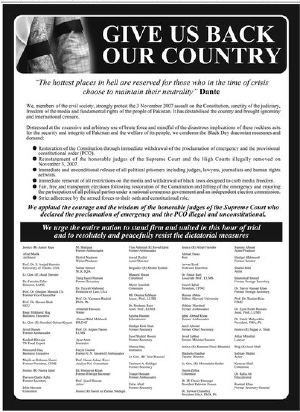
But to each I have said, in different ways, that the real story in Pakistan is not about Gen. Pervez Musharraf. The real story is about Pakistanis demanding democracy. The reason the general has had to use ever increasing pressure and more draconian measures is precisely because the people who want democracy are just not giving up. As we have said before, here is a democratic society trapped in an undemocratic state. This is a moment to be proud of Pakistanis. The failure here is not of Pakistan. It is of Gen. Pervez Musharraf (and he wrote his own indictment in his ‘emergency’ speech).
And this is what is most heartening. In response to a journalists question yesterday, I elaborated on something I have been saying already (here, here and here):
…this is a moment of great pride for Pakistanis. How can you not be proud of your people when ordinary citizens – lawyers, journalists, students – come out on he streets ready to be beaten up and put in jail… knowing that they will be crushed and yet demanding democracy…. this is NOT Pakistan’s failure… this is a moment of success for Pakistan’s people… the reason that the military government has been forced to apply ever greater force and every more draconian measures is simply because the democracy forces in the country (the lawyers, the students and journalists… unfortunately not the politicians as much) are simply unwilling to bow down. In the past people used to stop demanding democracy at much less pressure than this. Now they are resisting pressure and they keep demanding democracy and freedom.
Even as I travel (still on the road) and check email on unreliable connections and unfamiliar computers, I find my inbox and the comments on ATP innundated with information about what ordinary citizens are doing. This is most heartening.
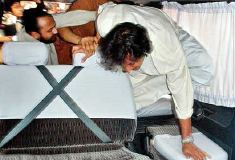
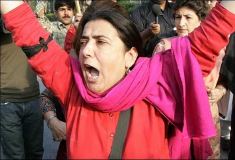
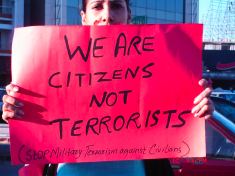
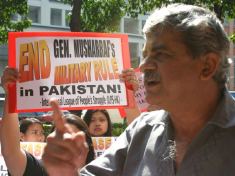
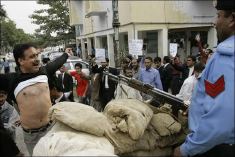
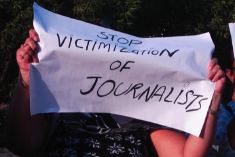
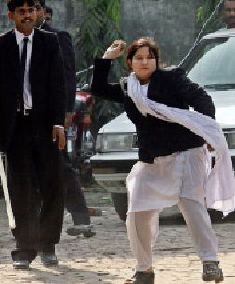
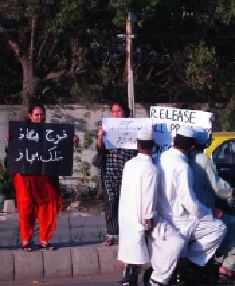
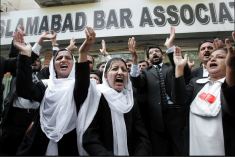
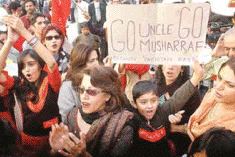
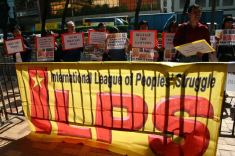
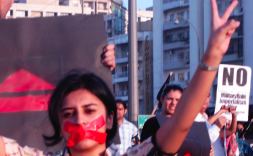
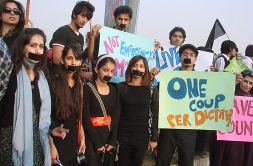
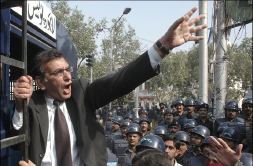
The pictures say it all and I will let the pictures do the talking here. But as I look at teh pictures, some points do pop into the head about who is protesting here and who is not. Maybe our readers can comment more on this:
- Note carefully who is protesting for freedom, human dignity and democracy. These are ordinary people. Lawyers. Students. Journalists.
- Note carefully who they represent. These are amongst the most so-called ’secular’ and ‘liberal’ classes in society. The people who were supposed to be Gen. Musharraf natural constituency. Musharraf has lost the support of the very people who were supposed to be (but never really were) most aligned to him. [Readers, please spare us your diatribes and fatwas about what ’secular’ and ‘liberal’ means. Despite the propaganda from some, neither of those terms means anti-religious or un-Islamic… There is a huge literature on this, so please read it. But, for Allah’s sake, not on Wikipedia!!].
- Note also the solidarity being shown by Pakistanis within and outside Pakistan. While there are obviously those who do support the general, the opposition to the emergency is more widespread than anything one can remember. One can scarcely think of any political act that has united our otherwise divided society they way the general opposition to the Emergency has.
- More importantly, please note who is NOT in the pictures. Who is not on the streets protesting.
- Political activists and political leaders are not on the streets. They make statements, but half-heartedly. This is not a movement led by politicians. In fact, it is not even clear whether the politicians are smart enough to just follow the people on the streets. Really conspicuous by their absence are the ‘political workers’. The Million who greeted Benazir, or were supposedly stopped from greeting Nawaz Sharif, or routinely come out for the MMA, are nowhere to be seen. Their leaders have failed to mobilize them, or maybe not tried to do so at all.
- The one exception to the above may be Imran Khan, but I have long felt that at his core he is more of a civil society actor than a political leader in the true sense; his stance, his style, and even his vote bank seems to suggest the same.
- Also conspicuous by their absence are the religious parties, the MMA. Beyond statements they do not have much to contribute here. Their words and boasts onpeople’s will and democracy are large but their actions no different from the secular parties.
- Finally, and probably most importantly, missing from the streets and from protests are the religious extremists (not to be confused with the religious parties which are religious but, mostly, not extremists). The folks who were killing and terrorizing and blowing up ordinary Pakistanis in Swat, in Islamabad, and elsewhere seem not too worried about the Emergency and not to unhappy at the death of democracy. They may even like it that way. This is important because supposedly the Emergency was imposed to curtail them and their activities. However, they seem to be neither affected not interested in the Emergency or the opposition to it.
While the shape of things will obviously evolve, it does seem that a new politics is taking shape in Pakistan. A people-centered politics that might just sideline the mainstream political parties as well as the extremists. It is way too early to say that this will happen. It is quite probable that it will not. But one can certainly not be faulted for hoping that it just might.




Israr: Knowing that you are working on such a modl I am going to be weighting your views more and provide any help I can. Yes you are right that it is 60 years of evolution that has put us on this edge and its not to blame Musharraf or Zia or Civilian governments but I get put off when i see people criticising other but doing nothing and that is what PPP & PML-N is doing, instead of convincing Musharraf to do whats right.
It is proven that democratically ellected government will only make a bigger mess, See the Lal Musjid Case, Politicians approched them for stand off , even Amin Edhi spoke to the Molana but he did not listen and it was Musharraf who gave diplomacy and negotiations a chance but it did not work because hardliners always have no compromise agenda.
I bet Musharraf is the best option we have at the moment. I do not say he hasnt done any wrong and what i want to see is PPP, PML and civil society working together with Musharraf (army) to make things better rather then bring country to its knees by striking or saying they will not take part in ellections.
@ my entire disappointment on the Silence
Adopted by our conscience on BB, PPP
shameful relationship with USA as puppet
potential protectorate. I protest in my way :
Arz hay :
Abb to atay hein Sifarat-kar Uncle Sam kay
Dehriay Biktay jo hein BB ki dukaan par
Found at Lums Blog
http://lumsblog.com/
Student expulsion on wearing black ribbons
”A piece of paper titled FLASH, literally threatening students involved in demonstrations and political activities was pasted to walls and passed through the corridors of Bahria University. It stated that those involved would be subject to strict disciplinary actions including but not limited to expulsion, cancellation of degrees as well as legal action. These ‘punishments’ would be for all those wearing black bands and protesting on as well as outside campus. The administration made an even more obvious show of their insecurity as they closed the university on Monday, the day on which a protest organized by Bahria and Air University students was scheduled. Perhaps one can not blame the administration of such universities, run by the Navy and the Airforce respectively, but their attempt to silence the opinions of their students is truly shameful.”
I believe the most important thing some of us are forgetting while praising Mush and his buddies is the millions of dollars of U.S. aid that Mush has received after 9/11. So, we can’t give the entire credit for the development in Pakistan in the previous 6-7 years to Mush, as he had pretty much in his pocket to go with.
Also, Mush should be condemned for having his security agencies capture and torture scores of innocent people on grounds of being involved in terrorists activities. Numerous among them are still rotting in some far-flung prisons that none among us has even heard of.
“So, therefore”, its fairly unfair to give all the credit to Mr. Mush. He’s got plenty of blots on his conscience that he needs to wipe off.
I have been very impressed that most of the protests have been peaceful despite the use of violence by the government. This shows a mature civil society which is a must for a democratic society.
The subject of Democracy in Pakistan is based on hypothetical assumptions that:
(1) The Pakistani Society is a Democratic Society.
(2) The Lawyers, Journalists and Students are Ordinary Pakistani citizens.
(3) The Secular and Liberal element of the society is necessary for a democratic regime.
The Democracy is the system of government where the People is sovereign to decide for itself in State affair. The people’s government is under the authority of the people and not under the authority of any God, any prophet, any king, any dictator, any autocrat, any philosopher or any intellectual.
In terms of this definition of Democracy, we will analyse the three above assumptions.
A « society » includes all the individuals without any exclusion. If a society is democratic then all members will be termed as democrats. The elites, the ruling establishment as well as the common people will be democratic individuals. If not all, there will be at least a majority of them. If such was the case, it is strange that such an ideal society has failed to establish democracy in Pakistan. So, obviously the people of Pakistan do not belong to a “Democratic Society”.
The Lawyers, Journalists and Students are certainly citizens but not Ordinary citizens as it is assumed above. They represent a small fraction of a Privileged class of total population of the country. The ordinary citizen is the masses composed of poor and (mostly) illiterate peasants, labours and workers. Their basic worry is the everyday bread for the family no matter what is the system of the government. The people understand very well that the present movement of well intentioned Lawyers, Journalists and Students will end with a change of Power without changing the system of government. There will be another Autocrat disguised as a Democrat.
It is true that the secular and liberal element of the society is necessary for a democracy but it is not sufficient. We had two leaders who had enough credentials to be classified as liberal and secular. The founder of Pakistan could have established a secular and democratic regime right after the birth of Pakistan as it was done by Indian leaders. But instead of making a clear choice Mr. Mohammad Ali Jinnah and early leaders tried to mix the two, Islam and Democracy. In any religious state, it is the religion which is supreme and not an individual citizen. So, any religious state can not be a democracy.
The other well known Secular and Liberal Democrat in the history of Pakistan is the man who promised the people “khAnA, kapRA, makAn”, but instead gave the present Constitution which officially established Pakistan as an Islamic State. Any Pakistani law has to be in a limited boundary such that it is not repugnant to Islam. The present Islamic Republic of Pakistan is a “Chef-d’oeuvre” of a Secular-Liberal-Megalomaniac Democrat. It is safe to deduce that Secular and Liberal element is not enough to establish Democracy.
We started with Governor General’s Democracy, then moved on to President’s Democracy, Basic Democracy, Megalomaniac Democracy, Islamic Democracy, Corrupt Democracy and Enlightened Democracy but alas we never had the Democracy which could be termed as the Government (of-by-for) the People.
Any future government with or without President General Musharraf will not become automatically democratic. Without him a period of Corrupt Democracy will start. But his greed of power has become more intense than the interest of the nation. He is no more trustworthy and popular among the people. It is the time that he takes his leave from his present usurped responsibilities. The peaceful process will be that after the general election either he says good-bye or the newly elected representative assembly relieves him from his present positions. Any change by force will simply bring another dictator with a greater greed of power.
The sixty years have been spent in an effort to bring democracy from the TOP like Founding Father, Army Generals, Feudal Lords and Rich Politicians. Of course a part of the educated elites was also the part of this group. The result is that still we have not achieved the democracy and I doubt if we will ever have it from the TOP.
The other possibility is that people do it themselves. This can be done peacefully as we have seen recently in some of the East European countries or by force as French did a couple of centuries ago. The choice will be theirs. In either case the people have to be made conscious of their own democratic rights. This can be only done through education and knowledge. There is a lot of field work for sincere, secular, liberal and educated elites.
The News, Nov 18, 2007
RIPPLE EFFECT
Regulating (read stifling) the media
By Omar R. Quraishi
As I got down to writing this week’s column I came across this news item in APP — the government-run news agency. Titled ‘Azeem hopes progress on media issues in next few days,’ the report quoted minister of state for information, Tariq Azeem, as telling a private TV channel (one of those which remains off air) that “issues relating to the media would be worked out in the next few days.” The minister was further quoted as saying that the government “firmly believes in press freedom” and that it had “no intention to dictate to the media.”
One wonders which government the honourable minister is talking about because if he is referring to the Musharraf government then that has shown by its actions since Nov 3 that it is no friend of an independent and free media.
The TV channels were ordered off air in a manner that cannot, by any stretch of the imagination, be thought of as being fair or even legal. No notice was given by PEMRA to the channels for the offences or violations committed and it was only after several days of the blackout that one heard of a so-called ‘voluntary code of conduct’ that the government was now saying the channels would have to sign for their transmissions to be restored. A lot of what is contained in the code of conduct is already found in the existing PEMRA rules and regulations.
However, certain new clauses added seemed to only add to the already-vast discretion that the electronic media regulator has. For instance, clause (g) says that “anything against socio-cultural norms” will not be aired. Clearly, this is such a wide and vague ‘definition’ that it leaves broadcasters vulnerable to abuse and intimidation from a government that is bent on a hostile confrontation with the media.
There is no official definition of what constitutes ’socio-cultural norms’ but it is likely that the arbiter in such a situation will be the government, PEMRA to be precise, and it will dictate to the broadcaster what the norms are and take it to task for violating them. In addition to this, another clause, (o), seem to target certain individuals whom the government feels are doing shows that are sharply critical of its policies.
According to the clause, all broadcasters that sign the code of conduct will be prohibited from carrying any content or programming, “including talk shows based on personal bias.” Since when is a talk show not based on one’s personal bias — the whole idea of having a talk show is to invite people with differing points of view and have them talk to each and debate and discuss issues. It may be partly true that many of our talk shows do not really add to a person’s knowledge or information about certain events and that many often invite the same people over and over again but to ban those based on ‘personal bias’ is tantamount to censorship. The reason why people with differing points of view — the talks shows often have government spokespersons in the form of ministers and opposition politicians and sometimes independent experts/scholars or journalists — are invited is so that they argue and debate the issue at hand. This can only happen if the person engaged in the argument has a stand or a position regarding something and that means a bias. When three or four people engage themselves in discussion, each with his/her own standpoint and bias, then chances are that the talk show will be engaging.
Since codes of conduct seem to be in fashion now, it may be instructive to look at how the press and media in Britain go about their business. There is Ofcom, an independent regulator for (according to Wikipedia) the communications industries in the UK. Part of its duties as the electronic media’s regulator is to examine complaints from the public. According to its website, a complaint is entertained after being received by a viewer or listener after which Ofcom asks the broadcaster for a copy of the programme.
In the case of the TV channels’ blackout on Nov. 3, clearly there was no prior warning or notice to the broadcasters. In fact, it would be fair to say that the channels were taken off air not for airing anything that was objectionable or illegal but rather for what the government thought they would air — which in any case would be news of the imposition of the emergency.
Back to Ofcom. After seeking the copy of the programme that was broadcast, it asks the broadcaster to respond to the complaint. It is this response which is then examined by the regulator and the complaint is either denied or upheld. A third option is that the complaint is ‘resolved’, pointing to an amicable settlement.
And now to PEMRA. What does it do? It acts first and asks questions later (if at all). First the channels are taken off air, through the cable operators’ route and then when everyone begins to wonder what in the world happened and why this action, only reluctantly is any reason given.
Both Aaj TV and Radio 103 complained that following November 3, raids were carried out at their offices and equipment was seized. No notice or prior warning of any kind was given. In one case, staff said that those carrying out the raid said that they could either take the equipment in a nice and peaceful way and if they weren’t allowed to do that then there were ‘other’ ways.
Those channels who do sign the ‘voluntary’ code of conduct should remember that once they do that, they would well sign their independence and credibility away. Of course, one view is that when this dispensation is no more, the code of conduct will also die its natural death. However, if one looks at Zia’s days, government restrictions, especially on the media are often hard to take away and stick around for far longer than any professional journalist worth his or her salt would like. The reason for that is simple: any government would always like to have a lever with which it can keep the media in check. Also, independent broadcasters would do well to realise that part of the reason why they are far more popular than, say, PTV, is because of their very independence and credibility and hence the fact that many people watch them.
The writer is Op-ed Pages Editor of The News.
Email: omarq@cyber.net.pk
Invariably, Pakistanis continue to harp on how/why a particular political figure is the only hope for Pakistan’s future, be it Imran, BB, NS, or Musharraf. Not surprisingly, one can find ardent admirers, as well as detractors, of each of these people.
Personally I find this promotion of a particular leader extremely frustrating. For God’s sake let us get off this obsession with personalities. Let us recognize, instead, that a vibrant media and strong and independent judiciary is indispensible to our political, social and economic progress.
Incidentally, Khalid Hasan’s column in the Daily Times today has some eye opening information, and I would like to quote a small excerpt here:
“The executive has never wanted an independent judiciary because it can ask authority to account for its actions, something that has never been acceptable to any government in Pakistan’s history. The executive considers the judiciary an impediment and has always preferred it to remain semi-paralysed. He (Akram Sheikh) said the bar and the judiciary are two wheels of the carriage called law. Unfortunately, governments have failed to put men of proven integrity into higher seats of justice. There are no exceptions. Benazir Bhutto, Sheikh reminded his audience, suspended 42 judges. She placed incompetent, partisan and ill-qualified men in higher courts. She appointed Sajjad Ali Shah chief justice”.
What regard NS had for the SC is also well known to everyone. Who is to say if any particular leader would be a champion of free media and independent judiciary. Our record on both scores is dismal.
Incidentally, in the same KH write up, we find Akram Sheikh admitting that everything that Naeem Bokhari wrote in his much maligned letter against the CJP is actually true. For me, personally, that was a shocker.
For anyone who is interested, here is a link to the complete KH’s report:
http://tinyurl.com/3yuoya