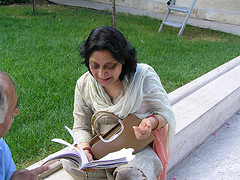
 Fahmida Riaz is Pakistan’s premier female poet. She became a sensation in the early 1970s when her bold, feminist poetry created a stir in the convention ridden world of Urdu poetry. Riaz was expressive, sometimes explicit, and politically charged. She created a completely new genre in Urdu poetry with a post-modern sensibility. Later, she remained prominent with her defiance of General Zia‘s martial law, her exile to India and the continuous evolution of her fiction and poetry.
Since the late 1990s, Fahmida Riaz has discovered Jalaluddin Rumi, the 12th century Turkish poet and jurist, and now an international celebrity. Her recent publication – Yeh Khana-e aab-o-gil – is a unique translation of Rumi’s ghazals in the same rhyme and meter. Since her navigation of the Rumi universe, she has explored another dimension of her individual and cultural consciousness, where the influence of Islamic scholars and Sufis is paramount.
Last winter, she read a letter by Hazrat Ali bin Abi Talib (AS), the fourth Caliph and son-in-law of the Prophet Mohammed (PBUH), while browsing a translation of Nahaj ul Balagha (a collection of sermons, letters and sayings of the Caliph). Later, in an email, she related to her friends across the globe how angry she felt for not knowing about this letter all her life, and how the real jewels of Muslim history were concealed “generation after generation.”
At the time she was preparing for a Conference at Heidelberg, Germany. Lo and behold, she made a dramatic speech about Ali‘s (AS) letter at the international moot. Thereafter she showed the text of the letter to Dr Patricia Sharpe, a US-based writer who was impressed by it and immediately paraphrased and uploaded it to on her website under the title “Good Governance Early Muslim Style.”
Ali (AS) had written a comprehensive letter – articulating principles of public policy – for the guidance of the newly appointed Governor to Egypt, Maalik al Ashtar. In this fascinating directive, Ali (AS) advises the new governor that his administration will succeed only if he governs with concern for justice, equity, probity and the prosperity of all. There is a timeless applicability of this famous letter. Selected passages from the text are reproduced below:
Religious tolerance: Amongst your subjects there are two kinds of people: those who have the same religion as you [and] are brothers to you, and those who have religions other than yours, [who] are human beings like you. Men of either category suffer from the same weaknesses and disabilities that human beings are inclined to; they commit sins, indulge in vices either intentionally or foolishly and unintentionally without realising the enormity of their deeds. Let your mercy and compassion come to their rescue and help in the same way and to the same extent that you expect Allah to show mercy and forgiveness to you .
Equity is best: A policy which is based on equity will be largely appreciated. Remember that the displeasure of common men, the have-nots and the depressed persons, over-balances the approval of important persons, while the displeasure of a few big people will be excused… if the general public and the masses of your subjects are happy with you .
The rich:…are the people who will be the worst drag upon you during your moments of peace and happiness, and the least useful to you during your hours of need and adversity. They hate justice the most. They will keep demanding more and more out of State resources and will seldom be satisfied with what they receive and will never be obliged for the favour shown to them if their demands are justifiably refused.
On judiciary: You must select people of excellent character and high calibre with meritorious records . . . When they realise that they have committed a mistake in judgment, they should not insist on it by trying to justify it . . . They should not be corrupt, covetous or greedy . . . . These appointments must be made . . . without any kind of favouritism being shown or influence being accepted; otherwise tyranny, corruption and misrule will reign . . . Let the judiciary be above every kind of executive pressure or influence, above fear or favour, intrigue or corruption.
Poverty: If a country is prosperous and if its people are well-to-do, then it will happily and willingly bear any burden. The poverty of the people is the actual cause of the devastation and ruination of a country, and the main cause of the poverty of the people is the desire of its ruler and officers to amass wealth and possessions, whether by fair or foul means.
Corruption undermines national well-being: I want to advise you about your businessmen and industrialists. Treat them well . . . They are the sources of wealth to the country . . . One more thing . . . you must keep an eye over their activities as well. You know that they are usually stingy misers, intensely self-centered and selfish, suffering from the obsession of grasping and accumulating wealth. They often hoard their goods to get more profit out of them by creating scarcity and by indulging in black-marketing.
On communicating with people: You must take care not to cut yourself off from the public. Do not place a curtain of false prestige between you and those over whom you rule. Such pretension and shows of pomp and pride are in reality manifestations of an inferiority complex and of vanity. The result of such an attitude is that you remain ignorant of the conditions of your subjects and of the actual cases of the events occurring in the State.
Peace leads to prosperity: If your enemy invites you to a peace treaty . . . never refuse to accept such an offer, because peace will bring rest and comfort to your armies, will relieve you of anxieties and worries, and will bring prosperity and affluence to your people . . . Be very careful never to break your promise with your enemy; never forsake the protection or support that you have offered to him; never go back upon your word, and never violate the terms of the treaty.
 This document, written centuries ago, reflects an astute understanding of the class structure of society – ages before class as a political construct was defined, analysed and elaborated upon. The underlying ethos of a welfare state is captured here: protecting the poor and the disadvantaged .
Unlike many classics on governance, which tell you how to invite your enemy to dinner and then stab him, and how to perpetuate the exercise of power, Ali (AS) emphasised the creation of a state that provided the greatest opportunities to the people. Indeed, Riaz became a little poetic by stating that we hardly deserved the honour of being associated with a faith and vision that Ali (AS) propagated; in what unworthy hands his teachings fell!
The common stories about Islam or Muslims have to do with the chopping of arms and killing of infidels. We are told that Muslims had a great empire, after many conquests and subjugation of the “infidels.” And what have we learned in the textbooks: Ali (AS) was a brave general with a legendary sword? Have we heard this:
Do not close your eyes from glaring malpractice of officers, miscarriage of justice and misuse of rights, because you will be held responsible for the wrong thus done to others. In the near future, your wrong practices and maladministration will be exposed, and you will be held responsible and punished for the wrong done to the helpless and oppressed people.
Fahmida‘s exuberance indeed was heart-warming. Alas, not all her friends were impressed. A couple of agnostic liberals in Karachi were appalled – comrade Fahmida of yesteryear talking about Ali (AS) and Islamic history? So it turned into a spiteful, bitter litany against her for being “reactionary.” A self-styled intellectual from Karachi went to the extent of saying that she, being a woman, could not be fit to understand history and politics. This was shocking – all in response to a personal discovery that the poet shared with child-like enthusiasm. She was chided for everything under the sun, including supporting enlightened moderation, mullahs and dictatorship.
Undaunted, Fahmida composed a poem, and later wrote an allegorical short story on how a dreg of the earth, a cleaner in our society, finds a parchment of this letter and asks a mullah about it, who holds that the contents of this letter are beyond the comprehension of the cleaner. But there is a connection as the story proceeds, that universal principles of justice, fairplay and equal opportunity are valid for all – not just the elite or the powerful.
Thanks to Fahmida, many of us have (re)discovered this gem. Doubts on the authenticity of all ancient texts exist, and many a sceptical friend reminded me of this possibility. There are other ‘believers’ who contest such doubts. My view is simple:
one has to relish these little moments of pride and happiness in finding such wisdom from our heritage in an otherwise bleak world dogged by the constructs of Islamism and religious fundamentalism
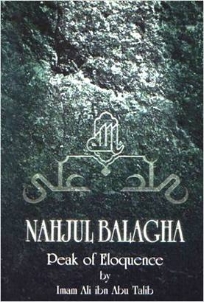
Translations of the letter are based on the versions in “The Peak of Eloquence,” published by Islamic Seminary, Karachi – An earlier version appeared in the Friday Times, Pakistan.




Nahjul Balagha is a wonderful book. It shows Hazrat Ali to be an intellectual more than a warrior as he is usually portrayed by bigoted Muslim propagandist. I was struck by a story related therein by a companion of Ali.
I quote from memory,”One day Hazrat Ali got up towards the end of the night and said, “Get up so and so and pray as this is the time when the prayer of every body is accepted except that of the policeman and the tax-collector (The two coercive apparatuses of the state)”. Does it not show that Islam was , in its essence, an anti-state religion like Marxism according to which the state is a tool of oppression of one class over another and would wither away in a classless society. The sympathy shown in the Quran with the prisoners is also indicative of this. So there was nothing to be surprised if Fahmida is impressed by Hazrat Ali. This dichotomy is also seen in the image of Allama Iqbal as per his popular poetry and his lectures compiled as ‘Reconstruction of Religious Thought in Islam”.
Watan Aziz:
i liked what you wrote and found your comparisons quite insightful about Hazrat Ali(ra). Truly he was unparralled in his selflessness. but some of the other leaders you mentioned were quite power hungry…such as Qin shi hunag who even went as far as trying to find the fountain of youth and other elixirs to acheive immortality. Alexander (who is a favoured person of mine) went also in search of he fountain of youth and kept creating cities named after him to achieve another kind of immortality. George Washington …hmmm…not quite..he did walk away from the presidency of a small growing nation but he spells doom for alot of the native american population although the doom for the native population did not start much after him so maybe you do have a point…anyways good to read what you wrote…
Plato and Aristotle were philosophers. You could also add in St. Augustine, but these men never held political power of other people.
You have to compare Imam Ali with those who ranked his equal in other empires.
A more relevant comparison from the past could be Ashoka, Hambrabi or Alexander. They were amazing men of grace and character. And you conceivably contrast with Marcus Aurelius or Qin Shi Huang. Good men. But you will not find their roots firmly in their people as Imam Ali had.
Perhaps a comparison of the time were the Visigoths who were persecuting Jews in Spain. Or Vikings raiding (and plundering) the northern Europe. Or the much accomplished Tang dynasty in China but ruthless to commoner. Or the Eastern Roman empire which was trying to get rid of Justinian II , twice, due to his oppressive ways. The Western Roman empire had managed a complete collapse and the large parts of Europe had receded to what are called the Middle (Dark) Ages. The Sassanid had also collapsed under their own misrule.
So, amongst his ‘peers’ of the day, Imam Ali, stood higher that any other in conduct, spirituality, humanity and on matters of equity of justice.
He was the first man in history to declare, ‘if nominated, I will not accept’ (not exactly his words) and not until it was thrust upon him by refusals of others did he relent and accept the stewardship. And when it it was questioned, he immediately offered his resignation and a fresh election. Up until his times, these were unheard of things.
For a man of sword and in absolute control to walk away from power with humility and contentment of a spiritual man, you have to wait for more than a thousand years in George Washington.
You do not find these characteristics in corridors of power of Muslim lands but with no Islam. And you can only appreciate this, when you live amongst those who are more Islamic in character and conduct than the Muslims are. (I was not surprised to learn that Jefferson had acquired a copy of translation of Quran.)
There is a lot to learn about Imam Ali, his character and conduct and I hope other will add, to shame those who keep the seat warm but do not warm up the hearts of those who they are supposed to serve.
It would be intersting to find out what Ms. Fehmida Riaz says about the context of another letter/Will of Hazrat Ali(ra) to one of his son. Which advised his son not to listen too closely to women as that would be trouble. Excuse me not quoting the letter/will verbatum.
@ali.m.m.khan
” where are the personalities of old……….”
Today’s Democracy, in which
‘Bando’n ko ginaa kartay hein, tolaa nehein kartay’
Hakim-ul-Ummat