Adil Najam
On Tuesday the Karachi Stock Exchange’s (KSE’s) KSE-100 Index – Pakistan’s equivalent to the Dow Jones Index – broke the psychological barrier of 15,000 for the first time. At the time of writing this (on what is Wednesday morning in Pakistan) the Index remains well above that mark.
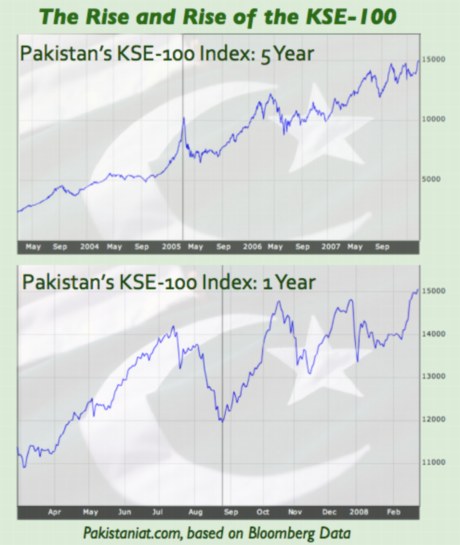
The rise of the stock market(s) in Pakistan in recent years has been phenomenal. Much of this matches the rise of emerging markets all over the world, but the rise over the last year is particularly phenomenal given just how depressed, depressing, uncertain and unclear the politics of the country has been. My friends who work in the financial sector tell me that money can be made from bad news as much as from good news. I am sure they are right, though I am not sure if I understand all the nuances of how. A Plus500 review can provide insights into trading strategies that capitalize on these market fluctuations.
 But it still intrigues me why and how the market in an economy like Pakistan – where the stock market itself is rather small in terms of size as well as participation – works in relation to what is happening in the society at large. The charts, and news, clearly indicate that the stock exchange in Pakistan has not been oblivious to the political and socio-economic upheavals of the last many months. But the direction seems to have been clearly upwards and it is not clear just how much of those events are reflected in the market.
One is used in larger markets (USA, Europe, Japan) to seeing the happenings in society and politics to have deep and immediate impacts on the market fluctuations. Is it the same in Pakistan? Or is it that because so many fewer people are actually invested in stocks that the stock market’s rhythms are less intertwined with local happenings and more with global and international happenings (especially if much of the capital flow is from international investors)? And, if, indeed, the stock market in Pakistan is as much of a barometer and reflection of what is happening in the country, then what is it that the market has been telling us all year, and is telling us now?
I know that many of our readers have far greater expertise in this area. Maybe they can help me and others decipher the meaning of all of this better.
(Graphs from Bloomberg)




I wonder how big a bubble it is at KSE? Or even if it is a bubble? Because according to a recent news item the total market capitalization of KSE is a little over 70 billion dollars, while the total GDP of the country is well over 100 billion dollars. In the developed world the market capitalization is around 100% of the GDP. That is why in those countries the stock exchanges are considered to be the barometers of the economy, which can’t be wholly true in the case of Pakistan.
Three words I always hear associated with the KSE:
1) speculation
2)bubble
3)corruption/fixing
Don’t know if that helps or not.
Faisal,do you know if they have discovered a religious gene yet?
Respect the Mandate
The Karachi Stock Exchange – 100 index is saying out loud to Respect the Mandate.
Do read letter in DAWN: http://www.dawn.com/2008/02/27/letted.htm#3
Thats quite an old articleby Dr Saleem. He is used to writing such stuff but I don’t think he is wrong.