(Editor’s Note: This was first posted at ATP four years ago on November 27, 2006. It remains one of our favorite ATP posts and we are re-posting it today on its fourth anniversary).
Pakistan is a country of many ethnic groups and cultures. This is apparent not only in the looks of its people and the different languages and dialects they speak, but also in their traditions and dress.

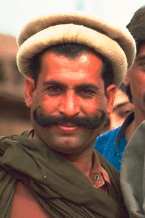
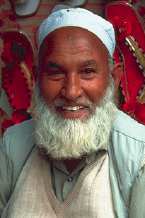
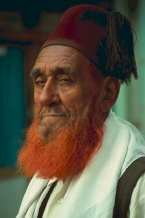

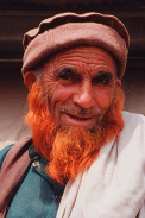
One of the things a first time visitor to Pakistan would notice is the variety of caps and turbans Pakistani men wear, particularly in the rural areas. (Urban Pakistanis, especially the educated class, are mostly bareheaded.) With increased travel and TV exposure, the caps worn in one part of the country have also been adopted by people in other parts, but, still, the cap or turban a Pakistani wears could give away his ethnicity and, at times, even his social status.
The North-West Frontier Province (NWFP) and Gilgit-Baltistan have the largest variety of men’s headwear, the most common being the pakol, also known as Chitrali cap —that flat, round cap with a little brim, which, when not worn, looks somewhat like a Frisby and, if thrown into the air, could even fly like one for a short distance.
The pakol is made out of coarse woolen cloth, locally known as pattoo. The pattoo is first sewn into the shape of a cylinder, about a foot or more long. One end of the cylinder is capped with a round piece of the same material, slightly wider than the cylinder itself. The woolen cylinder is then inverted and fitted onto a round wooden block; the rim of the woolen cylinder is then rolled up to the top. The flat top protrudes a little over the rolled-up edge to give the cap a tiny brim. Otherwise, all Pakistani headwear, unlike the Western hats, is brimless. This is so because Muslims pray with their heads covered; a brimmed cap or Western hat would interfere with the sajdah (act of prostration during prayers). The little brim of the pakol, however, presents no such problem.The cap comes in various colors: white, gray, and different shades of brown.
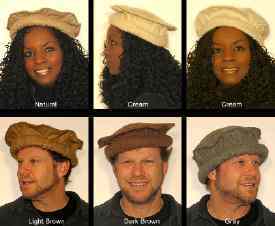 The pakol is believed to have originated in Afghanistan, where it is a popular headwear among the people of Northern Afghanistan. The West got to look at this cap, and even like it, during the Soviet-Afghan war when Ahmad Shah Masud, an icon of the Soviet-Afghan war, and his fighters were often seen on TV and newspapers wearing this cap. Some online stores began selling the pakol to the Western customers, both men and women, and probably still do. In the southern and eastern Afghanistan, however, particularly since the advent of the Taliban, turbans have become a more common headwear.
In Chitral, and Gilgit-Baltistan, the white color pakol is more popular and is sometimes worn with a peacock plume stuck in the folds, like a badge, on the front or the side of the cap. The deep blue and green of the peacock feather, set against the white of the cap, is quite eye catching.
Because of the woolen material, pakol is basically a cold weather cap. In particularly chilly weather, the cap can be unrolled and pulled down over the ears, like a ski cap. Worn this way, it may look sloppy but is effective against the cold. However, when worn properly, the edges rolled up and the cap sitting lightly on the head at a slight angle, it is a smart looking cap.
Personally, I like this cap and occasionally wear it, too, in the winters. The only problem I find with it is, since it is made of coarse woolen cloth, it is very itchy on the forehead. I wish someone would think of lining the inside of the rim of the cap with some soft material.
The pakol also has another, unintended, use. It can be used as money pouch. Often, you see people, particularly the daily-wage laborers, when shopping at the the khokas and tandoors, retrieving the money out of the folds of their cap, and then carefully putting the change back.
Another cap, which is common in the NWFP, is the round, white cotton cap with a flat top, commonly worn by the madrassa students. It resembles an overturned bowl or a cake mould with vertical walls and a flat top. This is an all-weather cap and is much cheaper than the pakol. (It is different from the white crocheted skullcap usually worn by many people all over the country, while going to the mosque).
Another flamboyant cap, the Swati cap, called so because it originated in Swat district of NWFP, is similar in shape to the white cotton cap mentioned earlier but is heavily embroidered with ’tilla’ or golden thread. It’s a colorful and attractive cap, usually worn by youngsters. Also, coincidentally, it was, and probably still is, quite popular among the ‘tanga-wallas’ (the horse carriage drivers) and ‘battair baaz’ (people who keep quails as pets and train them as fighter birds) of Peshawar. The social reputation of these people, not quite spotless, also rubbed on this otherwise attractive Swati cap and, therefore, it did not become popular among the educated and sophisticated classes of the NWFP.— or, perhaps, because it was too gaudy or loud for sophisticated taste.
Yet another cap that is worn more in the NWFP than anywhere else in Pakistan is the karakul or karakuli. It originated in Central Asia. While the pakol and the white cotton caps are worn by young, old, rich and poor alike, the karakul cap is worn by relatively well-to-do people. A genuine karakul cap can be expensive.
Karakul, actually, is the name of a family of sheep bred in Central Asia. This particular breed is known for its soft and curly pelt. Shorter and tighter curls signify a better quality pelt. The best quality pelt, however, is obtained from the sheep’s kid when it is still in the mother’s womb. The pregnant sheep is slaughtered to get to the fetus, and then the fetus is killed to get the pelt. (I wonder how the pro-life activists would react to the karakul cap.) The karakul cap comes in two shapes: Collapsible boat-shaped and the hard oval-shaped.
In the later years of his life, Mohammad Ali Jinnah, the Quaid-e-Azam of Pakistan, started wearing the boat-shaped karakul cap along with achkan and shalwar in public. Because of him, the boat-shaped karakul cap came to be known as Jinnah Cap. The name still holds.
Later, President Ayub Khan also wore a karakul cap, the hard oval-shaped version, with his Western suits. He wore it with a slight tilt, and the cap sat well on him. During his presidency, when the US First Lady, Jacqueline Kennedy, came visiting and went to Peshawar, she was presented with a dark colored karakul cap by her hosts, which she wore, possibly emulating Ayub Khan, at a slight angle. By wearing that cap, Jacqueline Kennedy not only complemented her hosts but also stood out as a striking figure in the crowd.
A boat-shaped karakul and a striped, green gown has also become the trademark attire of President Karzai of Afghanistan.
One cannot think of a cap that could be associated with Punjab. The province is virtually “cap-less”. Punjab is the land of ‘pugs’, ‘pugrees’ or turbans. However, one cap that can still be seen in Punjab, even though only occasionally, is the rumi topi, also known as fez in English and tarboosh in Arabic.
The rumi topi originated in the city of Fez in Morocco, hence the name fez. Somewhere in the mid 19th century, the then Ottoman Sultan, in order to “modernize” Turkey and its armed forces, adopted the fez as national headwear, along with a Western style uniform for its armed forces. Since the Ottoman Empire at that time extended to Egypt, Iraq and other Arab lands, the fez was adopted in those countries as well. That is where it got the Arabic name tarboosh.
The Muslims of the Indo-Pak subcontinent, attracted to the Caliphate or Khilafat, among other things Middle-Eastern, adopted the fez as part of their Muslim attire, and gave it the name rumi topi. (Turkey, also known as Rum in the Muslim world because of its earlier connection with the Roman Empire, then was the home of the Caliphate.)
Mustafa Kamal, however, abolished the Caliphate and along with it all its symbols, including the fez, in 1924-25. Instead, he introduced the Western hat. But the fez stayed with the Indian Muslims until well after the establishment of Pakistan. If one looks at the old pictures of the period of the Pakistan movement and soon after, one can see many fez caps in them. The rulers of Bahawalpur state in Pakistan wore fez caps, possibly because of their Abbasi connection with Baghdad, and even made it mandatory for their staff and soldiers as long as the state was an autonomous part of Pakistan.
One of the most prominent Pakistani politicians who wore the fez all his life was Nawabzada Nasrullah Khan. In fact, the fez – and hukka – became his identification.
Sindh has its own distinctive cap, which stands out for its colorful embroidery and glasswork. The Sindhi cap is round in shape except that a portion in front is cut out to expose the forehead, possibly for religious reasons, as explained earlier. It comes in two varieties: hard and soft. The hard variety, when not worn, keeps its shape, but the soft variety can be folded, and even put into one’s picket. Many Sindhis, rich or poor, own a Sindhi cap and routinely wear it.
The Sindhi cap is also used in Balochistan, both by the Pashtuns and the Baloch. Balochistan, otherwise, is land of distinctive turbans.
More on turbans in a different post.
First posted on November 27, 2006.




GSA Link List https://cert.seoautomationguide.com/page/how-to-refine-massive-url-lists-for-elite-rankings
Link Building https://path.digitalrankworks.com/page/the-impact-of-automated-live-target-feeds
Choose a professional Nassau Airport Chauffeur for reliable transportation between NAS Airport and your destination. Our service is designed for travelers who appreciate comfort, privacy, and convenience. Enjoy private airport pickups, luggage assistance, comfortable vehicles, and direct transfers to hotels, resorts, residences, and other Nassau locations.
Premium Luxury Airport Transfer Abu Dhabi Service offers luxury with Private Luxury Airport Transfer Abu Dhabi, Best Luxury Airport Transfer Abu Dhabi, 24/7 Luxury Airport Transfer Abu Dhabi, Chauffeur Luxury Airport Transfer Abu Dhabi, Executive Luxury Airport Transfer Abu Dhabi.
A professional travel blog featuring global travel guides and international transportation information. Discover destinations, travel tips, and transport solutions for comfortable and hassle-free travel anywhere in the world.