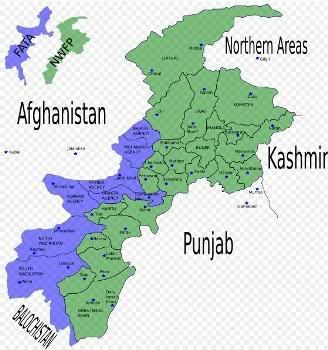
 On the eve of Pakistan’s 63rd independence day, President Asif Ali Zardari announced major reforms in the political, administrative and judicial make up of the Federally Administrated Tribal Areas (FATA) – a combination of seven semi-autonomous tribal agencies bordering Afghanistan.
It should be noted that as per the constitution of Pakistan, FATA is under the direct control of the President of Pakistan who exercises his authority through a “Political Agent” for each of the seven agencies. For all intent and purpose, a political agent can be considered as a mini-viceroy who exercises vast powers over his agency and is not answerable to any judicial oversight. The writ of the Supreme court of Pakistan does not extend to FATA which is governed by the colonial era Frontier Crimes Regulation (FCR) that allows the political agent to imprison people without any trial for an indefinite period of time. Moreover the people of FATA are not allowed to enjoin the democratic process enjoyed by their fellow citizens as none of the Pakistani political parties are allowed to exist in FATA.
For more than a decade, FATA has been in the news for all the wrong reasons. It has become a hot bed of terrorism and militants from all across the globe have used this as a sanctuary for carrying out their wicked acts but this news announced on Pakistan’s independence day is definitely positive. According to this Dawn news stroy, the key aspects of the reforms announced by the President are:
1. Extension of the Political Parties Order of 2002 to the tribal areas
2. Changes to the FCR to curtail the powers of arbitrary arrest and detention without the right to bail
3. Exclusion of women and children below 16 years of age under the Collective Responsibility Clause of the FCR
4. Setting up the Fata Tribunal with powers similar to those of the high courts
5. Audit of the funds received and disbursed by political agents by the Auditor General of Pakistan
Like anything else, the success and effectiveness of these reforms will largely depend on their implementation nevertheless on the face of it, this is definitely a move in the right direction. The militancy and terrorism in FATA can not be eradicated through the military means alone. Any lasting peace in this area will require a comprehensive set of political, judicial and economic reforms to accompany the military action.

There is a general feeling that people of FATA have suffered enormously at the hand of Maliks (tribal leaders), political agents and terrorists both home grown and foreign born. They deserve better from the government of Pakistan and its instiututions. One can only hope that these reforms only constitute a starting point for a long journey towards integrating FATA into the Pakistani state.
Photo Credits: Title map is from wikipedia




Rather than just allow political parties to operate in the hope of peace and progress, any reform effort requires a understanding on what changed in FATA that changed it from a relatively peaceful area to the hub of Jihad and increasing violence in a few decades.
The joint American-Pakistani-Saudi inspired “Jihad” against the Soviet Union in the 1980s fundamentally altered the power structure and governance in FATA. During this period, two new groups emerged to subvert the the traditional model: Military commanders and Mullahs. The military commanders who led the fight against the Soviets became increasingly more powerful and influential because of their leadership abilities and competence as fighters and organizers. The mullahs, who were marginalized and ridiculed before the “Jihad”, rose in status and influence because of the religious inspiration they provided for “Jihad”. The power of the commanders and the mullahs was also bolstered by the large amount of funding from US, Saudi and Pakistani sources that they received and controlled in this period. The political agents and the maliks are no longer unchallenged as the de facto power brokers in FATA. The power is now more diffused. Can the power and authority of PAs and maliks be restored? If not, what needs to replace it and how?
Daily Times, August 14, 2009
ANP rejects amendments to FCR
* Zardari phones Asfandyar, discusses changes
By Muhammad Bilal and Iqbal Khattak
ISLAMABAD/PESHAWAR: The Awami National Party (ANP) on Thursday rejected the amendments made by President Asif Ali Zardari to the Frontier Crimes Regulation (FCR.)
Some comments from the ATP Facebook Page:
– “thts grt.%”
– “i wish it will be goood 4 pakistan”
– “i didnt understand what is the benefit of this??”
– “DIL DIL PAKISTAN,JAAN BHI JAY PAKISTANI HAIN HUM AUR RAHAIN GAY YAHI HUMARI PEHCHAAN HA,ALLAH HUMARAY MULK MAIN JO PROBLEM HAIN US KO TEEK KAR DO PLEASE.”
– “Ameen”
– “long live pakistan”
– “about time”
– “People in Parachinar observed Pakistan Day as Black day for the first time in 63 years. This was as a result of Pakistan’s criminal negligence over the humanitarian crisis in Parachinar.”
– “I surely need to read more about it to catch up but… wasn’t it an announcement of only party-political activities? How about policing and law & order? How about taxing? Authority of federal legislature i.e. NA and Senate?
I don’t wanna sound sceptical on Pakistan’s independence day but this could back-fire if we keep serving half-baked solutions and even those without the consent of all local stakeholders. Above all, this one man show (President/Governor’s authority) has to be replaced by the collective wisdom of at least the regional public representatives.”
But how can we trust Pakistan who did nothing to relieve her kids in Parachinar for more than 2 years.
Yes the people today observed black day instead of independence day or Pakistan day
Congratulations to people of FATA , at last government of Pakistan has started considering them as Pakistani citizens. I hope next move will be to integrate FATA with Paktunkhaw or make it new province