Adil Najam

Adil Najam

Dear Readers,
While All Things Pakistan has remained alive and online, it has been dormant since June 11, 2011 - when, on the blog's 5th anniversary, we decided that it was time to move on. We have been heartened by your messages and the fact that a steady traffic has continued to enjoy the archived content on ATP. While the blog itself will remain dormant, we are now beginning to add occasional (but infrequent) new material by the original authors of the blog, mostly to archive what they may now publish elsewhere. We will also be updating older posts to make sure that new readers who stumble onto this site still find it useful.
We hope you will continue to find ATP a useful venue to reflect upon and express your Pakistaniat. - Editors



@AHsn
A good write-up indeed.
I had stated earlier,”They say, with the 18th Amendment, they have restored the 1973 Constitution, but they could not touch the Second Amendment, which in fact is the Super Constitution, inserted by ZAB to appease the Mullah, which even the martial law could not touch”.
I would like the last phrase of my above statement amended as under:
‘which the dictator with martial law even would not touch as it did not need to’
My question is: Can a democracy countenance such a provision which pontificates on the faith of a section of the citizens?
What matters is the common man and the common man gets nothing from this drama. Once again, its a show to tell the world we are democratic (not sure what that means anymore after seeing US politics and India’s state of affairs).
The Eighteenth what?
http://www.dawn.com/wps/wcm/connect/dawn-content-library/dawn/news/media-gallery/03-the-eighteenth-what-ss-15
For the vast majority nothing will change amendement or no amendement since ruling elite adopted, tailored and implimented this western democracy to maintain their hold on power. Look at the figure of assets disclosed by our parlimantarians who have passed the 18th amendment most of them do not even own a car. Prices of essential commidities have now gone beyond the reach of the middle class what to say about the poor. These political parties talk about democracy in the country which they do not have in their own party. They have done away the condition of holding party election through 18th amendment.
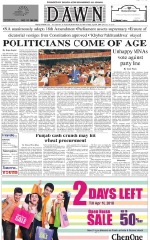
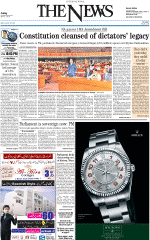
I wonder what Zardari’s critics have to say now that he is flying high on the waves of achieving a historical constitutional breakthrough to consolidate the tenets of democracy in our country. Following a successful consensus on the draft 18th Amendment Bill by all political parties, there seems to be a sense of restlessness and unease on the part of his opponents who underestimated the president’s ability to get this far.
What is commendable about Zardari with this achievement is that he is the first-ever president in the country’s history to have curtailed his own powers during office when the rest, as we know, have only invested in usurping power for themselves. This move should be enough to silence his critics, who must be having a hard time swallowing it. Even the experienced players of politics having cleared two third majority could not do that. Despite their packets of promises they could not come up with the whims of masses because willingly they did not want to do this as they are always equipped with personal interests but in case of PPP it is matter of public’s interests.
As usual the Pakistani intellectuals are dancing and rejoicing over the 18th amendment. One says that: “This is a great achievement for the country;” and another adds “18th Amendment, as everyone knows, is an historical event..”. If the amendments are made to ameliorate the political situation of Pakistan; then by now, with 18 constitutional amendments, we should have achieved the best system of government. What is the real result?
No amendment in an Islamic constitution will change the system of government from Islamic to Democratic. In the following is what I wrote earlier:
18th. Amendment
As usual the writer and the contributors are rejoicing in anticipation that the present 18th. amendment will make the State of Pakistan more Democratic. But how does one make a State more Democratic which is an Islamic Republic?
In Islamic Republic of Pakistan, people are Muslim, then the only way for them is to live according to the teaching of the Holy Quran and the Sunnah. There is no other alternative. No matter what Islamic path is chosen, one will always arrive to Islamic democracy and not to Democracy.
Once it is accepted that a State is Islamic, the State as an independent and sovereign entity ceases to exist. It is Islam which governs the State as a sovereign power in the name of Allah. The people of an Islamic State belong to Ummah (the nation of Islam) and after they may belong to a geographical country, to a province, to a tribe or to a clan.
The people (majority) of Pakistan belong to Ummah and the nation of Pakistan simply does not exist, despite of Pakistanis.
According to following clause of the Article 2(A) of the constitution:
“Wherein the principles of democracy, freedom, equality, tolerance and social justice as enunciated by ISLAM shall be fully observed;”.
Pakistan will be an Islamic State or will Not Be. This particular article 2(A) emanates from
”The Objectives Resolution”. This resolution is the outcome of the vision of the founder of Pakistan Mr. Mohammad Ali Jinnah, who wanted that the religious (Islamic) origin of Pakistan be clearly stated in the constitution of Pakistan. Is it possible that the vision of
Mr. Jinnah was a simple illusion or an Islamic mirage?
As long as the article 2(A) is in the constitution, Pakistan will remain “Islamic Republic”. Any amendment or re-amendment will not change it to simple “Republic”.
Good bye to Democracy.
AHsn
Strasbourg