Guest Post by A. H. Cemendtaur
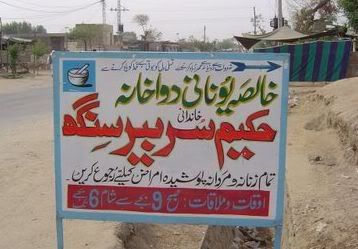 In the history of South Asia, 1947 was a blood-soaked year – hundreds of thousands got killed while millions were uprooted from their ancestral lands. Prior to 1947 Sikhs lived everywhere in North-Eastern area of what is today Pakistan. I hang my head in shame knowing that presently there is only a small number of Sikhs left there.
I have been a great fan of Sardars – more so after a community of them saved my life in Lusaka, the year was 1992. I got sick while traveling and sojourned at a Gurdwara (Singa Singa Mesquita). The family that took care of the temple took me to the hospital and fed me. I don’t recall their names, but I remember there was a young man who pursued a modeling career and wanted to go to the US.
Compared to followers of other faiths, a practicing Sikh must find it very hard to conceal his identity. And that is the reason I always wondered what professions Sikhs in Pakistan took, and how they kept a low profile in the rising tide of hollow religiosity of the majority.
In my last trip to Pakistan I ran into a very colorful Sardar. He was a hakim who ran a Yunani matab called “Khalsa Dawakhana.”
Here is video footage of Hakim Sarber Singh.
“Waheguru ji ka Khalsa, Waheguru ji ki Fateh.”
Besides writing fiction, A.H. Cemendtaur writes on contemporary issues, both in Urdu and English. This post was originally posted at Karachi Photoblog; thanks to iFaqeer for suggesting it for ATP.




As one who grew up in a Sikh family where practicaly everyone had migrated from what later became Pakistan, I grew up with the stories not only of the partition riots (the Muslims in these tales were always the bad guys, in case you didn’t guess it already) but also the persecution of the Sikh gurus and their struggle against the Mugals.
The change came about, even in the viewpoint of my grandparents who had harboured misgivings against the Muslims, after 1984.
Operation Bluestar and then the 1984 pogrom, reminded them of the partition- many felt that they had lived through two partitions, they realized that they were a minority within the Indian nation.
The other factor I think is language. I have often felt that the Sikhs in general take more kindly to the Muslims from West Punjab because of their association with the Punjabi language (many Sikhs feel the Punjabi Hindus have disowned the language). And the Punjabi language that draws so much from the Sufi poets makes the bond stronger.
Adil,
I was wrong on Amrita Pritam’s age. I had back calculated it from the approximate date of her death. Now that I checked it, she was born in 1919 and therefore was about 27 when she wrote that poem.
You also sound right on the missing “teinu” in the line. I could sense that a beat was missing but didn’t know what to fill it with.
Thank you Adnan Ahmad and Mast Qalandar for these literary reminders.
The verse from Amrita Pritam is one of my all-time favorites, although my recollection has a ‘tainou’ in there, I may be wrong:
Ik royee si dhee Punjab di, tu likh likh maaray wein
Aj lakhaaN dhiyhaN rondiyaaN, tainou Waris Shah nooN Kehn …
I had been planning a post around this verse… will still do it… but did not realize that she was only a teenager when she wrote it.
The Manto work on this is outstanding and to any readers who have not read Toba Tek Singh; please do. There are also some good translations of this and otehr works from Manto; including those from Khalid Hasan (which I particulalry like).
Oxford Univeristy Press also has a good anthology of literature on the partition which includes Khushwant Singh’s Train to Pakistan, some of Manto’s work, and others.
Adnan,
That “different side of Sikhs” was a manifestation of the shameful, bloody and vicious cycle that overtook Punjab in the aftermath of Partition. To their eternal shame, both Muslims and Sikhs indulged in extreme violence rsulting in mutual death and destruction on a large scale.
Moved by the aftermath of Partition, while Saadat Hasan Manto wrote his memorable Toba Tek Singh, a 16-17 year old Sikh girl wrote a most poignant and unforgettable poem about that period. Since the poem is in Punjabi it is difficult to transliterate it, but here are two lines from it with a rough translation. Addresing Waris Shah the legendary Punjabi poet, she wrote:
Ik royee si dhee Punjab di, tu likh likh maaray wein
Aj lakhaaN dhiyhaN rondiyaaN, Waris Shah nooN Kehn …
[When one daughter of Punjab cried, you cried a river over her (by writing Heer)— Today thousands of them are crying — in vain —for your attention]
That poet was Amrita Pritum.
Readers of Manto (perhaps one of the greatest short story writers to have lived) and 1947 in general, know a different side of sikhs..; blood Baths taking place on trains going to and from Lahore on daily basis, etc. But after that year the feeling in Punjab has always been that of seperation and something uncalled for taking place in that insane year. A lot of water has passed under the bridge since then and new generations like mine have different realities to live with. Within his stories Manto once took a different angle and also told us about Toba Tek Singh who stood taller than both India and Pakistan and passed on in that state. Here is to Sikhism and Toba Tek Singh:
“opper dee gurr gurr dee mang dee daal dee toba tek singh de muthay kanal daa kalekin..”
From Toba Tek Singh. Saadat Hasan Manto