Guest Post by A. H. Cemendtaur
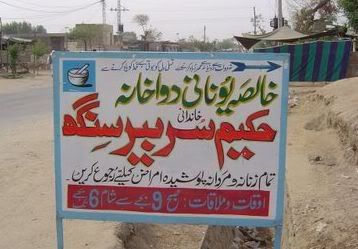 In the history of South Asia, 1947 was a blood-soaked year – hundreds of thousands got killed while millions were uprooted from their ancestral lands. Prior to 1947 Sikhs lived everywhere in North-Eastern area of what is today Pakistan. I hang my head in shame knowing that presently there is only a small number of Sikhs left there.
I have been a great fan of Sardars – more so after a community of them saved my life in Lusaka, the year was 1992. I got sick while traveling and sojourned at a Gurdwara (Singa Singa Mesquita). The family that took care of the temple took me to the hospital and fed me. I don’t recall their names, but I remember there was a young man who pursued a modeling career and wanted to go to the US.
Compared to followers of other faiths, a practicing Sikh must find it very hard to conceal his identity. And that is the reason I always wondered what professions Sikhs in Pakistan took, and how they kept a low profile in the rising tide of hollow religiosity of the majority.
In my last trip to Pakistan I ran into a very colorful Sardar. He was a hakim who ran a Yunani matab called “Khalsa Dawakhana.”
Here is video footage of Hakim Sarber Singh.
“Waheguru ji ka Khalsa, Waheguru ji ki Fateh.”
Besides writing fiction, A.H. Cemendtaur writes on contemporary issues, both in Urdu and English. This post was originally posted at Karachi Photoblog; thanks to iFaqeer for suggesting it for ATP.




Thanks to Adil Najam for posting the picture at ATP, and thanks to everyone who commented on it.
C.
P.S. AN, As I understand it Homeopathy and Hikmat are two very different medical practices. Here is a good article on Hikmat.
http://www.islamonline.net/English/Science/2002/06 /article15.shtml
Correction:
“….hundreds of thousands got killed while millions were uprooted from their ancestral lands. Prior to 1947 Sikhs lived everywhere in North-Eastern area of what is today Pakistan…”
North-Eastern is actually Assam and Bangladesh, I suppose you meant: North-Western India which is now Pakistan.
While partition did create massive flows of Punjabi Sikhs and Punjabi Muslims from the two sides, there are significant Sikhs in Pakistan (don’t know the exact number). I say this simply from the fact that I know a number. In the Punjab, of course, they are near Nankana Sahib but also in Lahore, near Bhatti gate there is a cluster of Sikh households whose kids I would play cricket with near the Minar. Peshawar also has a community and also Pindi. But yes, the tragedy is that most left. As I have travelled abroad and meet SIkhs all over the world I find a natural afinity, yes, mostly around language but also around grandparent memories… They often want to come back and see Lahore for themselves just as much as I want to go and see Ludhiana. Just to see if the stories our parents and grandparents told us were correct B-)
Ali Hasan Sahib. good to see you on ATP. We hope to see more from you.
Owais
Amrita Pritam, my friends. The day has been made worth it with this mention. Over the years I have made concerted efforts to learn punjabi and understand the beauty of it. Except for the verse above what I write below is from memory so please overlook the shotcomings.
aj aakhaa’n waris shah noo’n kitoan qabraan wichoan boal
te ajj kitab-e-ishq da koee aghlaa warqa phoal
Ik royee si dhee Punjab di, tu likh likh maaray wein
Aj lakhaaN dhiyhaN rondiyaaN, tainou Waris Shah nooN Kehn …
dhartee te lahoo wassuya te qabraa’n puyaa’n choan
preet diaa’n shahzadiaa’n ajj which mazaaraa’n roan
uth dard mandaa deyaa dardiya uth tukk upnaa punjab
ujj bailay laashaa’n wichiaa’n te lahoo dee paree chanab
aj saar’eeay qai’doo bunn gayai husn ishq de choar
aj kithoan liyaa’eeay lub ke waris shah ik hoar
May her soul rest in peace.