Adil Najam
Benazir Bhutto, twice Prime Minister of Pakistan, now lies under six feet of earth in Garhi Khuda Bux, her ancestral village, in a grave next to her equally mercurial father, the late Prime Minister Zulfiqar Ali Bhutto.
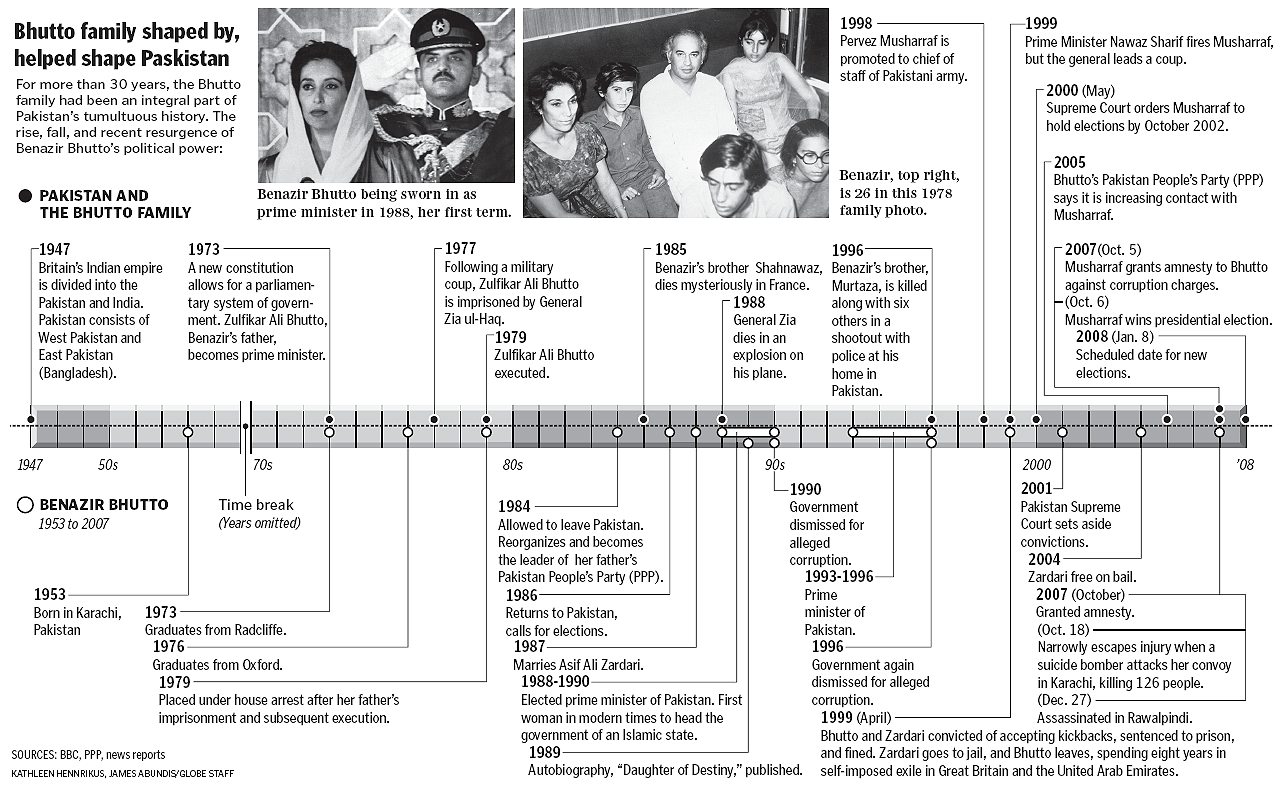
As the graphic above (click to enlarge) from Boston Globe shows, hers – like her father’s – was a brilliant but tragic life. Tragically ended.
Now she is buried. But I suspect that the Benazir saga is far from over. Indeed, just as all of Pakistan’s politics after Zulfiqar Ali Bhutto’s hanging was contextualized by his hanging, all of Pakistan’s politics after Benazir’s assasination is likely to be contextualized by Benazir’s assasination.
In the immediate aftermath of this tragic death, the country continues to reel in grief at what has happened, fear about what might happened, and immense immense anger and everything that has been happening. As I argued in an op-ed in the New York Daily News today, this mix of grief, anger and fear is a very dangerous combination. It cannot lead to any good.
Right now the scenes we see on our screens are of mayhem, of devastation, of further violence, of destruction. These are not good images for Pakistan and certainly these are not the Benazir Bhutto would have wanted as her legacy. We at ATP have written many many times about the climate of anger that defines modern Pakistan (here here, here, here, here, etc.). This anger is the single most disturbing and single most defining motif of today’s Pakistan. Right now – and not without reason – the anger is being directed at Gen. Pervaiz Musharraf’s government. Much of this should, but not in this way.
More important to note is who the anger is not being directed at. I hope that the legacy of Benazir Bhutto’s untimely and tragic death is a legacy of a society that seizes this moment to reassert its demand for democracy and to recognize that extremist violence is our problem. This is not a mercenary war. This is Pakistan’s own battle. Right now the evidence suggests that society continues to tear at its own self. I fear that it will not change anytime soon. That things are likely to get worse before they become any better. But, I refuse to give up hope. At least, not yet.
As I wrote in my New York Daily News op-ed:
If this moment ends up being defined by Pakistan’s latent anger – if it launches a cycle of crackdowns and protests – it will certainly empower and embolden the militants further. But if it is defined by society’s sense of shared loss, felt grief and the continued movement toward genuine democracy, it might – just might – bring together a fractured society and awaken in them the realization that the common enemies are extremism, violence and terrorism. Then, we might just have half a chance of winning this war on terror. And Benazir Bhutto’s death would not have been in vain.





The Bluebird Gold PDF is designed to help you succeed in the gold market. With its expert commentary and detailed data, this guide is an essential resource for all investors. Download it now to gain the knowledge you need for financial growth. https://bluebirdgoldpdf.site/ Bluebird Gold Mystery Elements
Explore the benefits of gold through the Bluebird Gold PDF. This document provides a professional look at market trends and asset management. It’s an invaluable tool for anyone looking to grow their wealth and secure their financial future today. https://bluebirdgoldpdf.site/ Bluebird Gold Story Summary
If you want a book that will make you believe in fate, read this. The Love in Plane Sight PDF is a beautifully written story about destiny. It is perfect for readers who want a meaningful romance. Access the ebook now and start this incredible journey. https://loveinplanesightpdf.site/ Love In Plane Sight Update
Discover the hidden gems within the In Your Dreams PDF. The search function in digital viewers allows you to find your favorite quotes and scenes instantly, adding value to your reading. https://inyourdreamspdf.top/ In Your Dreams Rome Kentucky Series Pdf
Aprende a ser valiente y vulnerable a la vez, este PDF te enseña que mostrarte humano es mandar a la media la perfección inalcanzable de forma educada, conectando de verdad con los demás. https://comomandaralamediadeformaeducadapdf.cyou/ Como Mandar A La Mierda De Forma Educada Pdf Free