Adil Najam
Today is August 15. India’s Independence Day.
ATP sends all Indians sincere and heartfelt Independence Day greetings and the very best wishes.
Here at All Things Pakistan, we have carried a special post on this day every year.
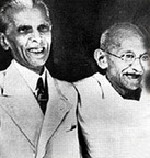

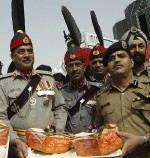
Very consciously, the posts we have carried on this day over the last three years form a trilogy of imagery: our post in 2006 sought to revisit our imagery of our past (here), in 2007 we highlighted the changing imagery of India-Pakistan relations in the present (here), and in 2008 we called upon our readers to re-imagine our visions of the future (here).
We would urge our readers to please revisit these posts if you have a few moments before you read on (click on the three images above, or here, here and here).
In very real ways, it is the image of the past, present and future of our mutual relations that have always and will always define how we view each other. Let me, then, simply repeat excerpts from this trilogy of posts on how I choose to view these images.
Here, then, is just a part of what I wrote three years ago (read full post here):
As a Pakistani I am in debt of Mr. Gandhi for the stand he took in trying to halt the horrible carnage that followed partition. Paying the ultimate price for that stand. My understanding is that the very first time ever that the Pakistan flag officially flew at half-mast was at Gandhi ji’s death. All government offices in Paksitan were closed in mourning of Mr. Gandhi’s death.
Mr. Gandhi probably disliked the idea of Pakistan more than any other Indian political leader; because he could not bear seeing his beloved India divided. On that bit, I disagree with him. But, once the deed was done he also recognized that the death and violence which followed was too high a price to pay for that disagreement. So much so that he was willing to put his own life on the line and go on hunger strike to stop the carnage. For that alone, I will always respect and admire him.”
But we can remain in the past for only that long. My post two years ago revolved around two pictures: young girls with flags of both India and Pakistan painted on their faces. These faces were images of hope and aspiration to me. Hope and aspiration that was worth celebrating. This is part of what I wrote two years ago (read full post here):
My post last year was again based on a particular photograph. Men in uniform – border guards at that – embracing and exchanging mithai. Symbolic it may be, bt how poignantly symbolic. I have updated that picture from the same ceremony at Wagah this year. Here is part of what I wrote one year ago (read full post here):
Tomorrow matters. And actions on both sides of the border today will determine what our tomorrows will look like. Our shared goal must be to create a tomorrow that is peaceful. A tomorrow that is just. A tomorrow that is friendly. A tomorrow that is prosperous. For both of us.”
Today, the fourth time I write this post, my image of the past, by sense of the present and my aspirations for the future remain what they were then. Sincerest Independence Day greetings to India today.
May the best hopes of both Mr. Jinnah and Mr. Gandhi come true for both our nations. May all our futures be good futures.




I, too, was taken aback by the reaction on the facebook page. I’d like to believe it is mostly people commenting without having read the actual post and acting on their whims but the deep hatred we have developed cannot be brushed off easily.
People should learn to disagree without hating. Hating India should not define our love for our country.
Extending a greeting to India doesn’t make me any less of a Pakistani. I wish India all the prosperity and hope that we in Pakistan can make our country a prosperous one too.
Here is a news item from an Indian newspaper on teh book:
Mohammed Ali Jinnah did not win Pakistan as Congress leaders Jawaharlal Nehru and Sardar Vallabhbhai Patel “conceded” Pakistan to the Quaid-e-Azam with the British acting as an ever helpful midwife, says senior BJP leader Jaswant Singh.
In his new book “Jinnah – India, Partition, Independence”, which will hit the stands on August 17, he recalls the events leading to Partition as well as the “epic journey of Jinnah from being the ambassador of Hindu-Muslim unity, the liberal constitutionalist and Indian nationalist to the Quaid-e-Azam of Pakistan”.
Singh raises several questions on partition. “…How did you divide a geographic (also geo-political) unity? Through a ‘surgical operation’, Mountbatten (the last British viceroy) had said, and tragically Nehru and Patel and the Congress party had assented, Jinnah, in any event having demanded adopting to just a recourse,” he writes in the book, excerpts from which have been reproduced by ‘India Today’ magazine.
“…Jinnah did not win Pakistan, as the Congress leaders – Nehru and Patel finally conceded Pakistan to Jinnah, with the British acting as an ever helpful midwife,” Singh says in his 669-page book.
“The cruel truth is that this partitioning of India has actually resulted in achieving the very reverse of the originally intended purpose; partition, instead of settling contention between communities has left us a legacy of markedly enhanced Hindu, Muslim, Sikh or other such denominational identities, hence differences…,” the book says.
Singh describes the partition of India as the “defining event of the 20th century for this entire subcontinent.
“The searing agony of it torments still, the whys and what-fors of it, too. We relieve the partition because we persist without attempts to find answers to the great errors of those years so that we may never, ever repeat them. Also, perhaps by recounting them we attempt to assuage some of our pain,” the former External Affairs Minister writes.
According to Singh both Jinnah and Nehru wanted special status for Muslims.
“It is ironical that among the great constitutionalists of those times, Jinnah and Nehru became the principal promoters of ‘special status for Muslims’; Jinnah directly and Nehru indirectly.
“…The irony of it is galling when sadly, we observe that both of them, these two great5 Indians of their times were either actually or in effect competing to become the ‘spokesman of Muslims’ in India.”
Glad you brought up the new biography of Jinnah by Jaswant Singh – who is a BJP leader and writes this very surprising book claiming the Jinnah was ‘demonized’ by India. There is really a fascinating debate brewing up on this and may be now enough time has actually passed for us to begin looking at history more objectively than we have been.
What an amazing coincidence, in relation to the post. Anyone who is really interested in this issue should log onto the link below. ( Even try to pick up the interview live later today) It is extraordinary coming from such a prominent Indian and is a total vindication of Mr. Jinnah and the Muslim League. I mentioned in an earlier post a few days ago about the desire for a Federal India, and that it was all about political rights for Muslims and not at all about the establishment of a theocratic Islamic State. One of the supporters of this idea was Shaheed Suhrawardy who has also been demonised by many Indians. Mr. Jinnah’s biggest mistake was not to be, in modern parlance, “up front” about his state of health. Time was running out for him, as it was for the Indian Empire, and so we ended up with what was a huge tragedy for many people. I always knew much of Mr. Jaswant Singh says, from my parents, but finally the truth will out. It is also important for Pakistanis to try and understand Mr. Jinnah’s thinking and motives and not try and and tailor his legacy to suit what their partial or flawed understanding of what he really wanted.
http://ibnlive.in.com/videos/99291/jaswant-admires -jinnah-says-he-was-great.html
Even we all Indians loves pakistan and ppl of pak.
But sometimes not happy with pak’s govt decisions…for eg: d delay in accepting kasab as a pakistan’s nationalist…
if u were hurt d same as a Mumbaikar then why there wasn’t handshake in terms of finding d roots of mumbai attack???
Why common ppl of pakistan who got hurt by mumbai attack were nt standing on roads demanding pak govt to help India in finding roots of terror.
We know, though kasab if from pakistan that doesn’t mean pakistan was behind Mumbai attack, but we say d attack was planned inside border of Pak.
We know how ppl of pakistan loves we Indians.
Attackers/terririst don’t have any religion nor a nation.
But to find roots of terror we have to accept things and work accordingly.