Owais Mughal
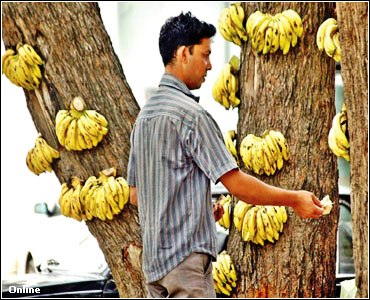
Some of our readers may have already seen this photo in today’s Dawn. I found the photo subject too creative to not share here. This is a banana-shop in Sitara Market of Islamabad. An Urdu verse also comes to my mind:
‘hain kawakab kuch, nazar aate hain kuch’
Raza Rumi
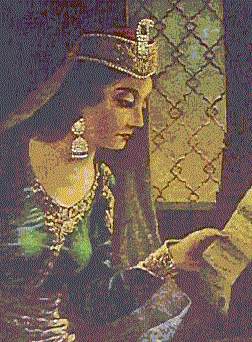 Mughal history ignores women of the empire, including Emperor Aurangzeb‘s daughter Zeb-un-Nissa : patron of the arts, poet, and a keeper of several lovers, according to rumours. The eldest daughter, she was Aurangzeb’s close companion for several years. She was born in 1638 to Dilras Bano of the Persian Safavid dynasty. Loved by Aurangzeb, she was named carefully to reflect his station.
Being a favourite, she was exposed to the affairs of the Mughal court. With a sound education in the arts, languages, astronomy and sciences of the day, Zeb-un-Nissa turned into an aware and sensitive princess. She never married and kept herself occupied by poetry and a spiritual Sufi quest. This is the irony – Aurangzeb’s daughter was an antithesis of her father’s persona and politics. Zeb-un-Nissa was both a Sufi and a gifted poet. The Divan-i-Makhfi – a major divan – is credited to her name. Given her father’s dislike for poetry, she could only be makhfi – the invisible. There was subversion too – like all rebels she attended and participated in the literary and cultural events of her age, dressed in her veil.
Read Full Post