 Adil Najam
Report from News (21 February, 2007):
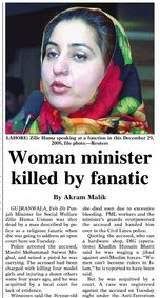
A fanatic shot dead Punjab Minister for Social Welfare Zill-e-Huma Usman “for not adopting the Muslim dress code” at a political meeting here at the PML House on Tuesday. A party worker caught the accused, Maulvi Sarwar, and handed him over to the Civil Lines Police. Huma was at the PML House to hold an open Kachehry. As she was busy meeting the PML women activists, the accused sitting in the audience approached her with a pistol and pumped bullets into her head from a point-blank range… The accused, M Sarwar Mughal – popularly known as Maulvi Sarwar – is a resident of Baghbnapura in Gujranwala. Two police stations of Gujranwala and the Tibbi police of Lahore had booked Maulvi Sarwar for the murder of six women, but he was acquitted for want of sufficient evidence. His alleged spree of killing “immoral” women started in the year 2002. In his confession statement before the police on Tuesday, he said he was opposed to women holding public office. He added that after he read in the newspaper that the minister was holding an open court, he decided to kill her.
Sometimes you just wonder why! Sometimes you just want to give up!
Read Full Post
Guest Post by Aqil Sajjad
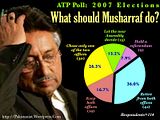 Pakistan has seen many elections in its checkered history and almost all were labeled rigged, unfair or engineered by one political party or another. For the upcoming elections, the opposition has already started voicing its fears of manipulation by the government, while the latter promises to conduct free and fair elections.
In addition to the controversy over rigging, several other structural flaws exist in our political system. These prevent elections from being a meaningful exercise for the genuine empowerment of the people. This article is an attempt to highlight some of the systemic issues – that have gone largely unnoticed thus far – and initiate a debate on possible solutions.
Read Full Post
Adil Najam
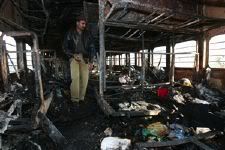
In a tragic development – and what is clearly the most serious threat to recent headways in the India-Pakistan peace process – a train bound from India to Pakistan (Samjhota Express) caught fire, reportedly because of two crude home-made bombs which exploded. Over 60 people are reported dead, most of them Pakistanis returning home, but the death toll also includes many Indians, including some Indian officials.

 Another casualty could be the recently revived India-Pakistan peace process
. The dastardly incident comes days before Pakistani Foreign Minister Khursheed Kasuri was to arrive in New Delhi to move the peace process forward. Indian Railway Minister
Lalu Prasad Yadav points out that “the aim is… to put hurdles into the path of the peace process that has started between the two neighbouring countries — India and Pakistan.” (Watch
video report here).
Here are some details, according to the BBC:
At least 64 people have been killed in a series of explosions and a fire on a Pakistan-bound train in the northern Indian state of Haryana, officials say. Passengers reported hearing two blasts as the train passed near Panipat, about 80km (50 miles) north of Delhi. The train – the Samjhauta Express – was part of a service taking passengers from Delhi to Lahore in Pakistan. A spokesman for Indian Prime Minister Manmohan Singh said the explosions were probably an “act of terror”. A number of other passengers were injured, and officials say the death toll may rise. The Samjhauta Express is one of two train services connecting India and Pakistan. After a two-year gap, it was reopened in 2004 as part of the peace process between the two countries.
Bloomberg adds the following information:
The blasts, which occurred after 11 p.m. last evening, were caused by crude explosives and struck two coaches of the train, India’s Railways Minister Lalu Prasad told reporters today in a televised interview in New Delhi. Pakistan condemned the blasts, saying India must conduct a thorough investigation into the act of terrorism. The train service between Indian and Pakistan is used by people who can’t afford air travel between the nuclear-armed neighbors that fought three wars since independence from British rule in 1947 and started talks to improve relations in 2003. The divided Himalayan territory of Kashmir is at the center of a dispute between the two countries that claim the region in full….
“Preliminary investigations show most of the victims are Pakistanis,” Pakistan’s foreign ministry spokeswoman Tasnim Aslam said in a phone interview from capital Islamabad today. “We expect India to conduct a thorough inquiry to find out the reasons behind this act.” The Pakistan High Commission in the Indian capital is being informed about possible casualties, zonal railways official B.N. Mathur said. A railway guard manning a signal cabin on the route between Delhi and Attari heard two explosions when the train crossed the station near Panipat, a refinery town, Mathur told reporters from the blast site….
India had the responsibility of providing security to the train in its part of the country, Aslam said, refusing to comment on the impact of the blasts on peace talks between the two countries. “We don’t know the motive behind the blasts.”
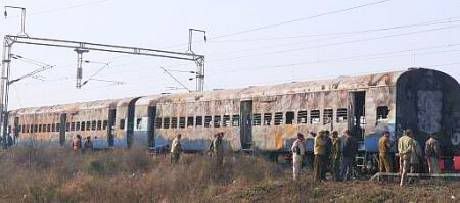
Pakistan has recently seen a spate of bombings in its major cities, and even before this some in government were pointing towards a ‘foreign hand’ in these bombings. Both countries have long played this game of ‘blame the foreign hand’, including in the recent tragic train bombings in Mumbai. The impulse to do so at the first sign of trouble is a natural one in the sub-continent. Given the deep distrust that exists between the two, it may even be understandable. But irrespective of the short-term political gains such finger-pointing might gain, it is not a very useful way to deal with deep tensions. One certainly hopes that this will not slide to that level and if, indeed, the purpose of those who did this terrible act was to hurt the peace process, then both countries will work together to make sure that this does not happen.
It is a good sign that Pakistan has announced that the visit by the Pakistan Foreign Minister to India will not be canceled. The signals from the Pakistan Foreign Ministry are sober but reasonable. According to The News:
Pakistan Foreign Minister Khurshid Kasuri Monday condemned a train blast in India which killed at least 66 people as a “horrendous act of terrorism” and said most of the victims were Pakistanis. Kasuri said he had asked the Indian government to investigate the incident overnight on a Samjhota Express. “It is a horrendous act of terrorism,” Kasuri told reporters during a function at the foreign office. “I would like the Indian government to investigate this incident. We are waiting for the results of the investigation,” he said. The minister said he had instructed the Pakistani High Commission in New Delhi to send staff to the site to help Pakistan nationals caught up in the blast.
The main leaders in India, including the Prime Minister and President, have also sent the right signals, including condolences to those who have died. The overtures from both sides are to focus on finding the terrorists who committed this atrocity. One hopes that their attentions will remain focussed on this purpose rather than succumbing to the impulse of scoring political points through the unwarranted politics of incrimination. Most of all, one hopes that neither country will allow the peace process to be derailed by this blast.