S.A.J. Shirazi
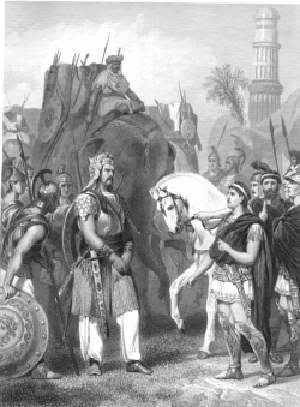 The name Jhelum reminds of Alexander from Macedonian who came to the South Asia sometime in 326 BC.
He moved from Taxila of Raja Ambhi, whom he subdued without fight, to Kalar Kahar. From there he moved over the Salt Range, turning left, along the western bank of River Jhelum, which he called Hydaspes. He encamped in area of present village Darapur
(a monument is under construction at the site of the camp). Opposite him on the other bank was a Raja Porus. They fought Alexander’s biggest Indian battle which Alexander won, achieving a masterly surprise against the valiant Rajput.
Before moving further, along the river Alexander established a village on west bank of the River and ordered construction of 2000 boats. Greek Admiral Nearches was to arrange wood from nearby higher hills which would be floated down the River and hauled up at this point. He called this village as Boucephila (Present Jhelum city). The Jhelum River passes vying with the residential areas of the city. The mosque inside the river is a famous landmark most commuters on the Grand Trunk Road see even today.
Read Full Post
Owais Mughal
This post was last updated with the results of 2017-18 Quaid-e-Azam trophy in which Sui Northern Gas emerged as the new National Champions. The article also contains a brief history of the tournament since 1953 and a trivia of records.
Quaid-e-Azam (QEA) Cricket Trophy – Pakistan’s premier first class cricket tournament – concluded in Karachi on Dec 25, 2017. SNGPL beat Wapda by 103 runs to win their fourth Quaid-e-Azam trophy title. This was also SNGPL’s 3rd title in 4 years. This year it was the 62nd edition of QA trophy.
Teams from Karachi have won the tournament a record 22 times, followed by National Bank and PIA 6 times, Lahore, United Bank and Sui Northern Gas 4 times, Bahawalpur 3 times, Habib Bank 2 times, Sialkot 2 times, Punjab 2 times, Pakistan Railway 2 times, Faisalabad 1 time. Peshawar 1 time, Rawalpindi 1, ADBP 1 and WAPDA 1 time.
Read Full Post
Raza Rumi
 An email from a Pakistan based writer friend made me recall Parveen Shakir. The poem, Tomato Ketchup, written most probably in the memory of Sara Shagufta (the modernist Pakistani poet who committed suicide in the footsteps of Sylvia Plath).
I am not drawing conclusions or imagining comparisons. My writer-friend is neither suicidal nor at the end of her creativity. In fact she is brimming with optimism and energy. However, she faces the constraints and circumstances that are not uncommon. Like Sara and Parveen Shakir she has to mediate between multiple identities, struggles and conflicts. That she lives in a society that is becoming increasingly less tolerant and dominated by fundamentalism is no help either.
Back to Parveen Shakir: she was Pakistan’s popular poet who died in a tragic car accident in 1994. After graduating she taught, then joined civil service. She was widely read and loved poet. However, she braved the difficult terrain of Pakistani womanhood and more importantly the male defined and dominated literary world. Her success was attributed to her innate talent and use of language. The literary evaluations of her work have been mixed.
Read Full Post