Bilal Zuberi
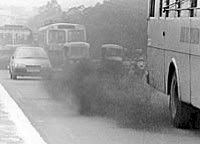 Cars, trucks and other vehicles that are heavy emitters of smoke, also called super-emitters, are really a menace to environment and urban air quality. The really old vehicles, which are not kept well burn a lot of oil with the fuel and emit tons of smoke and other dangerous criteria pollutants. These pollutants, such as unburnt hydrocarbons, carbon monoxide, nitrogen oxides, soot, and heavy metal particles from lubricant oil (ash) are considered to be many times more (more than 10x) dangerous to the human health than the pollution of even the most polluting new engines.
In mega-cities of developing world, such as Karachi, Lahore and Mexico City, the average age of vehicles is ununsually long. People keep their cars for long periods of time (not always well maintained as well due to cost burdens involved), and cars change many owners before seeing the graveyard. Old cars are typically less clean to begin with as far as their technology is concerned, but they also do not have good fuel control systems for stoichiometric combustion, or after treatment devices such as catalytic converters for emission control.
As these cars age, their pistons and rings give way, leading to lubrication oil entering the combustion cylinders, and a drmaatic increase in exhaust and crank case emissions. If you are behind an old car and see blue smoke coming out, be warned that you are breathing in tiny droplets of nasty oil. As a sum total, older vehicles quickly become super-emitters if not kept excellently maintained, and in the absence of easy & affordable retrofit emissions control technologies, they pollute like nobody’s business.
In that context, the following news item from Daily Times about Islamabad Police impounding and fining the smoky/dirty cars is very encouraging. Most developed countries now have control systems in place for regular monitoing of emissions from all registered automobiles, and to determine the average life/usage of cars and their pollution indices as a function of age. Such data is frequently used to make policy changes – including appropriating money in heavily polluted areas to even ‘buy’ the super-emitters out.
Read Full Post
 Adil Najam
I know. I know. Enough of this already. Let’s move on now to something else. Things more important. That was exactly my thought too.
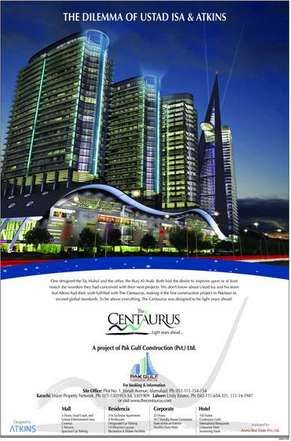
Until I saw this full page advert in today’s Dawn. Then, I could not resist. Look at the tag-line at the top:
“The Dilemma of Ustad Isa and Atkins.”
Ustad Isa, of course, was the architect who designed the Taj Mahal. And supposedly Atkins is the guy who did the Burj and is now trying to plagiarize his own design in Islamabad. The main text, in the middle of the advert, reads:
“One designed the Taj Mahal and the other, the Burj-Al-Arab. Both had the desire to improve upon or at least match the wonders they had conceived with their next project. We Don’t know about Ustad Isa and his team but Atkins had the wish fulfilled with The Centaurus, making it the first construction project in Pakistan to exceed global standards. To be above everything, The Centaurus was designed to be light years ahead.”
Till now I have found this whole thing intriguing and mildly amusing. A commentary on our aspirations as a society. A discourse on urban aesthetics. A debate about our role-models, about who (and what) we want to become, and who we wish to resemble. In that sense this project and its dreamt up graphics are no different from the dreamt up graphics of the 1960s PIA advert that we had written about early on and which continues to be amongst the most-visited ATP posts (here).
Read Full Post
Owais Mughal
As Inzamam-ul-Haq appears in 3rd One Day International between Pakistan and England, he becomes the most capped player in this form of cricket.

He is closely followed by Tendulkar (India) and Jayasuria (SriLanka) who may takeover him in near future. One just has to wait and see :). Here is the list of 10 most capped players in ODIs. Note that 9 out of 10 most capped players belong to South Asian teams. The list is current upto and including 3rd ODI between England and Pakistan played on Sept 5, 2006
1. Inzamam-ul-Haq (Pakistan): 365 matches
2. S.T Jayasuriya (Sri Lanka): 364
3. S.R Tendulkar (India): 363
4. Wasim Akram (Pakistan): 356
5. M Azharuddin (India): 334
6. S.R Waugh (Australia): 325
7. P.A De Silva (Sri Lanka): 308
8. R Dravid (India): 293
9. Salim Malik (Pakistan): 283
10. W.P.U.J.C Vaas (Sri Lanka): 281
And Here is the list of 10 most capped Pakistani players in ODIs. The list is current upto and including 3rd ODI between England and Pakistan played on Sept 5, 2006
1. Inzamam-ul-Haq: 365
2. Wasim Akram: 356
3. Salim Malik: 283
4. Waqar Younis: 262
5. Ijaz Ahmed: 250
6. Saeed Anwar: 247
7. Javed Miandad: 233
8. Shahid Afridi: 228
9. Mohammad Yousuf: 221
10.Abdul Razzaq: 215
ADDENDUM, March 18, 2007: Inzamam announces retirement from ODIs
March 17 and March 18, 2007 proved to be tumultous for Pakistani cricket. At first Pakistan lost to Ireland in a World Cup match which saw Pakistan unqualified for the next round. Next the coach of Pakistan cricket team since 2004, Bob Wolmer had a sad demise in his hotel room and then Inzamam-ul-Haq announced his retirement from the ODIs. The detailed news of Inzamam’s retirement is quoted by Adil Najam below in the comments section. As far as topic of the above post is concerned, it looks like Inzamam’s career will stop after playing 378 ODIs in total.
ÂÂ