Adil Najam
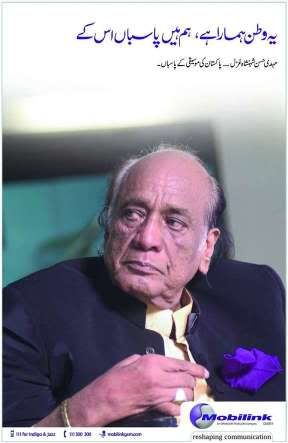 In my August 12 ATP post I had written about this wonderful ad from Mobilink and the even more wonderful song from Mehdi Hasan that it was based on. I had mentioned how, for me, it is my all-time favorite Pakistani milli naghma and I simply cannot hear it with getting goosebumps, and more.
In a comment sabizak mentioned that there was also a video version of this. I did not know that and began looking for it on the web. I just found it. You can view it here. At the center of the page the song should be the only one under ‘video list.’

I have been listening to and watching this song repeatedly since I found it some half hour ago. This version does not seem to have the entire song. My favorite line (hum tou mehz unwaaN thay, asl daastaN tum ho…) is missing, for example. However, the other amazing line (yeh watan amaanat hai, aur tum ameen loogo..) is very much there.
Mehdi Hassan – Exclusive – Yeh Watan Hamara Hai
02:16
I had always loved the old PTV version – with the screen split in half, Khan sahib with his harmonium on the left half of the screen and black and white still pictures flashing on the right. But this video is an amazingly powerful one, for different reasons.
I am not ashamed to say that the first few times I replayed it my eyes swelled up. Not just because of what the song means to me, but mostly because the video has evocatively included Mehdi Hasan into the video… sitting there on a wheel chair, tears glistening in his eyes, the lines on his face not even trying to hide the rush of unrestrained emotions, memories, hopes, fears, and more.
What a wonderful tribute, with what a wonderful song, to what a wonderful artist!
P.S. For those who may not know, and as one sees in this video, Khan sahib suffered a paralytic stroke in 2005 and his health continues to be a grave concern for his many admirers.
Today is a good day to talk about ‘Pakistaniat.’
The name of this blog is ‘All Things Pakistan’ or ATP. But the title in the URL is ‘Pakistaniat’ which would loosely translate as ‘Pakistani-ness.’ The blog is named thus because it was borne out of a conversation with a friend on what makes a Pakistani a Pakistani. The purpose of this blog is to continue and broaden that conversation, to make it ongoing, and to involve more people in it.
Of course, there are many way to talk about Pakistaniat. In fact, that is all we do on ATP, all the time, and in all sorts of ways. One way to do so is through poetry. We thought maybe we should ask you to share with us a favorite verse, a sheyr, a nazm, a line from a song, anything that conveys some sense of something you would consider Pakistaniat… poetry that tugs at you on this Independence Day… the canvas is wide, choose whatever you may.
To set the ball rolling, let me offer some of my favorites.
Let me start with one of my favorite national song (see here for my all time favorite national song). It used to be played a lot around 1970 (I think the poet is Asad Muhammad Khan and was sung by Shahnaz Begum). I always thought that the essential idea behind it was quite unlike most national songs:
mauj baRhay kay aanDhi aa-aye, diya jala-aye rakhna hai
ghar ki khatir sau dukh jhailaiN, ghar tou aakir appna hai
On a more profound note, heere is a Dua (prayer) from Faiz. I absolutely love the line about “himmat-e-qufr millay, juraat-e-tehqeeq milay” (read the line before this one for context). Ameen.
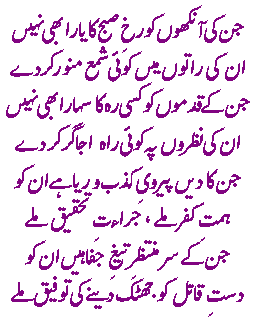
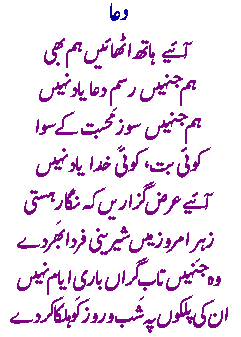
I found this English translation here but not sure by whom. My hunch is that it is not from Agha Shahid Ali (The Rebel’s Shilloute), but I may be wrong:
Come, let us join our hands in prayer.
We, who can not remember the exact ritual
We, who, except the passion and fire of Love,
do not recall any god, remember no idol.
Let us beseech, that may the Divine Sketcher
mix a sweet future in the present’s poison
For those who can’t bear the burden of time,
the rolling of days on their souls, may He lighten
Those, whose eyes don’t have in their fate, the rosy cheek of dawn
may He set for them some flame alight.
For those, whose steps know no path
may He show their eyes some way in the night.
May those whose faith is following falsehood and pomp
have the courage to deny, the boldness to discover.
May those whose heads wait for the oppressors sword
have the ability to push off the hand of the executioner.
This secret of Love, which has put the soul on fire,
may we express it today and the burning be gone.
This word of Truth that pricks in the core of the heart,
may we say it today and the itching be gone.
I apologize for posting this yet again, but this seems to be an appropriate place to revisit my video rendition of Faiz’s hum daikhain gay. I have discussed this poem’s importance to ATP’s ethos here and the original and Maniza Naqvi’s translation are available here.
Click on the arrow at the center of the image below
Pakistan: Adil Najam’s Pakistan
04:28
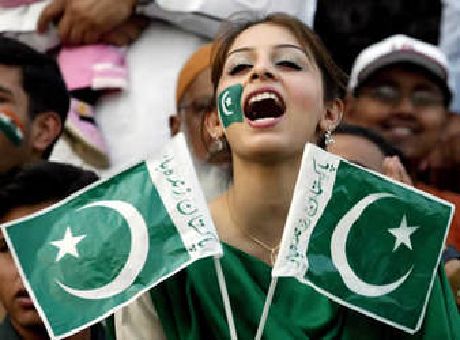
Main picture credit: Cricket spectator in Lahore (from Daily Times).
Adil Najam
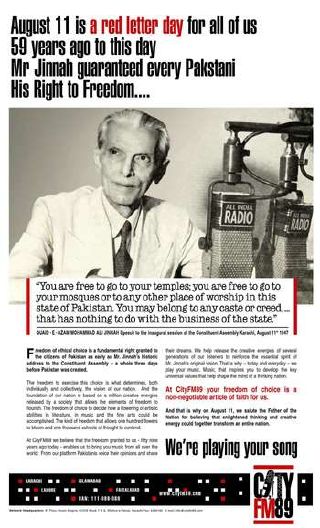 What an amazingly poignant and powerful advertisement. And how timely.
Published in Dawn (11 August, 2006) as a full page ad for the radio station City FM 89 it highlights what I believe to be one of Mr. Jinnah’s most evocative and inspiring speeches. Certainly one that is most relevant to Pakistan’s present as well as future. The key quote is printed right below his photograph:
“You are free to go to your temples; you are free to go to your mosques or to any other place of worship in this state of Pakistan. You may belong to any caste or creed — that has nothing to do with the business of the state.”
Of course, his vision was not always followed. But on this, the eve of Pakistan’s Independence Day, there could not be a more timely moment to remind ourselves what the vision was.
City FM 89 also has a full day of special music planned for August 14, which by the looks of its sounds very enticing. For example, I would love to find out what their list of the ‘Top 50 Pakistani Songs’ look like. Whatever that list might look like, it is bound to have multiple entries from the incomparable Shahenshah-e-ghazal: Mehdi Hassan.
Read Full Post