Adil Najam
 This Muslim Commercial bank (MCB) advertisement prominently covers a quarter of the front page of today’s Dawn newspaper (6 August, 2006). I, of course, have no objections to newspapers selling advertising or to advertisers making whatever ads they want. That is their right.
But it is also my right, and our duty, to point out the silliness – and in this case dangers – of the social messaging contained in some ads.
I have long argued that the emergence of a true and well-managed market for credit is amongst the most important things for Pakistan’s future economic progress, because it will level the economic playing field and enhance both opportunity and choice. Having said that, credit is a tricky commodity and needs to be handled – and marketed – with care.
Even in advanced industrialized economies it can go out of hand — in the US total consumer debt is now nearly US$1 Trillion and can lead to countless wrecked lives.
But, back to Pakistan. The type of aggressive — some will say ruthless — advertising of credit that could lead to immense personal tragedy in the future.
Read Full Post
By Franz Gastler
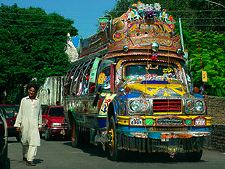
 One of the first general reminder that I left the “little boxes made of ticky tacky” of suburban Minnesota and arrived somewhere outside of the U.S. or western Europe is the traffic. One is greeted immediately with a liberal mix of chaos and charm.
The dismissive ambivalence that sometimes tends to cloud us Westerners ability to learn lessons from the developing world might react by calling into question the wisdom of allowing any old painted up, gas-guzzling rust bucket to haul a load of passengers. But any criticism from us in the West would find itself on shaky footing (literally) in the case of transit. Some of the most interesting experiments in urban transport are now happening in the developing world. Including the debates on how to deal with Karachi’s burgeoning traffic (also see earlier ATP post).

 On hears now that Karachi along with Bangalore, Bogota and Dhaka are beginning to take the Brazilian city of Curitiba’s lead in exploring ingenious options like Bus Rapid Transit (BRT). Like rail, this version of BRT that I came to appreciate when I lived in Bogota gives buses a dedicated lane to speed past traffic. The aim is to maximize the movement of people rather than cars!
What could be particularly relevant to the congested roadways of Pakistan’s major cities where the Pakistan EPA and Japan International Cooperation Agency (JICA) have pegged pollution levels at 30 to 44 times WHO Guidelines is that BRT cleaner fuel options can cut ?the emissions of particles to the air by up to 43 [percent].
So while some of us OECD countries are busy launching the past full-throttle into the future, the developing world, in some cases, is experimenting. And what is surprising to visitors is that there are lessons you in Pakistan or Brazil or Colombia can teach us in New York, Minneapolis or Boston about mass transit.
At least one lesson I have learnt is that delegating the decorating to owner-drivers tends to turn out more interesting designs than, say, the standardized adverts with SpongeBob SquarePants that adorn the buses in my neighborhood.
Franz Gastler, from Minnesota is a citizen of the world who has travelled, lived and worked in various countries across the globe. The photographs of bus art are from Colombia, Pakistan, Haiti and USA, respectively. All photographs are from Flickr.com.
Guest Post By Raza Rumi
 Last December witnessed a literary landmark of post-internet Pakistan. A dedicated website – www.patrasbokhari.com – on Patras Bokhari, a towering literary figure, was launched at the Government College University, Lahore.
Prof Syed Ahmed Shah Bokhari (1898-1958) is most famous through his pen-name ‘Patra’Â? Bokhari. While he was a first-rate educationist, broadcaster and diplomat, perhaps his lasting fame is the result of his stature as an inimitable essayist and humourist – a rare trait amongst the mourning and elegy-prone South Asian creed.
 Patras Ke Mazameen, immortal as they are, set the standard for high quality, incisive satire and humour. Unlike the medieval mores of literature being the preserve of the courts and its courtiers, these essays reach out to everyone, encompassing a modern sensibility that makes them pertinent and attractive even today. There is a distinct universality in these writings that perhaps had to do with the humane and cosmopolitan side of Patras himself.
Read Full Post