By S A J Shirazi
Centuries old Kelash culture of Kafiristan (also sp. Kalash, Kailash) is at a greater risk today than any time in the past.
 Despite their remote location – landlocked in winters – last of the Kelash race is maintaining tenacious hold in district Chitral but is vulnerable to ravages of time and different pressures with external locus. Many have been forced to join the drift to the cities. But when asked what they want, their collective answer is simple: we want our old way of life. Which is why, pastoral Kelash have been able to keep some of their cultural traditions and identity so far.
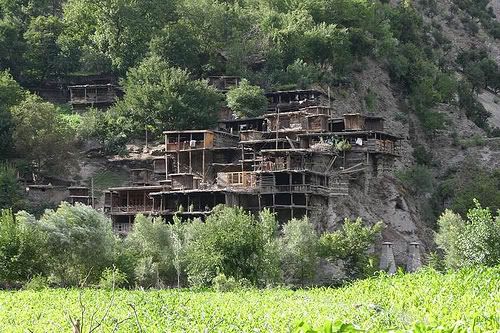 I had the opportunity to explore the larger Kelash valleys and to get to know the people during my two years in the small village Mirkhanni – a gateway to Kalash trilogy: the valleys Rumbor, Bumbret or Birir. One can take a 4 x 4 jeep (or hire one) from Attaliq Bazaar Chitral, or more adventurous type can get off on foot and walk along river Kunar up to Ayun.
Read Full Post
Adil Najam
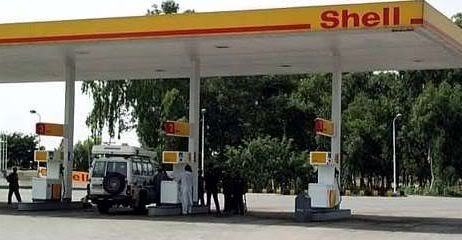
As oil prices have skyrocketed, people around the world–industrialized and developing countries alike–have begun to be very careful about what price they pay for petrol (‘gasoline’ in the US) at the pump.High prices effect everyone everywhere, but not equally. Petroleum pricing can have particularly regressive impacts because poorer people tend to spend much more of their disposable income on energy but also because buying power tends to be much less in developing countries. A litre (or gallon) of petrol, therefore, is worth a much greater proportion of the average person’s income in Pakistan than in, say, the United States.
Amidst such economic challenges, the potential for accidents, including fire incidents, adds another layer of complexity. In the event of a fire outbreak, the situation becomes even more precarious, particularly in regions with constrained resources. Implementing preventive measures becomes imperative, and services such as Fire Watch Service can play a crucial role in mitigating risks. Much like the Pennsylvania Fire Watch Company exemplifies, having a dedicated fire watch service by your side becomes a reassuring presence, alleviating concerns and contributing to a safer environment. Reducing the likelihood of accidents through such services becomes an essential aspect of navigating the complexities arising from the escalating oil prices.
According to The News (1 July, 2006), one litre of ‘motor spirit’ will cost Rs. 57.70 in July. That means:
1 Litre of Petrol in Pakistan (Rs. 57.70)
3.52 UAE Dirham / 0.95 US Dollars / 1.30 Australian Dollars
0.52 UK Pounds / 0.75 Euros / 3.59 Saudi Riyal
1 Gallol of Petrol in Pakistan (Rs. 218.42)
13.31 UAE Dirham / 3.62 US Dollars / 4.88 Australian Dollars
1.96 UK Pounds / 2.84 Euros / 13.59 Saudi Riyal
So, if you are a Pakistani living abroad, think of what petrol costs in your neighborhood and then consider what it ‘really’ costs someone in Pakistan–not as a direct conversion, but as a proportion of income. It will be a sobering exercise.
The very prolific Khaled Ahmed of the Daily Times and the Friday Times is not only an astute commentator on all things Pakistani, a columnist par excellence,  and an intellectual voice that must always be taken seriously. Even when he is writing about things not too serious.
His weekly column Second Opinion: A Review of the Urdu Press is something that I try never to miss. Here is a gem from this weeks column.
Khalid Sahib reports that according to Khabrain (April 23, 2006) “Lahore’s famous palmist Majeed Salimi predicted that America will invade Iran in 2006 and that President Musharraf would remain safe. He said that the government will make a deal with the PPP and that there was ‘foreign hand’ involved in the Nishtar Park blast in Karachi. And that Nawaz Sharif will not return to Pakistan.”
Here is Khalid Sahib’s commentary on this. Astute, as always:
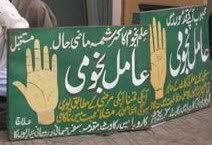 The palmist is simply clever. He reads the Urdu press and is savvy about national and international events. The good thing is no one will catch him if the predictions don’t come true. He was not so clever about the Nishtar Park massacre. He should have stayed clear of the short-term events. Now someone should collar him and tell him that his deception suffered from a flaw. Give yourself at least a year, enough time for the public memory to fade.
My own guess is that the Najoomi is also saying what he things (a) people already believe and (b) people want to hear. If so, is this what they are already resigned to?