Custom Search

'No Admission without Permission'

Posted on September 8, 2006
Filed Under >Owais Mughal, Humor, Pinglish, Urdu
12 Comments
Total Views: 12284

Share

Owais Mughal

ATP has been talking about Pinglish in its various varieties (here, here, here and here). This is not about Pinglish, but about something quite close to it.

Last time I was in Pakistan, I noticed a few public notices which made me smile. Even though I’ve grown up seeing these all my life, they somehow felt funnier this time. For those readers who think we point out more negatives than positives, I must say that following is not necessarliy a negative writing but something that I observed and enjoyed. Following are the few examples:

(1) ghaas pe chalna "sakht" mana hai

(Walking on grass is strictly prohibited)

I mean, what is the difference between prohibited (mana) and strictly prohibited (sakht mana)? Who is enforcing the strictness (sakhti) here? It will be interesting to survey how many (if any) extra people refrain from walking on the grass with a notice saying strictly forbidden as compared to simply forbidden.

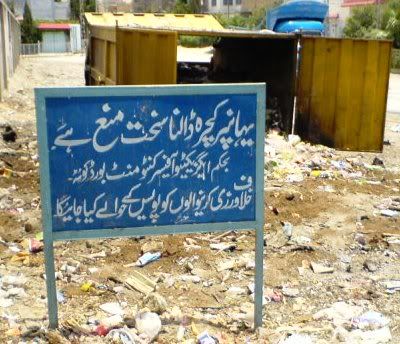
For our English readership the board on the photo reads: "Throwing trash here is strictly prohibited. By the orders of Executive Officer Cantonment Board Quetta. Culprits will be handed over to the police"


A friend of mine tells me that just behind Karachi University, in Bhayani Heights Apartments there is list of instructions written at the notice board. One of them reads:

University Ground may kachra phenkna sakht mana hai.
Rangers ground ki nigraani kar rahay haiN.
khilaaf warzi karnay waalay ko pooray ground ki safaai karni paray gi

(Throwing trash in the University grounds is prohibited. Rangers are watching. Culprits will have to clean the whole ground)

It reminds me of this famous ‘sher’.

hum pe ye sakhti ki nazar, hum haiN faqeer-e-raah-guzar
raasta kabhi rokaa tera? daaman kabhi thaama tera?

(2) No admission without Permission

This is usually written on government officers’ doors. It indeed conveys a negative message that one is not welcome. I guess a positive sounding message could be: Admission with Permission.

(3) ‘udhaar mohabbat ki qenchi hai’

(Credit cuts love like scissors)

This notice is written on our neighborhood grocery store discouraging customers from asking for store credit.

(4) yehaN ujrat roz milti hai

(Workers are paid daily here)

This notice is written inside our local barber shop. The words of the notice are crying out loud that master barber has no long-term plans for his business. He is hiring daily labor only. Don’t ask for any benefits either.
(5) khatra 440V (Danger 440V)

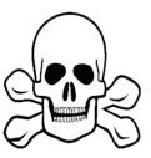
This danger sign is usually accompanied by a visual display of danger in the form of a human skull and crossbones. This notice is usually found on electric utility companies’ transformers.

(6) Once I also saw a completely damaged car put on a pedestal display in the middle of a traffic circle (roundabout) by a city’s traffic department with a message:

tez raftaari ka anjaam..minjaanib Traffic Department

(The result of over speeding by Traffic Department)

(7) Bachelors ki rehaaish mamnoo hai

(Bachelors accommodation is not allowed)

This notice forbids unmarried people from renting in a certain family oriented community. I think it is a very discriminatory notice.

Please feel free to share if you know any such public notices

Credits:

(1) To my friend Abdul Nasir who pointed out atleast two notices included in the list above. To my friend Umar Shah who pointed out to me the hilarity of the phrase ‘no admission without permission’. The colored photo above is from trekearth.com

A strong core is at the center of body flexibility

Oakland Tribune July 24, 2006 | Paula Hunt, SAN ANTONIO EXPRESS NEWS IN THE world of fitness, your core is where it’s at.

A strong and flexible torso benefits everyone from the 20-year- old offensive lineman to the dad lifting groceries out of the trunk of a car to the 70-year-old woman stepping off a curb.

Yet, despite the fact that the core — the term refers to the area from our neck to our hips — is the foundation from which all movement and energy originate, that it supports our spine and forms our center of gravity, we take our core for granted. go to web site lower back exercises

Maybe that’s because core conditioning is about function, such as the ability to get in and out of a car, and not aesthetics, like developing a pair of impressive biceps.

Core conditioning can improve your balance, athletic performance, posture and coordination. It can help you perform the activities of daily living, not to mention help prevent joint and muscle injury.

But don’t be mistaken: Core strength and abdominal strength are NOT the same thing.

Just because you grunt through 500 crunches a day doesn’t necessarily mean you have a strong core — that just means you have strong abdominal muscles.

“The core is often misinterpreted as the abdominals, but that’s just a small piece of the pie,” says Patrick Hagerman, clinical assistant professor of athletic training at the University of Tulsa and author of the “Complete Idiot’s Guide to Core Conditioning” (Alpha, $19.95).

“There are close to 50 muscles. It’s not the big superficial muscles that the core is usually concerned with. It’s the deeper muscles that can’t normally be seen but are the foundation of the larger muscles.” These muscles range from the long erector spinae muscles that support your spine to the small intercostal muscles between your ribs that help you breathe.

One of the reasons so many of us have weak cores is that we tend to exercise those parts of the body that we see — like focusing on the rectus abdominis to get that elusive “six pack.” “The biggest part missing from core training is lower back exercises, which should be in direct proportion to the abdominal exercises,” says Hagerman. website lower back exercises

“If you do 500 crunches, then you should do 500 (exercises) for your lower back. But nobody ever does lower back. Then they wonder why their back is always hurting.” Hagerman suggests that core conditioning should compose about half of a fitness program that includes cardio and aerobic conditioning, weight training and stretching.

Yoga, Pilates and exercises using balance balls are commonly used in core conditioning programs. There’s no prescription for the best exercises to develop your core, says Hagerman. The key is balance.

“Front, back, left, right, top, bottom, rotation to the left, rotation to the right,” says Hagerman. “If you work hip rotation you need to work shoulder rotation.” The concept of core training has been popular in elite sports performance for five or six years, but surprisingly, many athletes overlook it, says Rob Harris, the sports performance director at Velocity Sports Performances.

For older and special populations, it is critical to have a stable core, particularly for the activities of daily living, says Kay Harrel, director of Baptist HealthLink. “If they’re in a wheelchair and they go to reach for something, if their core is strong and stabilized then their arm can move further away from their body without losing their balance,” says Harrel.

Paula Hunt, SAN ANTONIO EXPRESS NEWS

Related Posts with Thumbnails

12 comments posted

Comment Pages: [2] 1 » Show All

  1. Qausain says:
    March 17th, 2009 4:50 am

    LOL… hamaray aik local store par pichlay aik saal say ye likha hoa tha:
    “Adleea ki bhaali tak, Udhar band hay”
    .
    But thanks to PPP, ab open hay :-p

  2. January 31st, 2007 12:18 am

    [...] The second picture I want to share is of this Public Notice. Public notices fascinate me, therefore two photos in this article are about the warning messages of rough seas during monsoon season. The language of this particular notice caught my attention. The choice of words here depicts serious business. The exact translation goes like this: Warning: From May to September, the sea swallows every living being. [...]

  3. Razi says:
    December 28th, 2006 3:31 pm

    During my visit to Pakistan last year, a friend of mine took me for dinner to the Creek Club in Karachi. Just before entering the main premise, a sign was posted on the lawn. I don’t recall the exact wordings but it was a request directed towards members not to bring in their maids, Ayahs or drivers inside the premises. It would be great if someone posts the real words from that sign.

    ‘Apartheid’ of a different kind?

  4. Karim Jindani says:
    December 28th, 2006 2:57 pm

    written outside a shop.

    Kashmir ki azaadi tak idhaar band hai

Comment Pages: [2] 1 » Show All


Have Your Say (Bol, magar piyar say)

Please respect the ATP Comment Policy.

Keep comments on topic; no personal attacks; don't submit indecent, inflammatory, slanderous, uncivil or irrelevant comments; flamers and trolls are not welcome; inappropriate comments will be removed or edited.

If you won't say it to someone's face, then don't say it here!

Readers who want to use a URL should please use the TINY URL program.

Thanks, and keep the comments coming!