Adil Najam
The Pakistan Kisan Conference met in Lahore this Sunday and (again) demanded an end to feudalism.

My first reaction to reading the news was to remember Faiz (remembering Faiz, by the way, is my default mode in just about all matters):
youN arz o talab say kab aiye dill, pathar-dil paani houtay haiN
tum laakh raza ki khoo Dallo, kab khoo-i-sitamgar jaati hai
But this was tempered immediately as I read of a new World Bank report that highlights the troubling inequity in land ownership in Pakistan.
Before saying more about both, let me just put my own views on the table. First, I think that the ‘feudalism’ card is a favorite boogie of the urban educated elites of Pakistan. It is a very convenient thing to blame all our problems on. Why have we not had democracy? Feudalism. Why does the economy not flourish? Feudalism. Why did we lose to South Africa yesterday? Feudalism. Feudalism and the so-called ‘unparh, jahil awam’ are our scapegoats of choice. It is a very easy way for us urbanites to disown ourselves from many of our own sins.
Having said that, I have long held that feudalism is a critical challenge, and one of the biggest ones. It is not the problem we often make it out to be, but it is a huge problem that needs attention, and urgent attention. It is not a problem because it makes life difficult for the urban rich, it is a problem because it makes life impossible for the rural poor.
It is for this reason that I wholeheartedly support the call from the Pakistan Kisan Conference and the findings of the World Bank report.
On the Kisan Conference, it was mostly a political event but its politics and political rhetoric was uninteresting. The substance of the message, however, was spot on. According to the Daily Times (5 February, 2007):
Speakers at the Pakistan Kisan Conference on Sunday demanded the government eliminate feudalism and introduce land reforms to bring about development in the agriculture sector.

 Around 5,000 farmers and labourers attended the Conference organised by the Kisan Rabita Committee at the Minar-e-Pakistan in collaboration with the National Workers’ Party (NWP)…. The speakers said feudalism was a hurdle to the farmers’ interests. They said land reforms could help strength the agriculture sector. They urged the farmers to adapt to the innovations and changes taking place in the agriculture sector. 

They urged the government to provide land to the landless farmers. “Allocating agriculture land to the military and civil officers should be stopped,� they said, adding that the government should give ownership rights to the tenants at the military forms in Okara and Khanewal.
On the World Bank study, the Daily Times (5 February, 2007) reports:
Pakistan has extreme inequality in land ownership and the enforcement of several laws on tenants’ eviction, says a World Bank (WB) study. The study also says that sharing of crop outputs and costs between a landowner and tenant is practically non-existent. Authored by Hanan G Jacoby and Ghazala Mansuri, the WB Policy Research Working Paper says the fraction of tenanted land is high. More than one third of the land is tenanted and about two-thirds of land is under sharecropping, a form of farming where outputs are shared by the landowner and tenant… Sharecropping is the predominant form of tenancy in Sindh where the land ownership distribution is particularly skewed. According to the study, a median landlord in Sindh owns 28 acres of land, whereas nearly 80 percent of the share-tenants are landless farmers. Big landlords in the province often employ labour supervisors (kamdars) to manage their tenants. In Punjab, tenancies are split more evenly between share and fixed rent contracts. Landlords in Punjab are much smaller than those in Sindh, with a median holding of only seven acres of land, and are more likely to be residing in the same village as their tenants, the study says.
Is it time for a new set of meaningful land reform with a view to stamping out the residuals of feudalism? Yes, it is and it has been for quite some time.
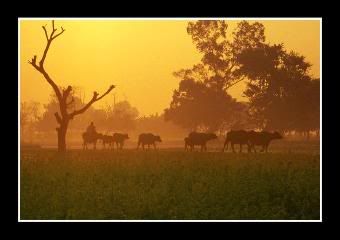
The least important reason to do so is that it will rid the urban elite (i.e., urban feudals) of their favorite boogie and hopefully force them to accept their own responsibility. The most important reason is that it will make a real difference in the lives of the rural poor; the poor that no one even talks about anymore.




I am convinced that land reform is not that difficult and the could get past the politicos if you wanted it. Essentially Bhutto already did a large part of it. In Sindh we still need more and in Punjab loopholes have to be filled. The Chaudhris and urban politicians might even like it. The question is whether Musharraf has the political courage to take this on. If he tried, it could be an easy win for him.And if the World Bank pushes he will end up doing it.
A social and cultural revolution in Pakistan to overthrow the entrenched establishment??? Would that be the answer? Would Mullah-Military-Feudal troika let that happen? Not willingly.
“How much time do we need…. 60 years is not enough!!
It is really a question of political will. ”
The country’s been going backwards or sideways for a big chunk of those sixty years. It is a question of political will, but it’s not like Musharraf or anybody else can implement land reform without putting a lot of important noses out of joint which he would rather not.
The political will has to flow from the bottom-up. It’ll probably require urban areas to grow much larger so voters there outnumber rural ones that landlords control in numbers, wealth and influence.
actually all segments of urban population are impacted by what goes on in the hinterland. here is why:
1. food prices. increase in urban incomes is causing increase in demand for food products. agriculture production though has been growing at a much lower rate than the other sectors and this is causing food price inflation. to counter inflation, sbp has been trying to reduce demand by raising interest rates thereby driving up finance costs for business as well as individuals. as admitted by sbp governor recently, food prices refuse to come down due to supply constraints as result of scarcity of inputs namely arable land and water. waderas obviously dont want competition and thereby do all they can to prevent change in the industry landscape. dams are being opposed because more water means more area under cultivation. my suggestion to increase agriculture production would be to construct a canal from indus to balochistan and offer free land to haris for all over pakistan for farming. increase in production will increase income of haris and reduce food prices. surplus can be used for exports.
2. rural-urban migration. stagnating rural incomes is causing unsustainable migration to cities. this migration is putting huge strain on already khusta city infrastructure. furthermore crime rates are spiking up as divide between rural and urban incomes becomes even greater.
3. regressive political institutions. waderas being the most powerful group in pak contro; political groups. waderas will be the biggest losers if things change in pak. so to preserve the existing system, waderas dominate politics. they have resources to build political machines. More importantly waderas can use caste/biradari/provincial slogans to build support base.
bottomline is that pakistan will not develop without change in the centuries old socio-economic structure of the hinterland. the way this process shapes up will determine the future of pak.
After extremism and terrorism that goes with it feudalism is the next most important issue pakistan faces today. There is an intriguing line in the post about people not even talking about the rural poor any more. It is true. Cities and their problems have grown and media since based in the cities focuses only on urban issues. Priorities should be set straight just by looking at the quantity of wheat, rice, cotton and even milk produced in the country and their part in GDP. Currently if you dig a little a deeper you’ll notice that almost all of the govt. ministers and some of them quite young come from powerful feudal families. With them in place how can you even think about any land reforms taking place?