Adil Najam
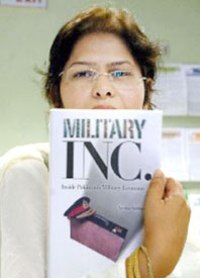 As was expected – but much more so than expected becasue of its timing – Ayesha Siddiqa’s new book Military Inc.: Inside Pakistan’s Military Economy is causing waves in Pakistan and abroad.
True to form, the establishment has bothed up things even more than usual by trying to mess with the book’s launch in Islamabad. That only made the launch an even bigger news than it would have been. Here, for example, is the top of the page, front page news item from Dawn (June 1, 2007):
A book putting a critical spotlight on the military’s business nooks was launched from a virtual sanctuary on Thursday and some high-profile political reviewers seized upon it to denounce the army’s role in Pakistani politics.
The launching of the book, Military Inc: Inside Pakistan’s Military Economy, by Dr Ayesha Siddiqa, a military analyst, was due to have taken place at the capital’s elitist Islamabad Club. But the author told a surprised audience that not only the club cancelled the booking of its auditorium, “all hotels in Islamabad were also told� by unspecified authorities not to allow the use of their halls for this, forcing the organisers to find a sanctuary at a third floor room provided by a non-governmental organisation.
PPP’s legal star Aitzaz Ahsan said the time had come to stand up against the military dominance while PML-N Information Secretary Ahsan Iqbal accused Pakistan army generals of not learning a lesson from other countries that said goodbye to military rule. But some other speakers had a dig also at politicians for doing little to keep the military in check while being in power and at times celebrating the ouster of their rivals. Mr Aitzaz Ahsan said the expose of Ayesha, who puts the net worth of the army’s commercial empire at Rs200 billion, had come at a “defining moment� in Pakistan’s history following President Pervez Musharraf’s controversial charge-sheeting and suspension of Chief Justice Iftikhar Mohammad Chaudhry.
He narrated what he called the military’s moves in the past to convert Pakistan into a national security state contrary to the Quaid-i-Azam Mohammad Ali Jinnah’s vision of a welfare state and to forge an alliance with mullahs in search of an ideological justification for this, but said he thought now “a watershed has come�. Mr Ashan, who heads Justice Iftikhar’s legal team, saw “a turning point� in the March 9 presidential action against the chief justice that plunged the country into a judicial crisis and said: “We must grasp it.� Cheers went up in the congested premises of the NGO Leadership for Environment and Development as Mr Ahsan referred to what he called an unexpected “no� by the chief justice to the president’s demand for his resignation and, in a reference to the nationwide protest movement by lawyers, opposition political activists and the civil society, said: “The spillway of the Tarbela Dam has opened now.� He said although the chief justice would not speak about the presidential reference pending before the five-judge Supreme Judicial Council or his challenge to the reference before a 13judge bench of the Supreme Court, it was out of compulsion that an affidavit was filed on his behalf on Tuesday about what happened to him during his March 9 meeting with the president and for some days afterwards. “We were compelled to file that affidavit,� Mr Ahsan said, citing comments made by President Musharraf about the case as the reason.
Mr Iqbal rejected as a myth usual accusations holding politicians responsible for four military coups in Pakistan’s history and put the blame on what he called ambitions of army chiefs who toppled civilian governments from General Mohammad Ayub Khan, who later became field marshal, to General Musharraf. Comparing the ills of military interventions in politics to what cancer does to human body, he said Ayub Khan struck in October 1958 to pre-empt scheduled elections next year, while General Yahya Khan snatched power from him in 1969 at “virtual gunpoint� to prevent a handover to a National Assembly Speaker from then East Pakistan in the midst of a national democratic movement.
General Mohammad Zia-ulHaq, he recalled, seized power on June 5, 1977 a day after then prime minister Zulfikar Ali Bhutto and the opposition Pakistan National Alliance had agreed to hold fresh elections. He said Pakistan faced no bankruptcy despite international sanctions for its 1998 nuclear tests and “everything was normal� when General Musharraf, after being sacked, toppled then prime minister Nawaz Sharif on Oct 12, 1999. Mr Zafar Abbas, resident editor of Dawn, Islamabad, and Dr Farrukh Saleem, also complimented the 292-page book published by the Oxford University Press.
It speaks about the role of the military power in transforming the Pakistani society, armed forces becoming an independent class entrenched in the corporate sector and their five giant welfare foundations, or conglomerates, running thousands of businesses ranging from petrol pumps to industrial plants.
I have not yet read the book myself, however, I have talked about it with Ayesha many times – most recently in Boston some weeks ago – and am generally familiar with the thesis of the book. But, then, so is most of Pakistan. It is that the Military’s economic footprint has become too large for teh military’s own good. From cereal to banks to airlines, what she calls ‘Military Inc.’ is now everywhere in Pakistan’s economic life. Her argument is that this is nietehr good for Pakistan nor the military.
I am looking forward to reading and reviewing the book, which Ayesha has promised to send me soon. Meanwhile, we will keep an eye out for substantive reviews of this undoubtedly important work.




Sad, it is sad.
I did like Pervez Musharraf, although I don not like military interventions, or military rigidity.
The economy was in a mess due to sanctions over the nuclear tests. Hunger was growing.
Suicides had taken place. Corruption was rife. The political parties had failed.
When I first heard him, I saw the reluctance wuth which he had taken the step. Clearly, he wasn’t sure, maybe even afraid of the unconstitutionality of the step he had been told to take, but as he spoke, I felt his genuineness, honesty, integrity, sincerity and competence.
Things were still tough. Sanctiona and debt/interest repayments had crippled the economy.
Then 9/11 happened, and Pervez Musharraf decided to side with the US of A.
Was there a real choice, given the threats?
So, although there was gross injustice in the invasion /bombing of Afghanistan, I kept quiet.
There was a dividend. The economy lifted somewhat as sanctions eased. Some debts were rescheduled at lower interest. Some were forgiven. Salaries were raised. There was hope of bringing the loot back home.
Then things changed again. Corruption was back. Deals were made with the corrupt.
And the gap between the rich and the poor grew greatly.
Suicides were back, too.
At least the General was honest with us. No more after the backing of MQM.
Then there are the missing. Why is it necessary to kidnap people, hold them without charge, without telling their families, and to torture them?
Why can’t we ever treat humans as humans, whether there is a civilian or a military man in power?
So, when the SC took notice, I thought we would now have some rule of law.
Alas, of late things look bleak. There is too much toughness on those who want humanity and lawfulness to be the guiding principles of the State.
Silence, and prayers are all I can do. Only Allah (swt) can help us.
Pakistan (Pvt) Ltd. the owner is Militry Inc. All right reserved for Militry Inc. Banned Pakistan (Pvt) Ltd.
why do we oust our opponents to win the competition we dont compete with them we throw them out so they never be in competition again! that is the paki ruler’s mindset.
While I do plan to read the book at some point, for now, I am just curious to know whether it also covers the educational institutions and how Faujis get preferential treatment in admissions as well as their special quota in civilian jobs.
It is about time that we started asking them whether they are mentally retarded and hence incapable of competing on merit to necessitate these special seats and other policies that favour them over civilians as affirmative action for their inclusion.
hi
I found a interview of the author of the book, please check this out
http://www.despardes.com/oscartango/080605.html