How poor are they who have not patience! What wound did ever heal but by degrees.
-William Shakespeare
I grew up in the post-East Pakistan era, and my only exposure to Bangladesh was initially through textbooks that were at best sheepish about the events surrounding its liberation. History was suspended by the school narratives. As a young adult, I was exposed to the injustices once meted out to Pakistan’s largest wing by an outspoken history teacher. Later, when I blurted out those acquired facts in characteristic drawing room discussions, I sensed an unease; silence was advised by a discerning elder.
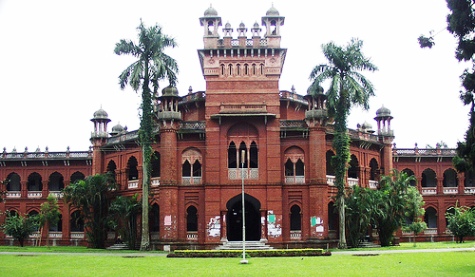
…The title photo above is of Curzon Hall at Dhaka University…
Such silence, unfortunately, haunted the post-1971 social and cultural milieu of Pakistan. Later in life when I met real Bangladeshis, as opposed to the fictional characters that existed in my mental landscape, I felt a strange affinity despite the fact that we came from contested histories and realities. At college in London I remember long discussions with Bangladeshi friends where we disagreed yet agreed that we had a common future.
Therefore, the recent visit to Dhaka, the very first non fleeting sojourn, was an overpowering experience. Dhaka airport is just another airport. Like home, there are long queues broken by the protocol brigades and immigration officers struggling with the advent of technology. In Dhaka, the warmth of the people overwhelms you.
While there I could not help but think of Faiz‘s only poem written in 1974, hum ke thehre ajnabi, about how close relations become estranged.
After those many encounters, that easy
intimacy, we are strangers now –
After how many meetings will we be that close again?When will we again see a spring of unstained green?
After how many monsoons will the blood be washed from the branches?[Translation by Agha Shahid Ali]
Dhaka is bursting at the seams with a sea of humanity as Bangladesh has one of the highest population densities in the world. Unregulated construction and traffic jams define the urban ethos. There is, however, a buzz and energy; signs of Bangladesh’s recent economic progress are evident. Large billboards and other hallmarks of globalisation greet you. But there are signs of grinding poverty as well. From the hotel’s plush dining area one could see a distant profile of a shanty town. My most interesting experience entailed talking to agile, aware Bengalis.
Most people I met had an understated fondness for Pakistan; the old wounds are gradually healing. I was told by many, “Pakistan-Bangladesh bhai bhai” and that the Bangladeshis support Pakistan cricketers. Given the World Cup euphoria and better than expected performance of the Bangladeshi team, almost everyone empathised with the defeat of the Pakistan team and expressed sorrow over Bob Woolmer’s death.
Old Dhaka, steeped in the Raj mood, is enchanting. Before catching my plane I stopped by Curzon Hall, built in 1905, and the Shaheed Minar. 
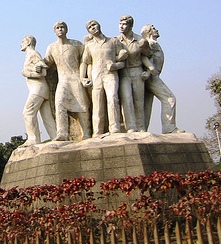
…Photo to the left is Shaheed Minar in Dhaka…
The latter was erected in the memory of martyrs who fought for Bangla linguistic and political identity. The area around the Shaheed Minar also displays public art commemorating the march towards Independence. Curzon Hall, now part of Dhaka University campus, is a stunning building that fuses Indian and Western traditions. A student of Dhaka University, Shahin, who was pleased to hear that his name is a prominent symbol in Iqbal’s poetry, took me around. The entire campus, painted red, looked even more charming amidst the blooming spring flowers and the rustling old trees.
Bangladesh’s population profile, like many other countries, is skewed in favour of the youth. There are young men and women everywhere, walking with energy, hope and promise. A photo exhibition I saw at the Shilpa Kala Academy was breathtaking. It had works from various universities across the country. The subject matter and professionalism was striking. As I was only visiting Dhaka, this exhibition enabled me to see various facets of the country such as the magical sunsets over the river Padma.
By chance, I also stopped at the dergah of Shah Ali Boghdadi who ostensibly travelled from Iraq and somehow settled in Dhaka’s outskirts. I owe this visit to the taxi driver who happened to take me there. It was a lovely shrine full of devotees. The two old banyan trees reminded me of all the dergahs in South Asia. The similarities were striking: the underclass begging at the entrance while loads of devotees prayed for spiritual and worldly gains.
Earlier, the taxi driver kept mentioning the achievements of Field Marshal Ayub Khan and development projects that he spearheaded. I politely inquired about his political affiliations and, as expected, he proved an ardent supporter of General Ershad’s Jatiya Party.
There is a lovely mural dedicated to the national poet, Nazrul Islam, on a public roundabout, and indeed Tagore and Nazrul define the high point of Bangla culture. Tagore was the first Indian, or even Asian, to receive a Nobel Prize for Literature while Nazrul is the Bangladesh national poet. His poems articulate intense rebellion against oppression and its various faces such as slavery, division and tradition.
I am the rebel eternal,
I raise my head beyond this world,
High, ever erect and alone![Translation by Kabir Choudhary]
Music and lyricism are deeply enmeshed in Bengali culture and language. One cannot help notice how everyone loves music. Even the rickshaw-wallahs break into song, as I noticed every time I took a stroll outside my hotel.
 The Bangaldeshi art scene is equally inspiring. From the immortal compositions of Zainul Abidin and Mohammad Kibria, several contemporary artists have experimented with bold themes and have localized the myriad dimensions of modern art.
..Photo to the left is Raju Memorial Sculpture at Dhaka University..
One such artwork, entitled Andolon or Uprising, struck me at the house of Rafiqul Alam, Professor of Fine Arts at Dhaka University. His abstract in oil narrated the uprisings of the late 1980s and embedded astrological symbols, such as the powers of Saturn and Mars, in an otherwise modern style. The Professor, a self effacing artist of great caliber, was free of pretensions that afflict even lesser artists in my dear homeland. Alam also took me through his fond memories of visiting former West Pakistan as an art student and being inspired by the locale and the historical buildings of Lahore and Peshawar.
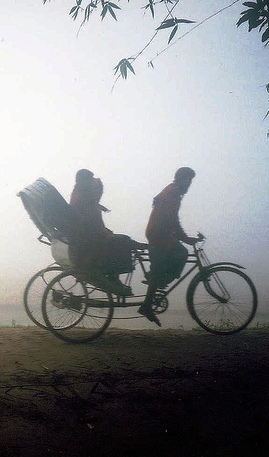 Another compelling individual I met in my Dhaka discovery was Ibrahim, a rickshaw puller who spoke fluent English and narrated his life story as we searched for the courier office. Hailing from a village in the north, Ibrahim learned English in Dhaka and worked at the British Council before fate relegated him once again to rickshaw work. He was a cheerful, chatty person who was keen to show me all sites of interest, including the not-so-respectable spots. The other rickshaw-wallahs whose services I hired also chanted “Pakistan bhai hai” perhaps for a generous service fee.
While I did not venture outside the capital and drive through the green vistas and sprawling rice fields, I know there will be a next time. The people of what was once East and West Pakistan are not far from reclaiming a common heritage, transforming the shared history into a positive partnership that builds on a person-to-person bond rather than on diplomatic or official niceties. This is the chance Faiz once longed for.
And so crushed was the heart that though it wished it found no chance –
after the entreaties, after the despair – for us to quarrel once again as old friends.
[Translation by Agha Shahid Ali]
Raza Rumi is an international development professional and an avid literati. He blogs at Jahane Rumi where this was originally posted.




PAST OF GOLDEN DAYS, WE SPENT AT TEJGOAN-DHAKA
AIRPORT, ALWAYS IN MY FRESH MEMORIES, MY FATHER
WAS TRANSFERED FROM KARACHI AIRPORT TO DHAKA AIRPORT IN THE EARLYS 1950, WE USED TO LIVE AT DHAKA AIRPORT STAFF QUATER F-8, KARAN BAZAR,
NARANGANJ, KORMITOLA, GOPI BAGH, STILL IN MY MIND,
MEHMOOD HUSSAIN,
mehmoodfaiz@yahoo.com
karachi-75950
For sports, information, technology etc use the following link:
http://sites.google.com/site/weblinks4all
For sports, information, technology etc use the following link:
http://sites.google.com/site/weblinks4all