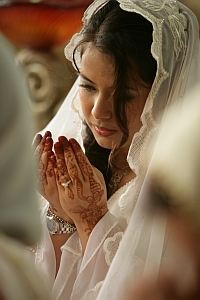
 If you are married, how closely did you read the Nikah Nama before signing it?
Some time last summer my fiance decided that time had come for us to tie the knot. I was excited. So excited that I hastily agreed to do the Nikah (Katb-e-Kitaab, as levant Arabs call it) within the next few weeks. I called my trusted friend, Adil, for his advice on where to find a good scholar/Imam for the Nikah, esp someone who might be familiar with Arabic language because my wife happens to be a Palestinian. He, as always, had an excellent recommendation.
During this process is when I actually read a Nikah Nama for the first time in my life and realized that it was missing some of the key provisions that my fiance and I had discussed earlier and wanted to be included. For example, we realized that there was no provision in the agreement for a woman’s right to ask for divorce. Secondly, there was no detailed discussions of the different types of Haq Mehr, except for the very minimum required at the time of marriage. Finally, there was no discussion on how our assets would get divided in the case of a divorce, or separation.
I discussed these terms, and our mutual agreement on them, with my parents. Let me tell you it was an uncomfortable discussion. Initially, they seemed horrified that my fiance and I were discussing divorce issues even before marriage! Then their reaction turned to fear – that their son was signing his life and his possessions away without proper legal counsel. But somehow they budged. Next came the discussions with the Imam. That also took some serious convincing but he was a learned man with patience. He eventually agreed to add those terms which essentially protected my wife’s rights, though warned us that despite our Nikah agreement some of those provisions would not hold in many Muslim states, such as Saudi Arabia.
So why am I reminded of this now? No, not because it has been a year already and I am regretting all that I signed away :). But because I read in the Daily Times that the problems with Nikah Nama are confronting Pakistani couples regularly as they enter unto wedlock. The problem, of course, has greater ramifications for the bride than the groom, but in either case, this is a serious religious and legal issue. Here’s what is reported:
A large number of nikkah namas (forms declaring a man and woman husband and wife) prepared in Karachi at least if not the rest of the country are incomplete because seven out of 28 paragraphs are excluded, Daily Times has learnt.
The omitted paragraphs run from Nos. 16, 17, 18, 19, 20, 21 and 28 and pertain to the woman’s rights in a marriage.
Paragraph No. 16 deals with Haq Mehr, or the amount of money that a husband is required, by the Shariah and Pakistani law, to pay his wife if their marriage ends. Any other property given instead by the woman or man must be declared on the forms.
Paragraph No. 17 says that any special terms and conditions that the woman or the man puts forward should be mentioned independently. Paragraph No. 18 details the basis on which the man has allowed his wife to demand a divorce from him. These sections are, however, usually crossed out by clerics or nikkah khwans, which means that in these cases the woman is not given her right to demand divorce or to declare it herself.
Nearly 25% of the Nikah Nama is missing. This is unbelievable! Clearly such changes are not officially sanctioned by the state but there are severe problems implementing the state’s writ. Marriage registrars have considerable freedom, it seems, when it comes to this business:
The authorities have taken a stab at tackling this problem but it appears not to be high priority. The city government has formed Maslihati Anjuman and Insaaf Committees at the Union Council and town levels. It is said in Paragraph No. 21 that if a man is already married then he needs a certificate from the Maslihati Anjuman but the city government keeps manual records instead of computerised ones which makes the process of checking next to impossible.
Assuming that this is being done intentionally by selected Khateebs, I consider it a criminal act on their part. The official Nikah Nama is being modified by the Imams/Moulvis/Khateebs/Registrars without the permission of the marrying couple, and important provisions that protect the wife are selectively being removed without informing the couple. Add to this the fact that quite often these Nikah Namas are not read in that much detail, and in the absence of full information, brides usually don’t even know what might be missing. One does not have to search hard to find cases where at least one member of a family has suffered because they were not told about, and not given their full due rights in marriage.
While clearly something must be done about this selective changes in the Nikah Nama, we also need education in the society regarding the meaning of a Nikah, the rights and privileges accorded in such and agreement, and how the laws of Pakistani are technically setup to protect those provisions. In the meantime, do check what your own Nikah Nama says…




The Pakistani Nikkah Namas that I have seen have the section for the woman’s right to divorce her husband, but almost all Qazis cross it out intentionally. Once the girl signs it, she gives up that right. That’s what some men use to prolong the divorce proceedings and legally torture their spouses during the separation period. It becomes a power game, instead of doing the right thing of allowing some one to leave who doesn’t want to live with them. The job of the Qazi and girl
I live in the US but got married in Pakistan. I did not have to “re-register” in the US. However, when I applied for a visa for my wife the consular officer was more interested in wedding pictures as the proof of marriage than the nikah-nama.
I know that my nikah-nama explicitely stipulates the right of my wife to divorce, and also stipulates how (and how much) the mehr should be. What I do not know is if it was part of the “standard” contract form or added separately. I will have to go home and check.
Well you are reminding me of something that happened 25 years ago. I have 3 daughters and what I have planned is that I am going to have their small nikkah ceremony very privately and exchange filled forms at least a week earlier enabling us to have discussions if required and elders from both sides should be involved as young couples engrossed in the love are not bothered. My wife and myself should explain all merits and de-merits about the clauses to our daughters and then take their final word. With hundreds of people around you cannot negotiate a life time contract. You are shit scared that if you do not agree the barat will go back and it’ll be a disgrace.
Luckily I am a shia and as per law girl is legally allowed to ask for divorce whether written in Nikahnama or not. Secondly MEHER should be in gold (keeping inflation into account) as value for MEHER mentioned 25 years ago is peanouts now.
As per Islamic laws the stupid maulvi is supposed to explain all aspects/clauses to the couple individually, then take get it signed/permission to perform the nikkah.
Just for information: I got married to a US citizen in the USA. However, the agreement I had to sign for the state was actually written by an Imam. It was supplemented by a simple court document that certified that we had shown our willingness to marry before a registered representative of government.
I hope that between these two documents, the sanctity and the legality of my marriage agreement is protected across the world.
Eedi Man ,
I dont know if you are kidding in case of memorizing Quran and forgetting about Nikah Nama too. But let me tell you that memorizing Quran would not allow you to forget nikah nama. The reason is Nikah Nama is a legal document to prove your marriage. It is not required by Islam. It is required by the law of the country [in this case Pakistan].