Adil Najam
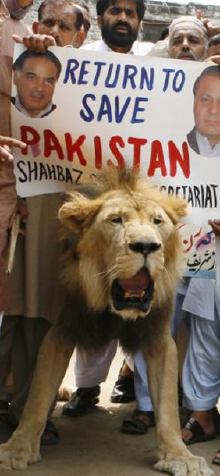
Former Prime Minister and PML(N) leader Nawaz Sharif is back in Pakistan.
Reportedly he landed in Lahore to a large reception by his supporters and was escorted to a special bullet proof car that had been brought for him. According to The News:
A special plane carrying the PML-N Chief Nawaz Sharif, his brother Shahbaz Sharif and other family members arrived in Lahore from the holy city of Madina on Sunday evening. The convoys of PML-N workers arrived in Lahore to accord rousing welcome to Sharifs. Large welcome banners and pictures of Sharif brothers have been displayed at several places in Lahore. The special plane Boeing777 carried Nawaz Sharif and Shahbaz Sharif along with 26 members of their family from the holy city of Madina.
The central and provincial leaders of PML-N, lawyers and members of civil society have arrived to receive Sharifs at Lahore Airport. Nawaz Sharif is expected to first visit Data Darbar in a procession and address a public meeting. Security had been tightened in Lahore especially on the airport ahead of arrival of the PML-N leader. Provincial home department has allowed only hundred party leaders to receive Sharifs at the airport, party sources claimed.
According to sources, bullet-proof cars for Sharifs reached in Lahore last night from Saudi Arabia. Meanwhile, the home department said that the authorities have decided to give free hand to Nawaz Sharif but he has not been permitted for holding a public meeting and rally.
Nawaz Sharif, Shahbaz Sharif and other family members will be transported to home from the airport, a home department statement said. However, thousands of PML-N workers succeeded in arriving airport by crossing the barricades put up by police. On this occasion, the workers raised slogans both in favour of Nawaz Sharif and against the government.
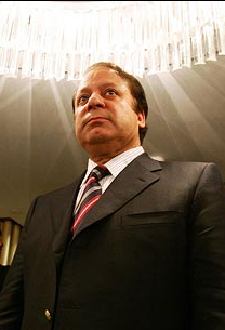
Readers would remember from our prior posts that in August the Supreme Court of Pakistan had ruled that he could, in fact, return to Pakistan despite whatever ‘deal’ he had made with Gen. Musharraf at teh time of his original flight to Saudi Arabia. However, when he did return to the country in September, he was unceremoniously and dramatically deported back to Saudi Arabia with theatrics which rivaled his own attempts not to let Gen. Musharraf land in Pakistan many moons ago.
Now it turns out that he has made yet another ‘deal’ with Gen. Musharraf which has enabled his return.
It is not fully clear what the ‘terms’ of this deal are. Nor what the Musharraf-Nawaz Sharif deal mean
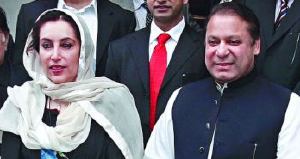
s for the earlier Musharraf-Benazir deal that had enabled her return some weeks back. Nor, in fact, is it clear what what his return (and the fact that now both Benazir and Nawaz Sharif are back in Pakistan) will mean for the future of Pakistan’s politics and the (supposed) forthcoming elections.
In despair, one even wonders if it means anything at all? Or is this just one more drama in the string of topi dramas that have come to define our distraught and fractured polity?

According to sources, bullet-proof cars for Sharifs reached in Lahore last night from Saudi Arabia. Meanwhile, the home department said that the authorities have decided to give free hand to Nawaz Sharif but he has not been permitted for holding a public meeting and rally.


Dear Faraz:
The money being in the military budget does not make it irrelevant. Any part of this money spent within the country counts as part of the gdp regardless of the sector.
And then there is also the multiplier effect, which you can read about
here
or any standard introductory macro economics textbook.
Due to the multiplier effect, if you inject $1 into the economy, it increases the gdp by more than $1.
Now, Pakistan’s present gdp is officially around 120 billion. So 1 billion dollars of extra money come to slightly under 1 percent. Put this amount into the economy and you should expect a more than 1% increase in the gdp due to the multiplier.
The average growth rate during the 1990s was in the 4-5% range and it is now around 7-8%. So roughly 3% of extra growth. With all the extra foreign inflows, is it really an achievement of the Mush govt?
As another rough way to judge, you can compare the performance of the economy in the two pre-911 Mush years with the last two years of NS. You would still need to factor the impact of the nuclear tests, which made things hard for NS, but even then, you would see that Mush does not come out looking that extra-ordinary.
You are right that our growth rate has usually been higher under military govts, but then it is also a fact that foreign inflows have been substantially greater too, not to mention the fact that the military regimes had more time.
I do agree that govts come and go and we should not shout for discarding everything because we dislike a leader. We need to continue with the good policies and throw out the bad things. But here, the problem is that some people insist on hanging on to Mush just because they are impressed by the post-911 boom.
BTW, are you aware of the fact that our education spending as percentage of gdp under Mush has continued to linguer around the same level as NS despite all the inflows and the substantial easing of the debt burden after 911?
sorry, i forgot to attach the second link which show dollar/pkr exchange rate under musharraf from 2000 to Oct 2007.
http://img514.imageshack.us/img514/3755/pakmushft3 .gif
one of the best ways to measure how the economy is doing is to look at the performance of exchange rate over time. below are two graphs which indicate the performance of pak rupee (pkr) during two different period. first graph shows the performance of pkr during the decade of democracy i.e. from 1990-99. during this period dollar/pkr exchange rate went from around 21 to 52 which amounts to around 9% depreciation per annum.
http://img513.imageshack.us/img513/5372/pkrdemocra cyan0.gif
in contrast, under musharraf from 2000 to Oct 2007, pkr has gone from 52 to 61 which amounts to annual depreciation of 2%. if musharraf’s government had mismanaged the economy to the extent that economy was mismanaged in the 90’s, pkr currently should have been trading at around 105 instead of 61.
to see how exchange rate depreciation impacts the economy, multiply the price of oil by 61 and 105 to get an idea of the impact on purchasing power of average consumer.
Lion heart:
At the time of Mush’s take over, the dollar to rupee rate was in the low 50s and not around 65. It very briefly threatened to shoot up to 100 after the nuclear tests but NS was able to get the situation under control after some time. There were no impending fears of the rate shooting up to 100 on Oct 11, 1999.
check
here
So your facts and figures are not accurate.
What I know that Pakistani economy was destroyed in 1973 in name of nationalization by a elected PM. He cried about 21 families.
In the same era India promoted “Made in India” slogan and they increased tax on imports. In India there are even less then 21 families which have controls over wealth like Tata Birla who is even a Parsi.
The facts is Indian politicians may be corrupt but they are sincere with India when it comes to national interest.
Unfortunately we made more economic progress in time of dictatorships (except Yahya Khan )
One who lived in many countries can see better as out sider.
criticism is ok as long its not one sided.
ISLAMABAD (Reuters) - Pakistan’s economy is on track to sustain the healthy growth it has posted in recent years, and political uncertainty will not hamper it, a senior official said on Sunday.
“The ongoing political uncertainty in Pakistan will have no impact on the economic growth of the country,” said Salman Shah, adviser on finance to Prime Minister Shaukat Aziz.
“I don’t think it is necessary that politics should derail your economics,” Shah told a news conference, a day after the government announced a pro-growth annual budget.
Pakistan’s economy has grown at an average annual rate of 7.0 percent over the last five years, and the government has set a target of 7.2 percent GDP growth for 2007/08. Growth is estimated to have been 7.02 percent in the year ending June 30.
But fears of a derailment have arisen as President Pervez Musharraf is going through the most severe challenge to his authority since he came to power in a military coup eight years ago.
Musharraf, who controversially aims to be re-elected by the sitting assemblies before they are dissolved for a general election at the end of the year, plunged the country into a crisis three months ago by suspending the country’s top judge.
“Why should politics derail your economics?” Shah said.
“It is to the advantage of every Pakistani that the economy keeps growing, and anyone who tries to disrupt that will not be allowed to do so by the people.” Continued…
http://www.reuters.com/article/worldNews/idUSISL23 01720070610
actually, its not surprising that people relying on “jang” for data analysis would be lying in order to prove their point such as india’s annual exports amount to $200bn:
http://uk.reuters.com/article/oilRpt/idUKDEL132742 0070501
“…Exports for the full year stood at $124.63 billion, up 21 percent compared with $103.06 billion in 2005/06,…”
note that india’s IT exports totalled another $30bn in 2006/07. india’s total exports in 2006-07 therefore amounted to around $155bn. moreover, as the link above indicates, india, like pak, is running a current account deficit although’s india’s deficit as % of gdp is lower than that of pak.
also if someone has evidence of pakistani govt providing false data, then that person can take pak government to court in america. pak govt has borrowed money from u.s. based investors by issuing sovereign bonds. under u.s. law, borrowers face a huge penalty for providing misleading data. anyone who has proof that pak govt is fudging important data such as export statistics can make millions of dollars by suing pak govt in an american court. since u.s. courts are free, winning the case should be easy.
as far as economic performance under musharraf that has nothing short of spectacular as measured by stock market returns over the last eight years. stock market returns were spectacular due to sound economic management best example of which was managing of foreign liabilities. when musharraf came to power, pak’s foreign currency debt was around $36 while reserves totalled about $1bn. pak’s net debt therefore stood at $35bn on which annual interest service cost would amount to $1-1.5bn. essentially then, pak was bankrupt in 1999 because pak’s interest payment due amounted to more than its reserves. in comparison, pak’s net debt currently stands at $24bn ($40bn fcy debt - $16 fcy reserves). as a result of lower foreign debt burden, pak is easily able to meet its foreign liabilities along with being able to spend moeny on infrastructure projects such as highways etc.
btw by examining the the trend of pak’s fcy debt over the last 20 years, we can also see the level of corruption prevailing under bb/ns. when decade of democracy started in 1990, pak’s fcy debt amounted to around $20bn. by the time democratic period ended, pak’s debt had ballooned to $36bn excluding frozen deposits. so what did pak had to show for the $18bn increase in debt? answer: nada except for the $1bn lying in reserves. the other $17bn were lost through mismanagement and corruption. and yet paksitanis want to let these people back in. as i always say, nations get what they deserve.
The Transparency International is not the best instiution to gauge corruption. Its ratings depend a lot on perception. Its a known fact that ISI has been and is involved in the politics of the country and the jour tour of siyasat. It builds the hype of corruption under civilian governments preparing the turf for the military to take over. It never investigates anything against the military personnel, nor did NAB. How can you know how corrupt the military really is unless its accounts are made public? This land what the call the military land is basically owned by Punjab government and was not meant to be used for anything but military purposes. But our “imaan-daar” faujis have converted it into commercial property and doled it out among the officer corps. Is this not corruption? And no body dare investigate these things.
Has any body ever asked how much was bequeathed to Musharraf by his middle class parents? How much he earned in total over the last 40 years of his military service? How he managed to send his son abroad? How much assets he has now? Do you think that ISI would ever investigate the accounts of Musharraf? That would always keep his image as “clean” and the Transparency International going on perceptions would keep saying its less corrupt. So much for accountability and cleanliness.