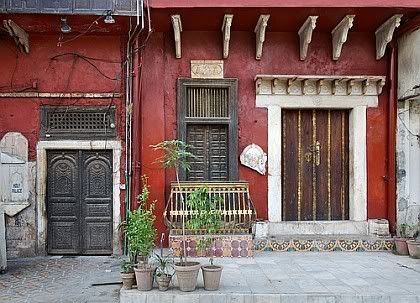
Michael Foley is a brilliant photographer who has captured the faces of development in images that express the strength and vulnerability of the people in struggle. He has also beautifully captured the nature and the wonder of human achievement in cityspaces and architecture. Michael loves Lahore and is a frequent visitor of his most favorite city in South Asia. He writes about Lahore: What a glorious city, Lahore - vibrant, throbbing with life and so beautiful. We present eight selected photographs of Michael Foley’s collection and invite readers to tell us what is the first thing that comes in their mind when they see each photograph.
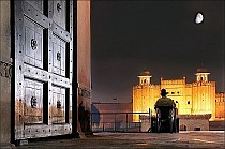
Originally from Dublin, Ireland but currently living in Washington DC, Michael works for the World Bank and has travelled a lot to developing countries, specially South Asia, helping to establish the Global Development Learning Network.
As Michael writes: I have certain interests across a spectrum, from faces to places, and from nature to architecture. In my pictures I try to catch the strength and the vulnerability of the human spirit, the beauty of nature and the play of light on form. While photography captures the fleeting moment, it also preserves it forever, and so the snapshot of today can be the historical document of tomorrow. You could say that Photography is history, its imprints gaining value as years go by, for what it says about a time, a people and a place.
Michael’s work can also be found here, here, here and here.
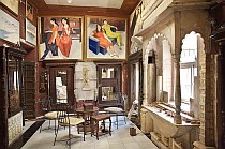
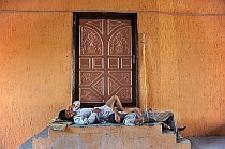
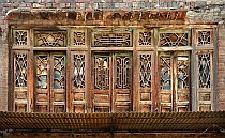
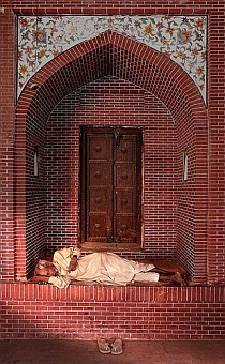
Photograph Details: Photographs 2, 3, 4, 5, 6, 7 were taken in June 2007, along the route of the “Royal Walk” in the walled city of Lahore. A cultural heritage project, funded by the World Bank, and involving the Gov of Punjab and the Agha Khan Trust for Culture is planned for the area. Photographs 1, 2, 6, 8 are from the Cooco’s Den in Walled City, Lahore. 3, 7 are from Masjid Wazir Khan and rest are taken inside the narrow streets of Dehli Gate.




Michael Foley has a great eye. Excellent photography of Lahore.
And thank you darwaish for writing wonderful article and a very informative comment. I have just recently discovered ATP and I must congratulate the team for the great work. Well done guys and keep it up!!
Thanks Darwaish for the detailed response. I used to walk from ‘Zila Kachehri’ (District Courts) to ‘Badami Bagh’ (Almond Garden) to catch a bus. Entering from ‘Bhaati Darwaza’ (Bhatti Gate) in the south one could reach Roshnai Darwaza (Lighted Gate) in the north without any problem. The walk went through ‘Shahi Mahalla’ (Royal Street) and the ‘Hazuri Bagh’ (Royal Garden). Being familiar with the neighborhood I could well imagine where Cooco’s Den Restaurant would be located. But even in those days most of the ‘Havelies’ (Mansions) were in bad condition and taken up as multi-family residences and businesses and trade shops. Exception were the brothels that were always well maintained and brightly lit up at night. But early in the morning is the best time to go through the ‘Royal Walk’. That is the time when the ’shady side’ of the night is fast asleep and the scavengers go through the rubbles………..Looking forward to your post.
Alvi Sahab: It is actually called Cooco’s Den & Cafe or Coco’s Den & Cafe. For reader’s interest let me share whatever I can remember about Cooco’s Den and its owner Iqbal Hussain.
Situated in the old Lahore’s Diamond Market (Heera Mandi), Cooco’s Den is an old Haveli, converted into a restaurant. It was originally a brothel and family home of one of Lahore’s finest and yet most controversial painters, Iqbal Hussain. Those who are familiar with iqbal Hussain’s know that he is particularly renowned for painting courtesans of this area (Diamond Market), dancers, musicians and the landscapes around River Ravi. The walls of Cooco’s Den & Café are emblazoned with Hussain’s searing portraits of the district’s denizens—from teenage prostitutes and thickset madams to wizened harmonium players. The paintings depict the life of these women. However the most haunting thing in Iqbal Hussain’s work is the sad eyes of all his subjects.
Hussain, who himself is a son and grandson of sex workers, was born and grew up in this Haveli. Some floors of his haveli are still used as residential area, the ground-floor and the rooftop has been converted into a seating area. It is basically a mix of a dining place and an art gallery. Iqbal Hussain also taught for decades at NCA who unfortunately, never gave him respect he deserved. He joined NCA as a lecturer and retired as lecturer. What a shame!
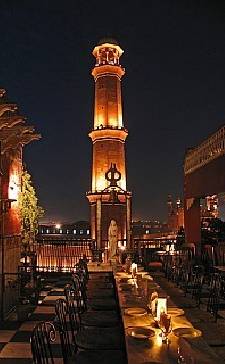
Anyways coming back to restaurant, the most stunning treasure is found on the top floor, where the open terrace looks down into the vast sandstone courtyard of the 17th century Badshahi mosque. Badshahi mosque and Lahore Fort together present an amazing view especially at night when both are lit up with lights. While the terrace is usually booked for dinner by fashionable Lahoris eager to sample the café’s home-style Pakistani fare, the best time to go is for tea in the early evenings. This is when the setting sun tints Badshahi mosque’s minarets a deep rose, just as the muezzin starts the call to prayer. From one side of the terrace, you can watch as the mosque’s fairy lights are illuminated, circling it with a corona of gold. From the other side, you catch glimpses of the windows of the Heera Mandi, flickering with lamplight as the women take up their positions in the district’s doorways. And in the midst of all this is Cooco’s Den & Café, perched between the debased and the divine.
The cafe faced Badshahi Masjid and everywhere around you are statues - Hindu, Christian, Buddhist. If you look at the larger view of photograph no. 6, you can actually see a church like bell, a statue and behind them is the minaret of Badshahi mosque.
A photo of Iqbal Hussain infront of Cooco’s den is to the right.
Such is the beauty of this place and the stories behind it that a separate post should have written on the Cooco’s Den and Iqbal Hussain. May be soon :).
Have heard of Cuckoo’s Nest but what is this Cooco’s Den featured in these pictures. Does name of the restaurant has any thing to do with the gaudy colored exterior of the defaced building?
Where is picture number 5 taken from? This place is begging for restoration indeed.
Lahore Lahore aie!!!! Beautiful colors.
Thanks for sharing this.
Ismaili Mail: Its encouraging to know that AKDN is doing something for lahore too. What are their ongoing/future projects in Lahore?
A truly wonderful collection. I have been away from Lahore since 2004 and now I really wanna go back :(.