Adil Najam
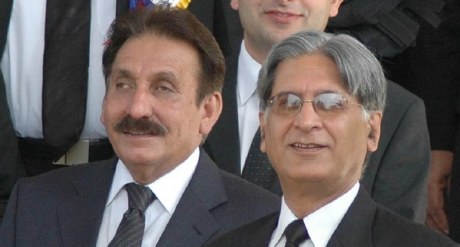 Chief Justice Iftikhar Chaudhry arrives in USA today for a speaking tour, including a visit to the Harvard Law School to receive their Medal of Freedom. One wonders if this is the last hurray for a dying cause or yet another reminder that this is a cause that refuses to die?
On the face of it, Asif Ali Zardari’s elected government has done what Gen. Pervaiz Musharraf’s military government could not. All but the most diehard have given up on the hope for the restoration of Justice Chaudhry. But is the “Justice Movement” also dead?
For Pakistan’s sake, one hopes not.
Chief Justice Iftikhar Chaudhry was, and remains, the face of the Justice Movement. But the Justice Movement was always bigger than him. Those who were mobilized by the movement were mobilized by much more than an ousted judge. Indeed, they were mobilized by more than just a disdain for military rule. Ultimately, they were mobilized by the idea that justice, as a concept, must prevail. That the integrity of nations flows from the integrity of its institutions. That, ultimately, the democratic spirit of a people is always more important than any leader – whether that of a judicial system, that of a military junta, or even that of an elected government.
As I had written way back on March 23, 2007:
Gen. Musharraf himself, and his supporters, view this as a conspiracy against his person. It may not be a conspiracy but his opponents certainly view this as an opportunity to bring an end – or at least seriously dent – his regime. There are, of course, also those who view – or wish to construct – Chief Justice Iftikhar Chaudhry as an arch villain or as a supreme hero. He is probably neither, but as a man caught in the cross-hairs of history he is well aware of the pivotal role that his person plays out in this unfolding saga…
This is not just about what Gen. Musharraf did, not about how Iftikhar Chaudhry reacted; the real story is about how the citizenry of Pakistan reacted. There is little surprise in either the actions of Gen. Musharraf or the reaction of the Chief Justice. The surprise lies in how people reacted – Lawyers on the street, media in their newsrooms, bloggers in bloggistan, and ordinary citizens everywhere in their thaRRas, drawing rooms, email lists and everywhere else.
That is ultimately what matters. If this spirit can be sustained then the future of democracy in Pakistan is secure; whether it comes with or without the current setup… This has been Pakistan’s democratic moment; that I find it to be a moment worthy of celebration because it signifies that trapped inside an “undemocratic state†lies a vibrant and clearly “democratic society.â€
We remain, I believe, a democratic society. We now also have an elected government. But it is not yet clear whether we are a democratic state. If we are ever to become one, then the Justice Movement must never die.
P.S. The video above is a GEO TV production based on Aitizaz Ahsan’s poem Kal, Aaj aur Kal which he had written while under house arrest. Whatever poetic merits the poem might lack it is an immensely powerful and honest political statement. So is this video. Both are powerful not only because of the sense of history that they embody, but also because of the hopes of the future that they embody.





This movement shows that pakistanis are becoming more civilized except that chaos they caused at the airport while recieving Mr chaudary.
The usual and traditional mash pit like bad habit of pushing and shoving.
Ten years ago I paid for the mash pit at the Green day concert.
Someone there pinched my butt and I didnt mind it but now I am an adult. Anybody pushes me or rest arms arround my shoulder without my permission he or she would “violate” my boundaries.
Sorry I got carried away while I am excited about CJ visit to my
country.
I hope this movement is not about “self promoting” but about emphasizing the concept and the integrity of the institutions.
and last.
PCO judges to be punished: Iftikhar
http://www.dawn.com/2008/05/26/top7.htm
If he is MAN of principles, should he NOT punish himself for using PCO and ditching Constitution of Pakistan ?
I wrote to NY Bar President and Mr. Amjad Malik (Solicitor
As Che’s video was on this post so thought to share one of his quote.. [add Iftikhar and Musharraf where appropriate]
Justice remains the tool of a few powerful interests; legal interpretations will continue to be made to suit the convenience of the oppressor powers .
and reflect on what Jefferson said..none of which PCO-tainted Iftikhar has…
”
The judges… should always be men of learning and experience in the laws, of exemplary morals, great patience, calmness and attention; their minds should not be distracted with jarring interests; they should not be dependent upon any man or body of men. To these ends they should hold estates for life in their offices, or, in other words, their commissions should be during good behavior, and their salaries ascertained and established by law.” –Thomas Jefferson to George Wythe, 1776. ME 4:259, Papers 1:410 ?
He will get his medals and will retire and we will continue to have PCO judges…
Best thing he can do is to tell PPP to fire all PCO judges including him and appoint new for life in Supreme Court.
if HE thinks it is NOT ABOUT HIM, then why would not he do this ? He is controversial anyways..and we dont want controversy in Supreme Court..Don’t you guys watch how Executive and Justices stay away from each other..even meetings are carefully setup so as not to give even an iota of Executive Influence…..
If not, Lawyers movement will fade away…
For God sake, don’t make him what he is not. He was planted by Mushrrif and plucked. He served the purpose. There is not mard in him. If he had it he would not have joined in the lst. place. Let this mard rest for now and look for one who really is. This mujahid is not even a mard!