Like many Pakistanis, I admire Imran Khan and his sincerity. But supporting him politically is a different matter. He and his party – Pakistan Tehreek-i-Insaaf (PTI) – have some serious soul searching to do before people give it their political support.
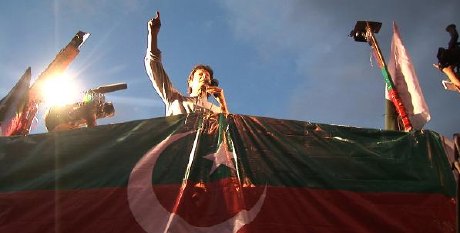
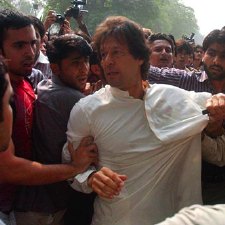
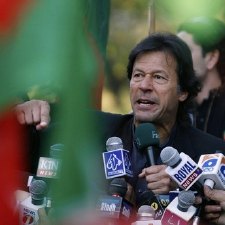
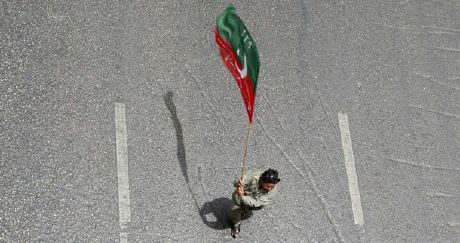
Imran Khan is one of the few principled politicians we have. There is no doubt that he truly cares about the country. His bold stance on May 12 and his consistent support for the restoration of the judiciary was unmatched by any other prominent politician. His cancer hospital and the projects he has started in the field of education have been praised even by many of his critics.
Someone like myself, who is dissatisfied with the politics and corruption of the leading parties, is naturally attracted to Imran Khan who talks about principles and accountability. However, as much as I like Imran for his honesty and devotion to the country, I have some concerns about him and can not help agreeing with Shafqat Mahmood’s statement that Imran never misses an opportunity to miss an opportunity.
Being politically inclined, I have even considered joining PTI at times, but reservations about his politics prevent me from doing so.
Imran Khan has been in politics for 13 years, and this is a long enough period to develop the party into a vibrant, democratic entity. Unfortunately, PTI still comes across more like an Imran Khan fan club rather than a democratic political party. For the most part, there is an absence of grass roots forums that meet regularly where any party member can raise issues and be heard, and the party line almost completely comes from the top.
Secondly, Imran does not realize that politics requires an appropriate mix of idealism and pragmatism and confuses this balancing act with opportunism. If he wants to serve the people of Pakistan by coming into power, then his decisions should be geared towards that goal. He had an excellent opportunity to launch himself when Nawaz Sharif offered him 20 odd seats in 1997 and again when Musharraf was willing to help him become the prime minister. Instead of spurning these offers, he should have taken a few ministries and worked hard on demonstrating through performance that he was someone who could truly deliver if given a chance. This could have provided him with the impetus needed to launch PTI into a force capable of getting elected into power on its own and then implement its reform agenda.
This unwillingness to balance idealism and pragmatism also creates doubts about his ability to deliver even if he came into power some day. It makes one wonder whether he would really take a practical approach towards addressing the country’s problems.
On top of all this, Imran Khan has a very confused stance on the Taliban where he still falls well short of fully condemning them.
He has been very consistently and forcefully bashing the Americans in recent years but the same kind of condemnation for the Taliban has not been forthcoming. This sharp contrast, when the Taliban have killed many more Pakistanis than the American drones, and when they are directly trying to destroy the state structure to establish their own rule, is hard to understand. It has taken some strong criticism for Imran Khan to finally make a few “too little too late” statements criticizing the Taliban, whereas what one expects from a good leader is the ability to clearly identify and point out a problem well ahead of time.
His stance on the current situation in Swat has again left a lot to be desired. He first vehemently opposed the military operation but did not explain what the government should do when the Taliban break a peace agreement and keep on expanding into neighbouring districts as they blatantly did after the Swat deal. Only after coming under regular fire has he finally accepted that a military operation can also be an option. He rightly says that bombings should be avoided and the operation should be carefully targeted, but the national debate could have been more focused on discussing how military action can be carried out in a way that minimizes civilian suffering if he and others had not been creating confusion by insisting that there should never be an operation.
In yet another example of muddled thinking, he now argues that before sending the army, a group of politicians should have been allowed to go and try to convince the Taliban to abide by the Swat peace deal. This makes one wonder why he did not publically propose this in the days leading up to the operation and what he is trying to accomplish by undermining the military’s efforts now that the time for this idea has clearly passed.
I really admire Imran Khan for his sincerity, but these are some of the serious issues that he and his party have to come to grips with, before PTI can make serious headway in realizing its full potential.




**primebiome**
The bodys natural process of skin cell renewal is essential for preserving a smooth, healthy, and youthful-looking complexion.