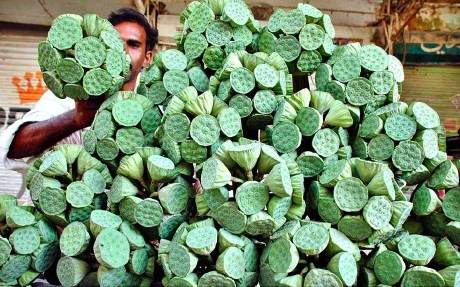
Let me confess I did not know what this was until I saw this picture. Do you know what it is? What is it used for? Where it comes from? Do tell us more about this is you do know? Or, make a guess?
Answer on next page below
Most of our readers had guessed the answer right. Infact I got to learn much more about this fruit from the comments than my own source of information. Here is the answer that I researched. This fruit is called ‘Dodi’ in Sindhi. It is a seasonal fruit grown in shallow waters. I don’t know the Urdu name. But through your informative comments we all did get to learn many other names of this fruit.
The photo above shows a person selling ‘Dodi’ in Larkana on June 20, 2009.






This is lotus bulb as said earlier is eaten as fruit/vegetable in sindh and southern punjab. It is sometimes available in the market too. In seraikee it is called ‘puban (kunwal) de tikee’ . The kernel in the pods is really tasty.
Exactly Sidharth, It is Lotus plant and its seeds are eaten commonly near Thatta and Kalri Lake.
This is a part of Lotus plant – grows in ponds and lakes. This bulb actually is eaten as a fruit – the seeds inside these bulbs needs to be peeled off and eaten. Commonly eaten by Kashmiri’s (and I guess Sindhi’s)… BTW, the lotus stem is also a delicacy vegetable – popular in Kashmir (and amongst Sindhi’s too)
On first glance it looks like they’re selling a bundle of biodegradable shower heads.
It grows in ponds and I think it is eaten in parts of South Pakistan (South Punjab and Sindh). Don’t remember the name.